Oof is an informal exclamation, not a formal acronym. It signals sympathy or discomfort — similar to saying “ouch” or “yikes.” Uppercase OOF in email and workplace tools typically stands for “out of office.” The correct meaning depends entirely on where and how it appears.
What Oof Actually Means
Dictionary.com describes it as an exclamation used to sympathize with someone’s pain or to express your own. That definition holds up perfectly in real use.
People reach for “oof” when something mildly painful or awkward happens, when they want to show empathy without typing a full paragraph, or when a situation is embarrassing but not serious. It is short, emotionally readable, and flexible — which is why it spread across so many platforms.
What Does Oof Mean in Texting and Chat?
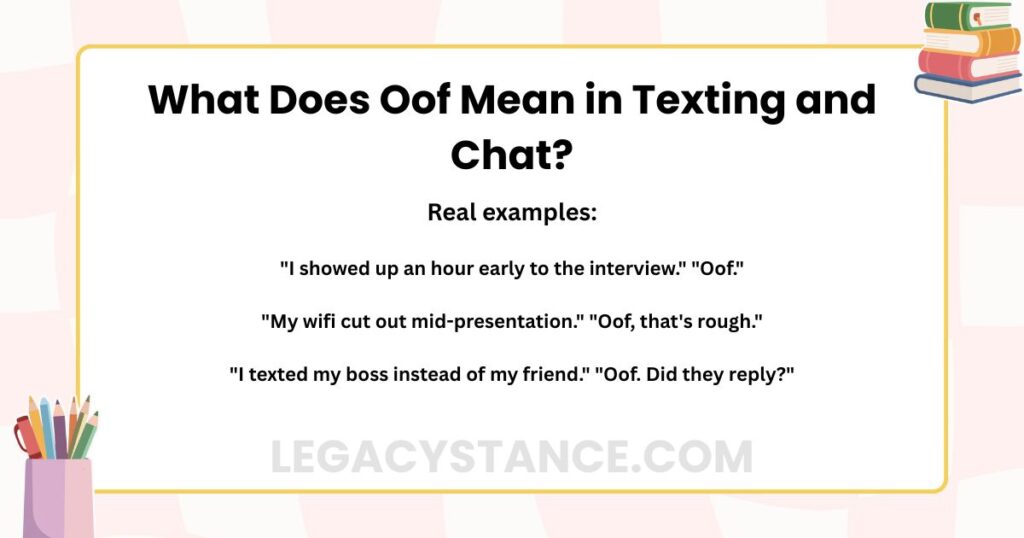
In texting and online chat — WhatsApp, iMessage, Discord, Reddit — “oof” works as fast empathy. One word tells the other person you felt the moment.
Real examples:
“I showed up an hour early to the interview.” “Oof.”
“My wifi cut out mid-presentation.” “Oof, that’s rough.”
“I texted my boss instead of my friend.” “Oof. Did they reply?”
In group chats, “oof” often becomes collective shorthand. Someone shares bad news, several people reply “oof” within seconds, and that communicates genuine shared sympathy without anyone writing an essay.
On Reddit, it appears constantly under stories about missed opportunities, social slip-ups, and minor disasters. The brevity is the point — it says “I get it” without overdramatizing.
What Does Oof Mean on TikTok?
On TikTok, “oof” fills comment sections under videos showing something painful, embarrassing, or relatable in a cringe way. A cake collapsing at a party, a sports fail, a visible social mistake — the comments fill with “oof” almost immediately.
The emotional tone is sympathetic rather than mocking. Typing it under someone’s video reads as “I felt that” rather than “I’m laughing at you.” Creators also use it in captions and on-screen text to frame their own awkward moments before the audience reacts.
What Does Oof Mean in Gaming?
Gaming — specifically Roblox — is where “oof” became genuinely iconic. For years, Roblox played a distinct grunt sound when a character died. Players started typing “oof” in chats whenever someone got eliminated, made a bad move, or lost a round.
The sound became so associated with the word that it was simply called the “oof sound.” Roblox removed the original audio in 2022 after a licensing dispute, but the word had already embedded itself in gaming culture well before that.
Gaming chat examples:
Player falls off a platform → teammates type “oof” “I just lost everything on that trade.” “Oof, brutal.”
Outside Roblox, it appears across Discord servers, Twitch chats, and in-game messaging whenever a strategy fails badly, someone dies unexpectedly, or a team loses a close match. There is always a slight humor to it — not mean-spirited, just the natural reaction to watching something go wrong.
What Does OOF Mean in Email and Business?
This is where genuine confusion happens. Uppercase OOF in email means “out of office” — and it has nothing to do with the slang meaning.
The backstory is interesting. Microsoft’s older internal mail system, called Xenix Mail, used OOF to mean “out of facility.” That shorthand carried into Microsoft Outlook and eventually spread across workplaces as standard availability shorthand.
Email example: “I’m OOF until Thursday. For urgent matters, contact Sarah.”
If a coworker’s calendar shows OOF or their email auto-reply includes it, they are simply unavailable — traveling, on leave, or away from their desk. Completely professional, completely unrelated to the reaction word.
| Form | Meaning | Where It Appears | Example |
| oof (lowercase) | Sympathy, awkwardness, shock | Chat, texting, gaming, social media | “Oof, that’s rough.” |
| OOF (uppercase) | Out of office / out of facility | Work email, Outlook, Slack status | “I’m OOF until Monday.” |
Capitalization genuinely matters here. Lowercase is slang. Uppercase is professional status.
What Does Oof Mean From a Girl or a Guy?
Searches like “oof from a girl” or “oof from a guy” come up often because people want to decode a message from someone they are interested in.
The honest answer: the word carries no gender-specific meaning. “Oof” is not a hidden romantic signal. What it communicates depends entirely on the full conversation — the tone, what came before it, whether emojis appear alongside it, and the relationship between the two people.
If someone sends “oof” after you share bad news, they felt sympathy. If the conversation already has a playful tone and they add “oof 😅,” the emoji and context are doing the emotional work, not the word itself.
Oof vs Similar Reaction Words
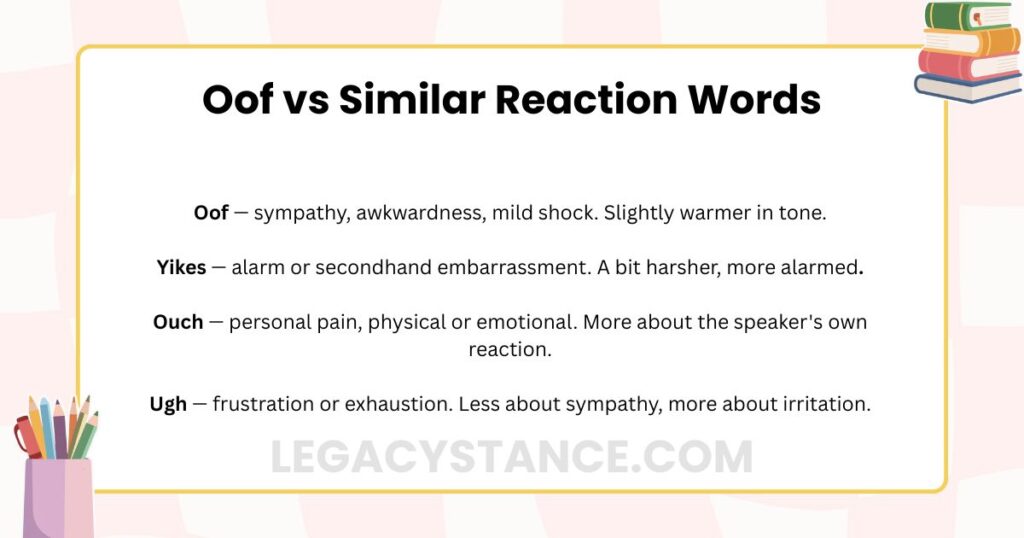
These words are close but not interchangeable:
Oof — sympathy, awkwardness, mild shock. Slightly warmer in tone.
Yikes — alarm or secondhand embarrassment. A bit harsher, more alarmed.
Ouch — personal pain, physical or emotional. More about the speaker’s own reaction.
Ugh — frustration or exhaustion. Less about sympathy, more about irritation.
Knowing when to use each one comes from reading the emotional register of the moment. “Oof” leans empathetic. For genuinely serious situations — grief, illness, major setbacks — none of these short words work well. A real sentence lands better.
Oof in Real Conversation Examples Across Platforms
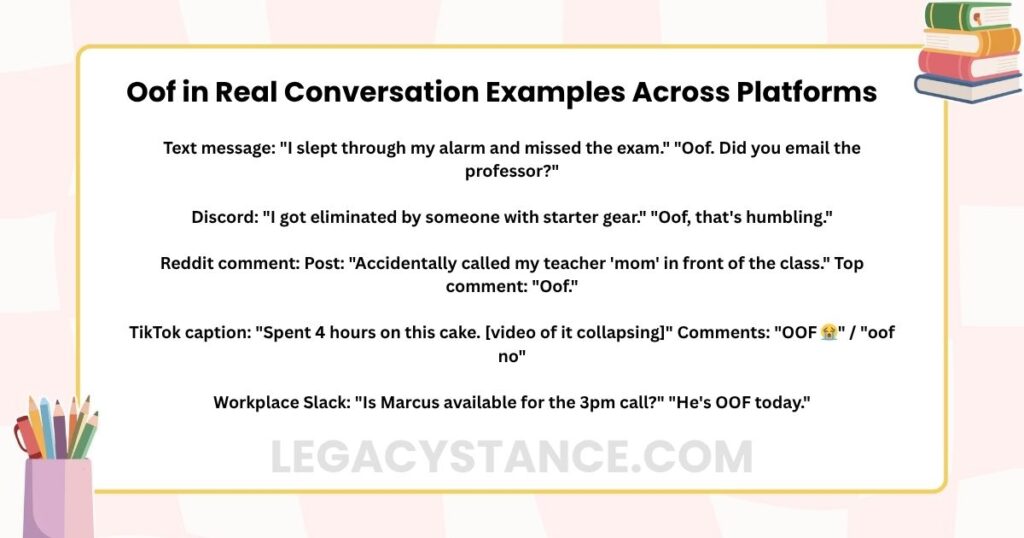
Text message: “I slept through my alarm and missed the exam.” “Oof. Did you email the professor?”
Discord: “I got eliminated by someone with starter gear.” “Oof, that’s humbling.”
Reddit comment: Post: “Accidentally called my teacher ‘mom’ in front of the class.” Top comment: “Oof.”
TikTok caption: “Spent 4 hours on this cake. “ Comments: “OOF 😭” / “oof no”
Workplace Slack: “Is Marcus available for the 3pm call?” “He’s OOF today.”
OOF Common Misunderstandings
“Oof and LOL mean the same thing.” They do not. LOL signals laughter. Oof signals sympathy or discomfort. Both are quick reactions, but the emotional direction is different.
“Oof is rude.” Usually not. It can feel dismissive if someone shares something genuinely serious and receives only “oof” in return. For minor inconveniences and everyday fails, it reads as warm and relatable. Tone and situation determine whether it lands well.
“OOF in an email subject line is strange.” It is completely standard workplace shorthand. “OOF Wednesday” from a manager simply means they will not be available that day.
“Oof means something different depending on who sends it.” The word itself does not change. Whatever extra meaning exists comes from the broader conversation and relationship — not the word alone.
FAQs
Is “oof” actually in the dictionary?
Yes. Dictionary.com and Merriam-Webster both recognize it as an informal exclamation expressing sympathy, discomfort, or mild shock. It moved from internet slang into documented usage because of how widely and consistently people used it across platforms.
Why does the Roblox connection matter so much?
The Roblox death sound made “oof” audible, not just readable. Millions of players heard it thousands of times across years of gameplay, which turned a typed reaction word into something with a recognizable sound attached. That crossover between audio and text is rare in internet slang and is a big reason the word stuck so widely.
Can “oof” ever be used in professional settings?
Informal team Slack channels with a casual culture — sometimes yes. Formal emails, client communication, or written reports — no. The uppercase OOF for out-of-office status is entirely professional and appropriate in work email. The lowercase slang version belongs in casual spaces only.
Final Thought
“Oof” became popular because it does one small thing well — it acknowledges a bad moment without making a production of it. Three letters, and the other person knows you registered what they shared.
The only real source of confusion is the lowercase versus uppercase split. Slang in chat. Professional status in email. Once that distinction is clear, the rest comes naturally from reading the conversation around it.

Hi, I’m the creator of Legacystance.com, dedicated to making English learning simple and enjoyable. I write clear, practical guides on adjectives, verbs, idioms, pronunciation, spelling, and more. Every article is carefully researched to give accurate, easy-to-understand information. My goal is to help readers improve their English skills confidently, one step at a time, with content that is trustworthy, useful, and beginner-friendly.