From home repairs and woodworking to automotive work and heavy construction, Tools That Start With S cover an enormous range of jobs. Some are simple everyday tools like screwdrivers and shovels, while others are advanced industrial machines used in factories and engineering workshops.
This guide is designed for real people who want practical knowledge without confusing jargon. Whether you are a student, DIY beginner, mechanic, contractor, or curious learner, you will find easy explanations, clear examples, and helpful tips that make these tools easier to understand and remember.
Quick List: Tools That Start With S
- Screwdriver
- Spanner / Wrench
- Socket Wrench
- Saw (hand, circular, jig, scroll)
- Sledgehammer
- Shovel
- Spirit Level
- Speed Square
- Staple Gun
- Stud Finder
- Sander (orbital, belt, detail)
- Soldering Iron
- String Line
- Strap Wrench
- Scalpel / Utility Blade
- Seam Roller
- Spoke Shave
- Snips (tin snips)
- Scriber
- Scraper
- Surface Planer
- Spray Gun
- Steel Float
- Sand Rammer
- Straight Edge
- Sliding Bevel
- Steel Rule
- Set Square
- Scroll Chuck
- Snap Ring Pliers
- Spark Plug Socket
- Slide Hammer
- Screw Extractor
- Sabre Saw
- Spot Welder
- Swaging Tool
- Surface Grinder
- Shaper
- Suction Cup Lifter
- Steam Jenny
- Sine Bar
- Surface Plate
- Sonic Tester
- Sinker EDM Machine
- Safety Harness
- Safety Goggles
- Safety Knife
- Sound Level Meter
- Spill Kit
- Smoke Detector Tester
Basic Hand Tools That Start With S
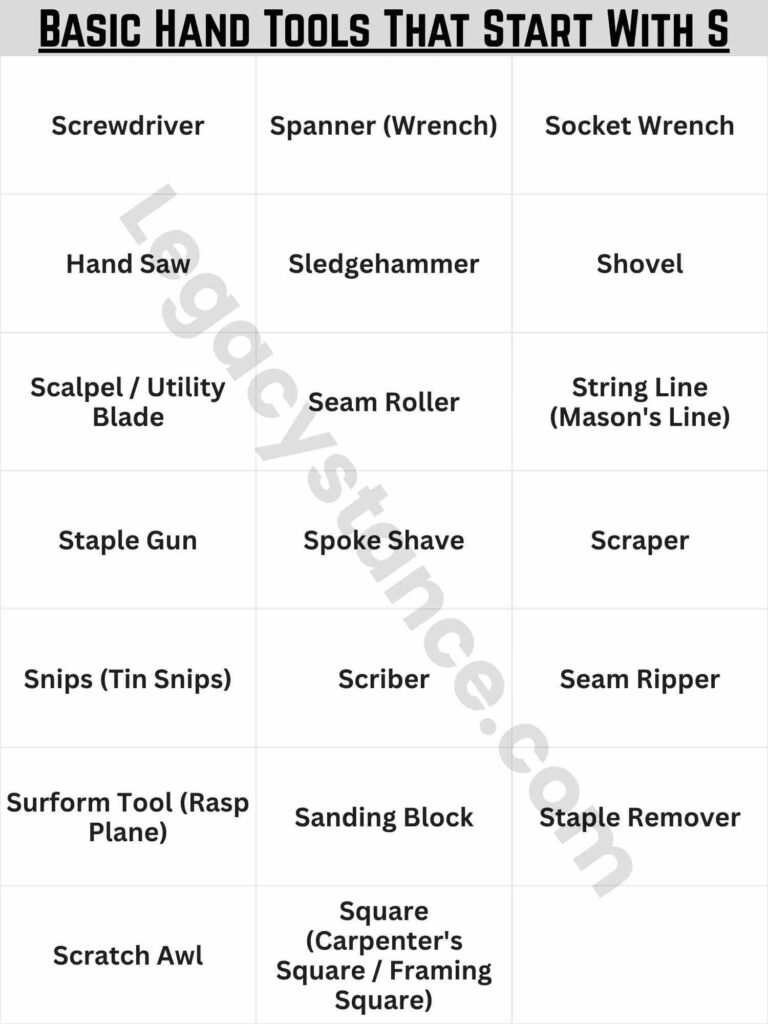
Screwdriver
Drives and removes screws. Comes in flathead, Phillips, Torx, Pozidriv, and hex head types. Used in furniture assembly, electrical work, appliance repair, and household fixes.
Tip: Always match the head size to the screw — a wrong fit strips the head instantly.
Spanner (Wrench)
Grips and turns nuts, bolts, and pipe fittings. Open-end spanners fit flat sides of a fastener; ring spanners wrap fully around for better torque. Mechanics use metric and imperial sets. Plumbers use pipe wrenches for round fittings.
Socket Wrench
A ratcheting handle with interchangeable sockets that fit over bolt heads. Much faster than a spanner for multiple fasteners. Deep sockets reach bolts inside recessed holes. Essential in automotive, machinery, and appliance repair.
Hand Saw
Cuts wood, plastic, or metal with a toothed blade. Coarser teeth cut faster but leave rough edges; finer teeth produce cleaner cuts. Tenon saws have a reinforced spine for precise joinery cuts.
Sledgehammer
A long-handled, heavy-headed hammer for maximum force. Drives stakes, breaks concrete, demolishes walls, and knocks framing into position. A construction and demolition site staple.
Shovel
Moves and lifts loose materials — soil, gravel, sand, snow, mulch. Pointed blades penetrate hard ground; flat blades scoop; spades cut clean turf edges. Used in landscaping, construction, and gardening.
Scalpel / Utility Blade
A sharp, thin blade for precise cutting. Medical scalpels are used in surgery. Utility blades handle drywall, rope, vinyl flooring, and packaging. Retractable versions protect the blade when stored.
Seam Roller
A small roller that presses wallpaper or vinyl flooring seams flat, bonding them firmly and preventing lifting or bubbling. Used in flooring and decorating.
String Line (Mason’s Line)
A taut cord stretched between two fixed points as a straight reference line. Bricklayers keep courses level with it; landscapers use it to mark trenches and garden edges.
Staple Gun
Drives heavy-duty metal staples into wood, fabric, insulation, or upholstery. Manual versions squeeze by hand; pneumatic and electric models handle high-volume work.
Spoke Shave
A two-handled blade tool for shaping and smoothing curved wooden surfaces — chair legs, bows, paddle handles. The blade sits between two handles for push or pull action along curves.
Scraper
A flat or curved blade that removes old paint, adhesive, rust, or debris from surfaces. Putty knives are a common type. Used in surface preparation before painting or refinishing.
Snips (Tin Snips)
Hand-operated scissor-like blades for cutting sheet metal, thin plastic, and mesh. Straight-cut snips handle flat cuts; aviation snips (left, right, straight) cut curves in sheet metal. Common in HVAC, roofing, and metal fabrication.
Scriber
A hardened steel point that scratches fine reference lines onto metal before cutting or machining. More accurate than a pencil, which smudges. Used in metalworking and engineering.
Seam Ripper
Removes stitching from fabric without cutting the surrounding material. A hook-shaped blade slips under thread and cuts it cleanly. Standard in tailoring, upholstery, and clothing repair.
Surform Tool (Rasp Plane)
A hand tool with a perforated steel blade that rasps wood, plaster, or soft metal into shape. Works like a grater — material passes through the holes to prevent clogging. Used in rough shaping and fitting work.
Sanding Block
A rigid block that holds sandpaper flat against a surface for even, controlled hand sanding. Prevents finger pressure from creating uneven spots or rounded edges.
Staple Remover
Removes staples from paper or upholstery without tearing the material. Jaws slide under the staple and lever it free. Used in offices, upholstery shops, and document handling.
Scratch Awl
A pointed steel spike used to mark starting points for screws, pierce holes in thin materials, and scratch layout lines. Prevents drill bits from wandering when starting a hole.
Square (Carpenter’s Square / Framing Square)
An L-shaped flat tool for checking and marking 90° angles on large timber and sheet material. Framing squares are large — used in roof cutting, stair layout, and framing. Try squares are smaller for bench work.
Mechanic Tools That Start With S
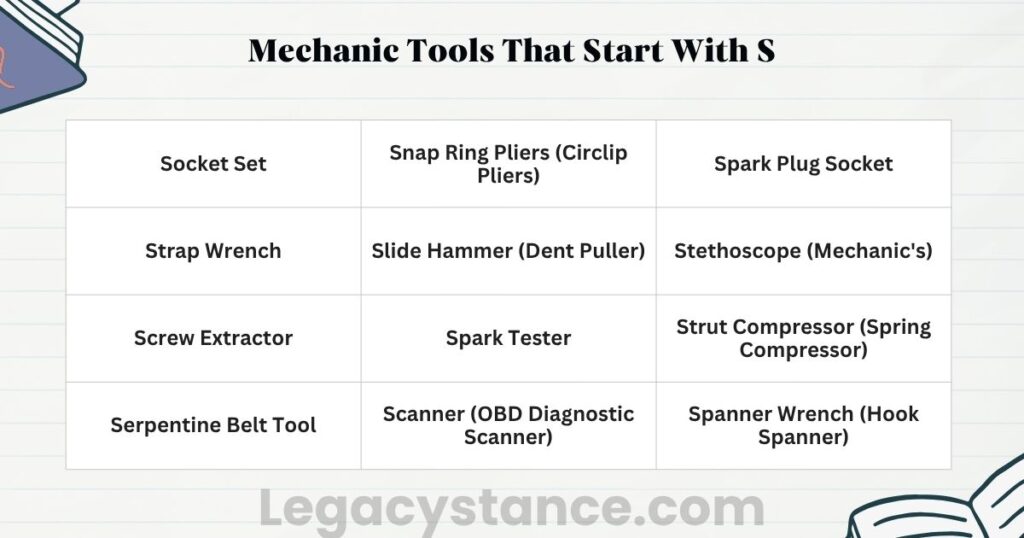
Socket Set
A complete collection of sockets in multiple drive sizes (¼”, ⅜”, ½”) with extensions, adapters, and a ratchet handle. The core of every mechanic’s toolbox. Get both metric and SAE sets — most modern vehicles are metric, older American vehicles use SAE.
Snap Ring Pliers (Circlip Pliers)
Removes and installs snap rings — small circular retaining clips that secure bearings, pins, and shafts. Internal and external versions exist. Common in transmission work, suspension repair, and engine rebuilds.
Spark Plug Socket
A deep socket with a rubber insert that grips and protects the ceramic spark plug body during removal and installation. Available in 14mm and 16mm for most gasoline engines.
Strap Wrench
Grips smooth, round, or irregular surfaces without scratching — oil filters, PVC pipe, chrome fittings. The rubber or nylon strap wraps around and tightens as the handle turns.
Slide Hammer (Dent Puller)
A weighted rod that slides along a shaft to generate impact force through momentum. Pulls stuck bearings, removes dented body panels, and extracts seized components. Interchangeable heads attach to various surfaces.
Stethoscope (Mechanic’s)
Amplifies internal engine and drivetrain sounds so a mechanic can pinpoint clicking, knocking, or rattling at specific components. Diagnoses worn bearings, valve train faults, and injector issues.
Screw Extractor
Removes broken bolts or stripped screws by drilling into the fastener center and threading in reverse to back it out. Essential when a bolt snaps inside an engine block or manifold.
Spark Tester
Checks whether a spark plug or ignition system is producing a proper spark. Clips onto the plug wire and flashes visibly when the engine cranks. Used in ignition system diagnosis.
Strut Compressor (Spring Compressor)
Compresses coil springs safely during shock absorber and strut replacement. Without it, releasing a compressed spring is extremely dangerous — it stores enormous energy. Required for front suspension work on most vehicles.
Serpentine Belt Tool
A specialized socket or tensioner tool that releases the automatic belt tensioner on a serpentine belt drive system, allowing belt removal and replacement. A standard wrench often cannot reach or apply proper leverage in tight engine bays.
Scanner (OBD Diagnostic Scanner)
Reads fault codes from a vehicle’s onboard computer system. Plugs into the OBD-II port (standard on all vehicles since 1996) and retrieves stored trouble codes that identify engine, transmission, ABS, and emissions system faults. Modern scanners display live data and clear codes after repair.
Spanner Wrench (Hook Spanner)
A specialized wrench with a hooked end or pin that fits into notches or holes on lockrings, bearing retainers, and specialty fasteners. Used on motorcycles, lathes, and machinery with non-standard fastener formats.
Construction Tools That Start With S
Spirit Level (Bubble Level)
Determines whether a surface is horizontal (level) or vertical (plumb) using a liquid-filled vial with an air bubble. When the bubble sits between two lines, the surface is true. Used by carpenters, tile setters, and plumbers. Digital versions display angle in degrees.
Speed Square
A triangular layout tool for marking 90° and 45° angles quickly on timber framing. Roofers and carpenters carry one constantly. Also works as a circular saw guide for cross-cuts.
Scaffolding Spanner
A wrench designed specifically for tightening scaffold tube couplers. Fits the standard 21mm scaffold nut; the handle end often doubles as a hammer for anchor bolts.
Steel Float
A flat rectangular steel blade with a handle for finishing concrete and plaster surfaces. Produces a dense, hard surface on concrete slabs. Plasterers use it for smooth final-coat wall finishes.
Sand Rammer (Tamper)
A flat-bottomed tool — manual or pneumatic — that compacts soil, gravel, or sand in trenches and around foundations. Proper compaction prevents settling. Hand tampers suit small areas; plate compactors handle large sections.
Stud Finder
An electronic device that detects wooden studs or metal framing behind drywall. Locates safe anchor points before hanging heavy objects. Better models also detect live electrical cables and pipes.
Straight Edge
A precision-machined bar or rule with a flat edge for checking surface flatness and guiding cuts. Used in tiling, plastering, and metalworking to identify high and low spots.
Sump Pump
Removes accumulated water from basements, excavations, and flooded sites. Submersible models sit in the water; pedestal models sit above it. Construction sites use them during wet weather to keep excavations workable.
Spreading Trowel (Notched Trowel)
A flat or notched steel blade used to spread and comb adhesive, mortar, or mastic onto surfaces before laying tiles or flooring. Notch size determines adhesive thickness and coverage.
Sash Clamp (Bar Clamp)
A long clamp with a fixed jaw at one end and an adjustable sliding jaw on a steel bar. Holds wide panels, door frames, and cabinet carcasses together during gluing. Woodworkers and joiners use multiple sash clamps simultaneously on large assemblies.
Snatch Block
A pulley block that opens on one side, allowing a rope or cable to be inserted without threading the end through. Used in rigging, lifting, and recovery operations to redirect pull force or increase mechanical advantage.
Surveyor’s Staff (Levelling Staff)
A graduated rod held vertically at a survey point so a levelling instrument operator can read the height difference between points. Used in land surveying, road construction, and drainage layout.
Shot Firer (Powder-Actuated Tool)
Drives fasteners — pins, studs, anchors — into concrete, steel, and masonry using a powder charge (similar to a blank cartridge). Far faster than drilling and plugging for high-volume anchor installation. Requires operator certification in most countries.
Measuring and Precision Tools That Start With S
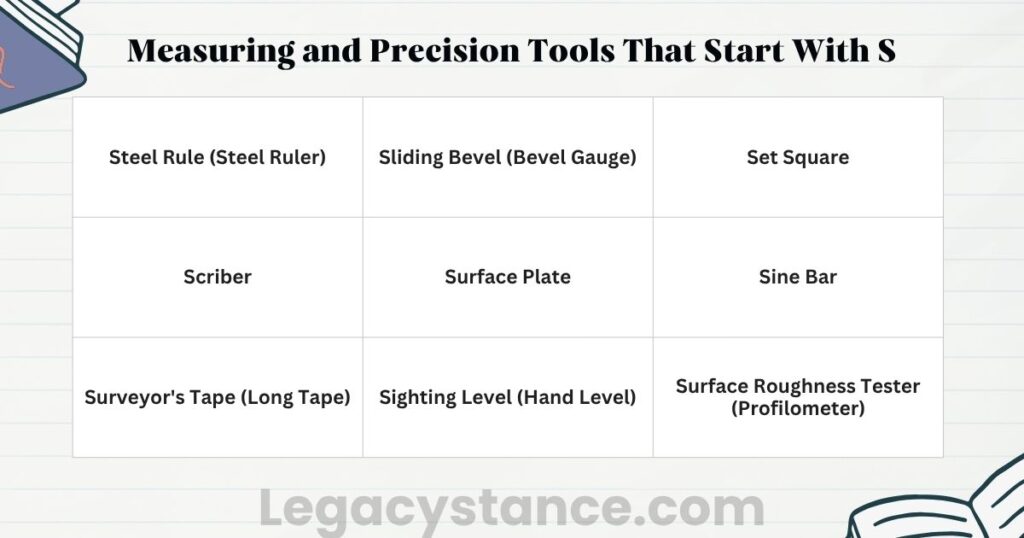
Steel Rule (Steel Ruler)
A rigid, graduated strip in stainless steel for short, accurate measurements. More stable than a flexible tape. Used in metalworking, woodworking, and drafting.
Sliding Bevel (Bevel Gauge)
Transfers and replicates any angle. The blade locks at a set angle to transfer it to a workpiece or verify an existing cut. Used in joinery, roofing, and stair construction.
Set Square
A fixed-angle drafting and layout tool with 90°/45° or 30°/60° angles. Used to draw perpendicular and angled lines and check corners. Common in technical drawing and carpentry layout.
Scriber
Scratches precise reference lines onto metal before cutting or machining. More accurate than pencil marks. Used in metalworking and fabrication.
Surface Plate
A flat cast-iron or granite slab used as a precision reference plane in engineering. Components are checked for flatness on it; measuring tools are set up from it as a zero reference. Found in machine shops and metrology labs.
Sine Bar
Sets and measures angles in machining by using gauge blocks of precise heights under one end. The resulting angle is calculated using trigonometry. Used in tool rooms for grinding and milling setups.
Surveyor’s Tape (Long Tape)
A long measuring tape — 20m, 30m, or 50m — used in land surveying, construction layout, and site measurement where a standard 5m tape falls short.
Sighting Level (Hand Level)
A handheld tube with a spirit vial and crosshair used to sight a horizontal line across a landscape or building. Less precise than an optical or laser level but fast for quick checks in the field.
Surface Roughness Tester (Profilometer)
Measures the microscopic texture of a machined surface in Ra (average roughness) values. Confirms whether a machined part meets surface finish specifications. Used in precision manufacturing and quality control.
Power Tools Beginning With S
Sander — Orbital / Random Orbit
Smooths wood, metal, or filler by vibrating an abrasive pad in randomized small circles. Prevents swirl marks. Used in furniture making, automotive bodywork, and floor finishing.
Sander — Belt
Runs an abrasive belt over two rollers for aggressive material removal on large flat surfaces. Faster than an orbital sander. Requires a steady hand to avoid gouging.
Sander — Detail (Mouse)
A small triangular sander for tight corners, edges, and intricate surfaces where larger sanders can’t reach. Used in furniture restoration and cabinetry.
Circular Saw
A handheld power saw with a spinning toothed blade. Cuts lumber, sheet goods, and composite materials. The most-used saw on construction sites. Standard blade size is 7¼ inch for framing work.
Sabre Saw (Reciprocating Saw)
A back-and-forth blade motion cuts wood, metal, pipe, and drywall. Plumbers and electricians use it to cut through walls and framing during installation. Also known as “Sawzall.”
Scroll Saw
A stationary saw with a fine vertical blade for highly detailed curved cuts in thin wood, acrylic, or metal. Used in decorative woodworking, sign making, and model building — a precision tool, not a speed tool.
Spray Gun (Paint Sprayer)
Atomizes paint, primer, varnish, or stain into a fine mist for fast, even coverage. HVLP (high-volume, low-pressure) guns reduce overspray. Used in furniture finishing and automotive painting.
Soldering Station
A temperature-controlled soldering iron unit with a stand and tip cleaning pad. Gives more consistent heat than basic fixed-temperature irons. Used in electronics assembly and circuit board repair.
Spot Welder
Joins two metal sheets by clamping them between copper electrodes and passing high electrical current through the contact point, creating a localized fusion weld. Used in automotive manufacturing and sheet metal fabrication.
Spiral Saw (Rotary Cutter / Rotozip)
A high-speed rotary tool with a spiral-cut bit used to cut drywall, tile backer, and thin panels. Cuts from any point without needing an edge start. Used heavily in drywall installation for cutting outlet and switch boxes.
Shear (Electric / Pneumatic Metal Shear)
Cuts sheet metal using two blades that pass each other in a scissor action, driven by electric or pneumatic power. Cleaner and faster than snips for large sheet metal cutting. Used in HVAC, roofing, and auto body work.
Steamer (Wallpaper Steamer)
Generates steam through a plate held against wallpaper, softening the adhesive so the paper can be peeled away cleanly. Faster and more effective than chemical strippers on heavy, multi-layer wallpaper.
Specialized Industrial Tools That Start With S
Swaging Tool
Deforms metal tubing ends to create joints, flares, or press-fit connections. Used by HVAC technicians for copper refrigerant lines and plumbers for push-fit fittings. Eliminates the need for welding in many tube joining applications.
Sonic Tester (Ultrasonic Thickness Gauge)
Sends ultrasonic pulses through material and measures echo return time to calculate wall thickness. Detects corrosion in pipes, tanks, and ship hulls without cutting into the material.
Sinker EDM Machine (Spark Erosion)
Uses controlled electrical sparks to erode metal and form complex shapes that conventional cutting tools can’t reach. Makes injection molds, dies, and aerospace components.
Steam Jenny (Industrial Steam Cleaner)
A high-pressure steam cleaning machine that dissolves grease and oil from engines and heavy equipment. Used in automotive shops, food processing facilities, and industrial maintenance.
Surface Grinder
A precision grinding machine that moves a rotating abrasive wheel across metal held on a magnetic table. Produces flat surfaces to very tight tolerances. Found in tool and die shops.
Shaper (Wood Shaper / Spindle Moulder)
A stationary woodworking machine with a vertical rotating spindle holding profiled cutters. Shapes moldings, rabbets, and tenons. Cabinet makers use it for producing consistent profiles on doors and furniture.
Suction Cup Lifter
Uses vacuum suction to grip and lift smooth non-porous surfaces — glass panels, stone slabs, sheet metal, and ceramic tiles. Industrial versions lift car windshields and granite countertops.
Skim Coat Applicator
Applies a thin layer of finishing plaster or compound to walls and ceilings. Professionals use wide-blade spatulas or mechanical applicators for large areas to produce a paint-ready flat surface.
Shear Press (Hydraulic / Mechanical)
A large industrial machine that cuts metal sheet, plate, or bar stock by forcing a blade through the material. Found in steel fabrication shops, metal service centers, and manufacturing plants.
Shot Blast Cabinet
An enclosed cabinet where metal parts are bombarded with steel shot or grit to remove rust, scale, and old coatings, and to produce a clean surface for painting or coating. Used in automotive restoration and metal fabrication.
Stud Welder
Welds threaded studs, pins, or fasteners directly onto a metal surface using an arc discharge — no drilling required. Used in automotive panel repair (for pulling dents) and structural steel fabrication.
Straightening Press (Panel Press)
A hydraulic press used in auto body shops to straighten bent frames, panels, and structural components after collision damage. Works alongside measuring systems to restore factory dimensions.
Digital and Software Tools That Start With S
SketchUp
3D modeling software used in architecture, interior design, and construction planning. Allows users to design and visualize buildings and spaces before construction begins.
SolidWorks
Professional CAD software for mechanical engineers and product designers. Creates precise 3D models of components and assemblies. Common in manufacturing, aerospace, and product development.
Sage (Accounting Software)
Business management and accounting software widely used by contractors and construction companies for invoicing, job costing, payroll, and financial reporting.
SAP
Enterprise resource planning software used in large construction and manufacturing businesses to manage projects, supply chains, inventory, and workforce scheduling.
Slack
Team communication platform used in construction management and architecture firms to coordinate teams, share documents, and track project updates in real time.
Simio (Simulation Software)
Industrial simulation software used by engineers and operations managers to model manufacturing processes, logistics flows, and facility layouts before physical implementation.
SmartDraw
Diagram and floor plan software used by architects, contractors, and facility managers to create building layouts, electrical plans, and project diagrams quickly without specialist CAD training.
Safety Tools and Equipment Starting With S
Safety Harness
A body-worn strap system that connects to an anchor point and arrests a fall within a short distance. Required by law on roofing, scaffolding, and elevated work. Inspect every buckle and strap before each use — a harness can have internal fiber damage invisible from outside after a previous shock load.
Safety Goggles
Sealed eyewear that protects against flying debris, chemical splashes, and grinding sparks. Required when using angle grinders, routers, chisels, or working with chemicals. Distinct from safety glasses, which offer less coverage around the eyes.
Safety Knife (Retractable)
A utility knife where the blade automatically retracts when cutting pressure is released. Reduces accidental cuts in packaging, warehousing, and material handling.
Sound Level Meter (Decibel Meter)
Measures ambient noise in decibels. Readings above 85 dB require hearing protection under occupational health regulations. Used on construction sites and in factories during equipment assessments.
Spill Kit
Absorbent pads, socks, pillows, and disposal bags for containing chemical, oil, or fuel spills. Required by environmental regulations in workshops, fuel storage areas, and industrial facilities.
Smoke Detector Tester
An aerosol can that releases simulated smoke particles to verify detector sensitivity and function during building commissioning and fire safety inspections — without creating an actual fire.
Self-Retracting Lifeline (SRL)
A compact fall arrest device that pays out and retracts a cable or webbing automatically as a worker moves. Locks instantly on sudden movement. Replaces traditional lanyards in applications requiring continuous movement at height.
Safety Boots Tester (Steel Toe Tester)
Used by safety equipment inspectors to verify the integrity of steel or composite toe caps in safety footwear. Confirms they meet impact and compression standards before issue to workers.
How to Choose the Right S Tool
| Situation | Right Tool |
| Tightening many bolts fast | Socket wrench, not a spanner |
| Cutting detailed curves in thin wood | Scroll saw, not a jigsaw |
| Gripping smooth rounded surfaces | Strap wrench, not adjustable spanner |
| Locating wall anchors safely | Stud finder before drilling |
| Large flat surface material removal | Belt sander, not orbital |
| Removing a broken bolt | Screw extractor set |
| Checking a surface is level | Spirit level — digital for angles |
Best Starter S Tools for Beginners
| Tool | Why It Belongs First |
| Screwdriver set | Handles 80% of household fastening |
| Spirit level | Essential for shelves, tiles, cabinets |
| Socket wrench set | Faster than spanners on multiple bolts |
| Speed square | Checks every corner in carpentry |
| Stud finder | Locates safe wall anchors |
| Staple gun | Upholstery, insulation, cable runs |
| Soldering iron | No substitute exists when you need one |
Safety Tips for S Tools
Power saws: Let the blade reach full speed before contact. Never remove the blade guard.
Sledgehammer: Check the handle is firmly seated before every swing. A loose head becomes a dangerous projectile.
Soldering iron: Always rest it in a proper stand. Tips stay hot several minutes after unplugging.
Safety harness: Never reuse a harness that has arrested a fall without inspection — internal fibers may be permanently damaged.
Sanders: Wear a proper dust mask, not a paper face mask. Fine wood and drywall dust causes cumulative lung damage.
Snap ring pliers: Wear goggles. Snap rings under tension can fly off and travel at high speed when released.
Read more –
125+ Tools That Start With J: Hand Tools, Power Tools & More
120+ Tools That Start With R: Names, Types & Uses
FAQs
What are the most useful S tools for a beginner?
A screwdriver set, socket wrench set, spirit level, speed square, and staple gun are great starting tools. They handle many common home repair and DIY jobs without needing advanced skills.
Which S tools are commonly used by mechanics?
Mechanics regularly use socket wrenches, spark plug sockets, screw extractors, snap ring pliers, serpentine belt tools, and OBD scanners. These tools help repair engines, suspension systems, and vehicle electronics.
What is the safest way to use power saws?
Always wear eye protection, keep both hands steady, and let the blade reach full speed before cutting. Never remove safety guards, and unplug the saw before changing blades or making adjustments.
Why are spirit levels important in construction?
A spirit level helps ensure surfaces are straight and balanced. Without one, shelves, walls, tiles, cabinets, and framing can end up uneven, causing both appearance and structural problems.
Final Thoughts
Tools that start with S span every trade, every skill level, and every workshop — from the screwdriver in a kitchen drawer to a surface grinder in an aerospace factory. Knowing what each tool does, where it belongs, and who uses it builds both practical skill and technical vocabulary.
Whether you’re building your first toolkit, studying for a trade exam, or helping students understand workshop equipment, this guide gives you real, usable knowledge — not just a list of names.