Learning math becomes much easier when you understand the language behind it. This collection of Math Words That Start With N brings together important terms from arithmetic, algebra, geometry, statistics, calculus, and more. Whether you’re studying for class, helping a child with homework, or building your math vocabulary, these clear definitions and examples make complex ideas easier to understand and remember.
Quick List: All Math Words That Start With N
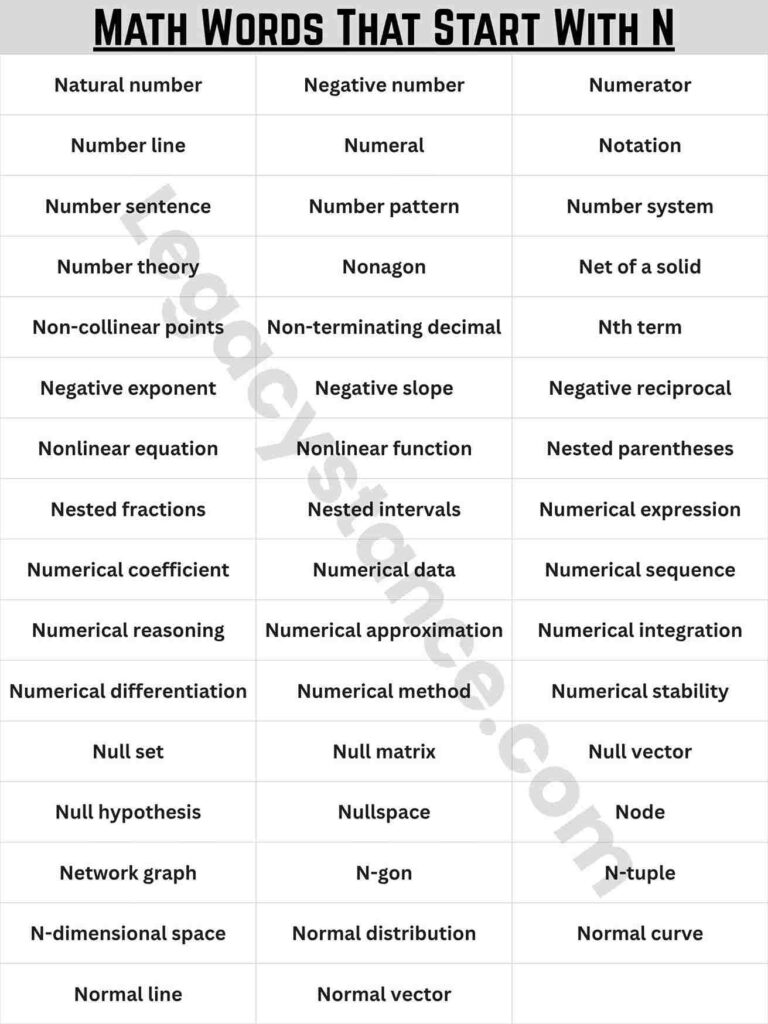
- Natural number
- Negative number
- Numerator
- Number line
- Numeral
- Notation
- Number sentence
- Number pattern
- Number system
- Number theory
- Nonagon
- Net of a solid
- Non-collinear points
- Non-terminating decimal
- Nth term
- Negative exponent
- Negative slope
- Negative reciprocal
- Nonlinear equation
- Nonlinear function
- Nested parentheses
- Nested fractions
- Nested intervals
- Numerical expression
- Numerical coefficient
- Numerical data
- Numerical sequence
- Numerical reasoning
- Numerical approximation
- Numerical integration
- Numerical differentiation
- Numerical method
- Numerical stability
- Null set
- Null matrix
- Null vector
- Null hypothesis
- Nullspace
- Node
- Network graph
- N-gon
- N-tuple
- N-dimensional space
- Normal distribution
- Normal curve
- Normal line
- Normal vector
- Normalized form
- Normalized vector
- Normed space
- Normal subgroup
- Non-Euclidean geometry
- Negative correlation
- Nominal scale
- Nonparametric test
- Negative binomial distribution
- Noise (statistics)
- Nearest tenth
- Nearest hundredth
- Net change
- Net displacement
- Net area
- Newton (unit)
- Newton’s method
- Natural logarithm
- Napierian logarithm
- Natural base e
- Napier’s bones
- Negation
- Necessary condition
- Necessary and sufficient condition
- Negligible quantity
- Nontrivial solution
- Non-singular matrix
- Nonnegative integer
- Negative definite matrix
- Nilpotent
- Noether’s theorem
- Non-measurable set
- Nonstandard analysis
- Neutral element
- Number partition
- Number base
- Number field
- Numeral system
- Nodal analysis
- Necklace problem
- Norm (of a vector)
- Norm (of a matrix)
- Noncommutative algebra
- Non-degenerate
- Net present value
- Net profit (applied math)
- Net pay (applied math)
- Nominal value
- nth root
- Neighborhood (topology)
- Negative definite
- Number sentence
- Numerical reasoning
- Napier’s constant
- Null space
- Non-collinear
- Nappe
- Normal form
- Net worth (applied math)
- Nonlinear system
- Nonnegative number
- Number ray
- Non-adjacent angles
- Numerical coefficient
- Non-standard form
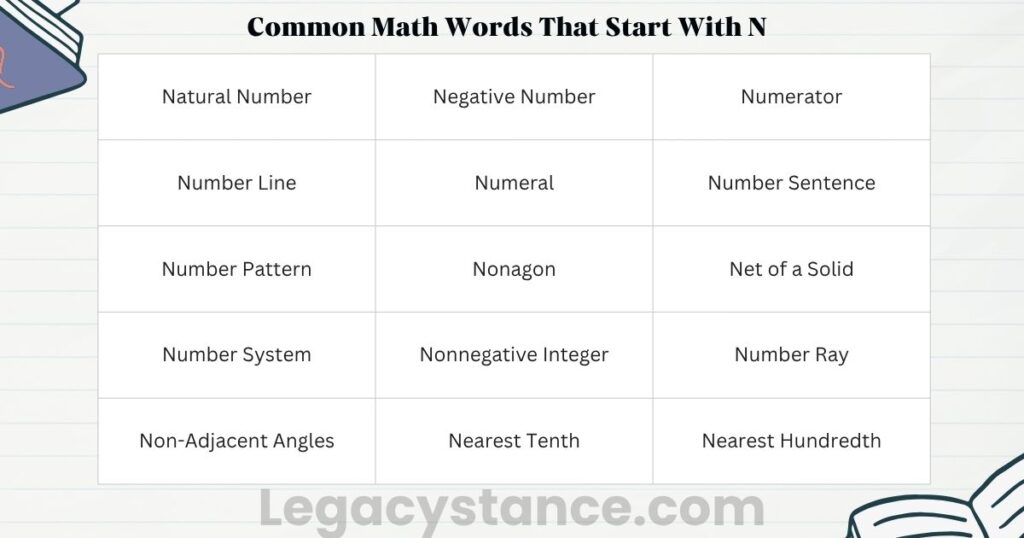
Common Math Words That Start With N
Natural Number
Meaning: The counting numbers starting from 1 and going upward — 1, 2, 3, 4, 5…
Example: You have 9 pencils. The number 9 is a natural number.
Why it matters: Natural numbers are the foundation of all arithmetic. Every multiplication table, counting problem, and whole number operation starts here.
Negative Number
Meaning: Any number less than zero, written with a minus sign in front.
Example: The temperature was −8 degrees last night.
Why it matters: Negative numbers represent debt, temperatures below zero, elevations below sea level, and are essential throughout algebra.
Numerator
Meaning: The top number in a fraction — shows how many parts you have.
Example: In 5/8, the numerator is 5.
Why it matters: You cannot add, compare, or simplify fractions without correctly identifying the numerator.
Number Line
Meaning: A straight line with numbers placed at equal spaces. Zero sits in the middle, positives go right, negatives go left.
Example: To solve −4 + 6, start at −4 and jump 6 spaces right. You land on 2.
Why it matters: Number lines give students a visual model for addition, subtraction, ordering, and early algebra.
Numeral
Meaning: A written symbol that stands for a number.
Example: The Roman numeral X and the Arabic numeral 10 represent the same quantity.
Why it matters: Understanding that symbols represent quantities is the first step toward mathematical literacy.
Number Sentence
Meaning: A complete math statement using numbers and operation symbols.
Example: 6 + 4 = 10 is a number sentence.
Why it matters: This term appears heavily in early elementary math and helps children connect words to written equations.
Number Pattern
Meaning: A sequence of numbers that follows a predictable rule.
Example: 3, 6, 9, 12, 15 — the rule is add 3.
Why it matters: Pattern recognition builds algebraic thinking and prepares students to write formulas and predict future terms.
Nonagon
Meaning: A polygon with exactly nine sides and nine angles.
Example: A shape with 9 equal sides is a regular nonagon.
Why it matters: Nonagons appear in polygon studies, interior angle calculations, and shape classification problems.
Net of a Solid
Meaning: The flat, unfolded version of a 3D shape. Fold it back up and it becomes the solid.
Example: Unfold a cereal box completely flat — that flat shape is the net of a rectangular prism.
Why it matters: Nets connect 2D and 3D thinking and are used to calculate surface area.
Number System
Meaning: An organized set of numbers following defined rules. Base-10 is the most common.
Example: The binary system uses only 0 and 1. The decimal system uses 0–9.
Why it matters: Understanding number systems opens the door to computer science, advanced arithmetic, and number theory.
Nonnegative Integer
Meaning: Any whole number that is zero or greater — 0, 1, 2, 3…
Example: The number of students in a class is always a nonnegative integer.
Why it matters: This term is used precisely in algebra and computer science when a number cannot be negative.
Number Ray
Meaning: A half-line starting from zero and extending in one direction, typically showing only positive numbers.
Example: A ruler starting at 0 and going right is like a number ray.
Why it matters: Number rays introduce young learners to the concept of a number line before negative numbers are introduced.
Non-Adjacent Angles
Meaning: Angles that do not share a common side or vertex — they are not next to each other.
Example: In a quadrilateral, opposite angles are non-adjacent.
Why it matters: Understanding which angles are adjacent versus non-adjacent is essential in geometry proofs and angle relationship problems.
Nearest Tenth
Meaning: Rounding a decimal to one digit after the decimal point.
Example: 4.76 rounded to the nearest tenth is 4.8.
Why it matters: Used constantly in measurement, science, and everyday calculation.
Nearest Hundredth
Meaning: Rounding a decimal to two digits after the decimal point.
Example: 3.2481 rounded to the nearest hundredth is 3.25.
Why it matters: Currency is expressed to the nearest hundredth — this is one of the most practical rounding skills in daily life.
Algebra Math Words That Start With N
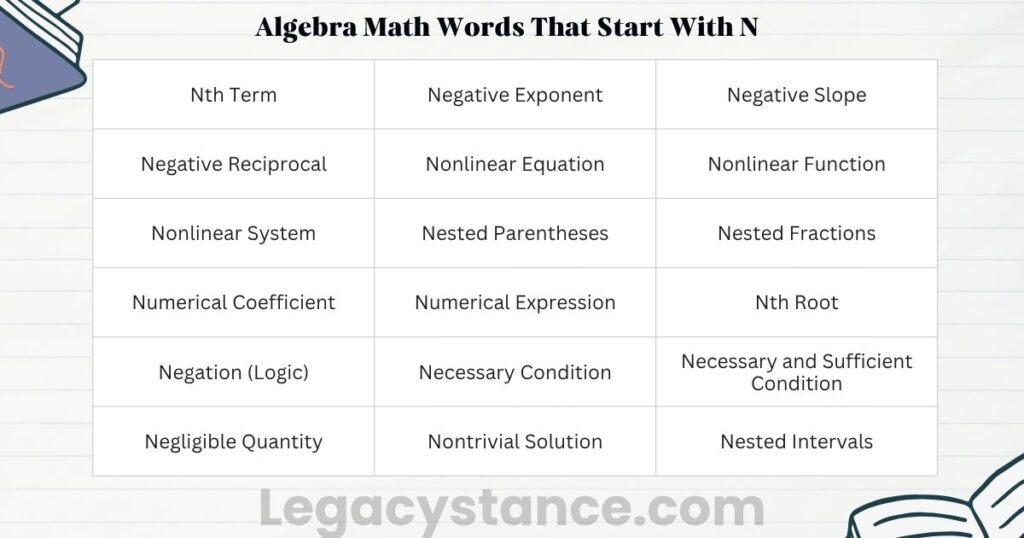
Nth Term
Meaning: A formula that gives any term in a sequence based on its position number n.
Example: If the nth term is 4n − 1, the 5th term is 4(5) − 1 = 19.
Why it matters: The nth term lets you describe infinite sequences with one expression — a core algebra skill.
Negative Exponent
Meaning: An exponent with a negative value. It equals the reciprocal of the base raised to the positive exponent.
Example: 3⁻² = 1/(3²) = 1/9.
Why it matters: Appears constantly in scientific notation, algebra simplification, and calculus.
Negative Slope
Meaning: When a line on a graph descends from left to right, its slope value is negative.
Example: A line through (0, 6) and (2, 2) has slope (2−6)/(2−0) = −2.
Why it matters: Slope describes rate of change. A negative slope means the quantity is decreasing.
Negative Reciprocal
Meaning: The reciprocal of a number with its sign flipped. Perpendicular lines have slopes that are negative reciprocals of each other.
Example: The negative reciprocal of 3/4 is −4/3.
Why it matters: This relationship is used to determine whether two lines are perpendicular in coordinate geometry.
Nonlinear Equation
Meaning: An equation where the variable is raised to a power other than 1. Its graph is not a straight line.
Example: y = x² + 2 is nonlinear — its graph is a parabola.
Why it matters: Most real-world relationships are nonlinear. Students encounter these in quadratics, exponentials, and circle equations.
Nonlinear Function
Meaning: A function whose graph is not a straight line — the rate of change varies at different points.
Example: f(x) = x³ is a nonlinear function.
Why it matters: Understanding the difference between linear and nonlinear functions is essential for modeling real-world situations accurately.
Nonlinear System
Meaning: A system of equations where at least one equation is nonlinear.
Example: Solving y = x² and y = x + 2 together forms a nonlinear system.
Why it matters: Nonlinear systems appear in advanced algebra and have multiple or no solutions depending on how curves intersect.
Nested Parentheses
Meaning: Parentheses placed inside other parentheses. Solve from the innermost set outward.
Example: 5 × (3 + (6 − 2)) = 5 × (3 + 4) = 5 × 7 = 35.
Why it matters: Order of operations depends entirely on correctly handling nested parentheses.
Nested Fractions
Meaning: A fraction where the numerator, denominator, or both contain fractions themselves. Also called a complex fraction.
Example: (1/2) ÷ (3/4) written as a stacked fraction is a nested fraction.
Why it matters: Simplifying nested fractions is an important rational expression skill in algebra.
Numerical Coefficient
Meaning: The number placed in front of a variable in an algebraic term.
Example: In 9xy, the numerical coefficient is 9.
Why it matters: Coefficients are what you add or multiply when combining like terms.
Numerical Expression
Meaning: A math phrase containing numbers and operations — no variables, no equals sign.
Example: 8 + 3 × 4 is a numerical expression with a value of 20.
Why it matters: Students must evaluate expressions before they learn to solve equations — understanding this distinction is foundational.
Nth Root
Meaning: The value that, raised to the power n, gives the original number.
Example: The 3rd root (cube root) of 27 is 3, because 3³ = 27.
Why it matters: Nth roots generalize square and cube roots and appear throughout radical and exponent work.
Negation (Logic)
Meaning: The opposite of a mathematical statement. If a statement is true, its negation is false.
Example: The negation of “x > 5” is “x ≤ 5.”
Why it matters: Negation is a foundation of mathematical logic, proof writing, and Boolean algebra in computer science.
Necessary Condition
Meaning: A condition that must be true for a statement to hold — but it alone doesn’t guarantee the result.
Example: Being divisible by 2 is a necessary condition for being divisible by 4. (But not all multiples of 2 are multiples of 4.)
Why it matters: Necessary and sufficient conditions are fundamental to writing mathematical proofs correctly.
Necessary and Sufficient Condition
Meaning: A condition that is both required for and guarantees a result. Written as “if and only if.”
Example: A triangle is equilateral if and only if all three sides are equal. That makes equal sides both necessary and sufficient.
Why it matters: This concept is the backbone of biconditional statements in logic and proof writing.
Negligible Quantity
Meaning: A quantity so small it can be ignored in a calculation without meaningfully affecting the result.
Example: When calculating the mass of a car, the weight of one speck of dust is negligible.
Why it matters: Scientists and engineers drop negligible terms constantly to simplify equations.
Nontrivial Solution
Meaning: A solution to an equation that is not simply zero or the obvious answer.
Example: In the equation Ax = 0, the solution x = 0 is trivial. Any other solution is nontrivial.
Why it matters: Finding nontrivial solutions reveals deeper structure in linear algebra and differential equations.
Nested Intervals
Meaning: A sequence of intervals where each is contained inside the previous one, shrinking toward a single point.
Example: [1, 3], [1.4, 2.6], [1.9, 2.1], [1.99, 2.01] — closing in on 2.
Why it matters: The nested interval theorem guarantees convergence to exactly one real number — foundational in real analysis.
Geometry Math Words That Start With N
Non-Collinear Points
Meaning: Points that do not all lie on the same straight line.
Example: The three vertices of any triangle are non-collinear.
Why it matters: Three non-collinear points define a unique plane — a key concept in 3D geometry.
Non-Terminating Decimal
Meaning: A decimal that goes on forever without ending.
Example: 1/3 = 0.333333… is a non-terminating repeating decimal. π = 3.14159… is non-terminating and non-repeating.
Why it matters: Students need to distinguish terminating from non-terminating decimals when classifying rational and irrational numbers.
Normal Line
Meaning: A line perpendicular to a curve or surface at a given point — meets it at exactly 90 degrees.
Example: At the peak of a hill-shaped curve, the normal line points straight up.
Why it matters: Normal lines appear in calculus and physics when studying forces acting perpendicular to a surface.
N-gon
Meaning: A polygon with N sides — a general term for any polygon.
Example: A 10-gon has 10 sides (also called a decagon).
Why it matters: N-gon lets mathematicians write formulas that work for all polygons at once, using N instead of naming each shape separately.
Nappe
Meaning: One of the two cone-shaped parts of a double cone, extending from the vertex in opposite directions.
Example: A double cone has two nappes. When a plane cuts through one nappe, you get a conic section (ellipse, parabola, or hyperbola).
Why it matters: Nappes are central to understanding conic sections in analytic geometry.
Non-Degenerate
Meaning: Describes a geometric figure or equation that has the full expected structure — not collapsed or simplified into a simpler form.
Example: A non-degenerate triangle has three distinct sides and three distinct angles. A degenerate triangle collapses into a line.
Why it matters: Identifying degenerate cases prevents errors in geometric proofs and equation solving.
Statistics Math Terms That Start With N
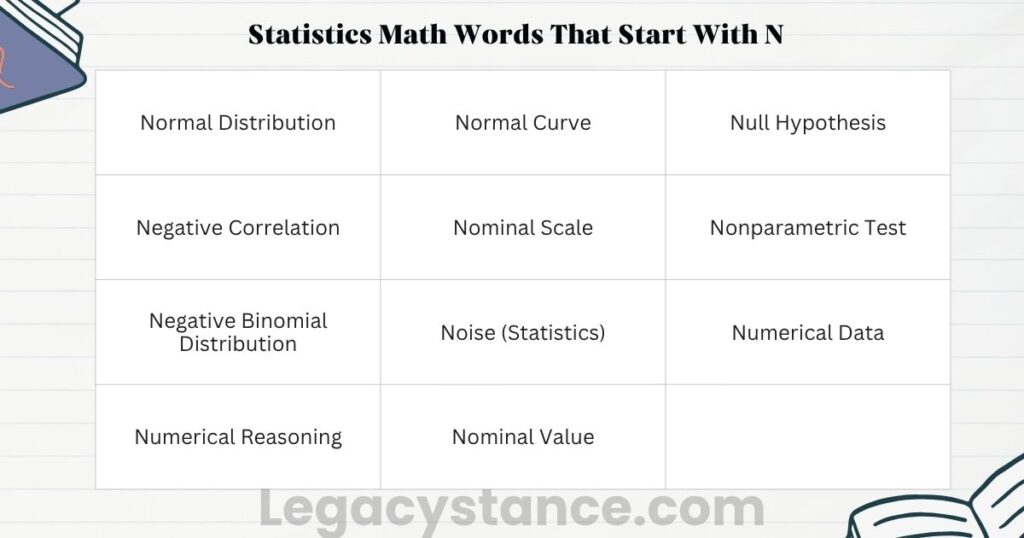
Normal Distribution
Meaning: A symmetric, bell-shaped curve showing how data clusters around the mean, with fewer values at the extremes.
Example: Adult heights follow a normal distribution — most people are near average, very few are extremely short or tall.
Why it matters: The normal distribution is the most important concept in statistics. It underlies grading, research, quality control, and virtually every data-driven field.
Normal Curve
Meaning: The specific bell-shaped graph of a normal distribution.
Example: When test scores for a large group are graphed, they typically form a normal curve.
Why it matters: The shape of the curve tells statisticians how data is spread and lets them calculate probabilities.
Null Hypothesis
Meaning: The default assumption in a statistical test — that there is no effect, no difference, no relationship.
Example: “This medication has no effect on blood pressure” is a null hypothesis. Researchers try to disprove it.
Why it matters: All formal statistical testing begins here. Understanding the null hypothesis is required to correctly read research findings.
Negative Correlation
Meaning: A relationship where one variable increases as the other decreases.
Example: As hours of TV watched increases, academic performance tends to decrease — negative correlation.
Why it matters: Correlation analysis is used in health, economics, education, and science. Negative correlation is one of three types students must know.
Nominal Scale
Meaning: A measurement scale that sorts data into named categories with no meaningful order or numerical difference between them.
Example: Eye color (blue, green, brown) is measured on a nominal scale.
Why it matters: Choosing the right statistical method depends on knowing your measurement scale. Nominal data requires different tests than numerical data.
Nonparametric Test
Meaning: A statistical test that doesn’t assume the data follows a normal distribution. Used with ranked or categorical data.
Example: The Mann-Whitney U test compares two groups without assuming normality — it’s nonparametric.
Why it matters: Real-world data often violates normal distribution assumptions. Nonparametric methods are more flexible and widely used in research.
Negative Binomial Distribution
Meaning: A probability distribution modeling the number of trials needed to achieve a set number of successes.
Example: How many times must you roll a die before getting 3 sixes? That follows a negative binomial distribution.
Why it matters: Used in insurance modeling, clinical trials, and reliability engineering.
Noise (Statistics)
Meaning: Random variation in data that is unrelated to the real pattern being studied.
Example: A one-day temperature spike caused by a broken sensor is noise — not a real climate trend.
Why it matters: Separating signal from noise is one of statistics’ central challenges, appearing in regression analysis, data collection, and experimental design.
Numerical Data
Meaning: Data that is expressed in numbers and can be measured or counted.
Example: Height in centimeters, test scores, and time in seconds are all numerical data.
Why it matters: Numerical data can be analyzed with mathematical operations — unlike categorical data, which cannot.
Numerical Reasoning
Meaning: The ability to understand, interpret, and work with numerical information to solve problems.
Example: Looking at a data table and figuring out which product sold most over six months requires numerical reasoning.
Why it matters: Numerical reasoning is tested in academic assessments, job aptitude tests, and everyday decision-making.
Nominal Value
Meaning: The face or stated value of something, without adjusting for inflation or other real-world factors.
Example: A bond with a nominal value of $1,000 might be worth more or less in real terms after inflation.
Why it matters: Understanding nominal versus real values is fundamental in financial and economic mathematics.
Calculus and Advanced Math Words That Start With N
Natural Logarithm
Meaning: A logarithm with base e (≈ 2.718). Written as ln(x).
Example: ln(e) = 1. ln(1) = 0. ln(e²) = 2.
Why it matters: The natural logarithm appears throughout calculus, physics, and engineering. It describes continuous growth and decay and is the inverse of the exponential function eˣ.
Natural Base e
Meaning: The mathematical constant approximately equal to 2.71828… It is the base of the natural logarithm and appears naturally in growth and decay problems.
Example: Continuously compounded interest uses the formula A = Pe^(rt), where e is the natural base.
Why it matters: The number e is to calculus what π is to geometry — it appears constantly in derivatives, integrals, and differential equations.
Newton’s Method
Meaning: An iterative technique for finding approximate solutions to equations by starting with a guess and refining it using a formula.
Example: To solve x² − 5 = 0, start guessing x = 2 and apply the formula repeatedly until you get close to √5 ≈ 2.236.
Why it matters: Newton’s method is used in calculators, software, and numerical analysis when exact solutions are impossible to find by hand.
Net Change
Meaning: The overall difference between a starting value and an ending value.
Example: A stock starts at $50, rises to $80, then falls to $55. The net change is +$5.
Why it matters: Net change is the conceptual foundation of the definite integral in calculus.
Net Displacement
Meaning: The straight-line change in position from start to finish — not the total path traveled.
Example: Walk 8 meters right, then 3 meters left. Total distance = 11 meters. Net displacement = 5 meters right.
Why it matters: Distance and displacement are often confused. This distinction is essential in physics and integral calculus.
Net Area
Meaning: The area calculated by counting area above the x-axis as positive and below as negative — they can cancel each other.
Example: If equal areas lie above and below the x-axis, the net area of the region is zero.
Why it matters: Net area comes directly from definite integrals and is a key concept when integrating functions that cross the x-axis.
Numerical Integration
Meaning: Approximating a definite integral using calculations when an exact formula isn’t available.
Example: The trapezoidal rule estimates the area under a curve by dividing it into trapezoids and summing their areas.
Why it matters: Most real-world integrals cannot be solved analytically. Engineers and scientists rely on numerical integration constantly.
Numerical Differentiation
Meaning: Approximating the derivative of a function using numerical values rather than exact symbolic formulas.
Example: Estimating the slope of a curve at a point by computing (f(x+h) − f(x))/h for a very small h.
Why it matters: Used in computer simulations, physics modeling, and any situation where an analytical derivative is unavailable.
Numerical Method
Meaning: Any technique for solving a mathematical problem using arithmetic calculations rather than exact symbolic manipulation.
Example: Newton’s method, the trapezoidal rule, and Euler’s method are all numerical methods.
Why it matters: Numerical methods make impossible-to-solve equations solvable in practice. They are the foundation of scientific computing.
Numerical Approximation
Meaning: An estimate of a mathematical value that is close but not exact.
Example: π ≈ 3.14159 is a numerical approximation — you can write more digits, but never all of them.
Why it matters: Perfect precision is often impossible. Knowing how to approximate accurately — and how much error is acceptable — is a practical mathematical skill.
Numerical Stability
Meaning: A property of an algorithm that gives reliable, accurate results even when small rounding errors occur during computation.
Example: An unstable algorithm might multiply a tiny rounding error into a huge wrong answer. A stable one keeps errors small.
Why it matters: Without numerical stability, computer programs that solve equations can produce completely wrong results.
Numerical Sequence
Meaning: An ordered list of numbers following a defined rule or pattern.
Example: 2, 4, 8, 16, 32 — each term doubles. This is a numerical sequence.
Why it matters: Sequences underpin series, limits, and a large portion of analysis and calculus.
Linear Algebra Math Words That Start With N
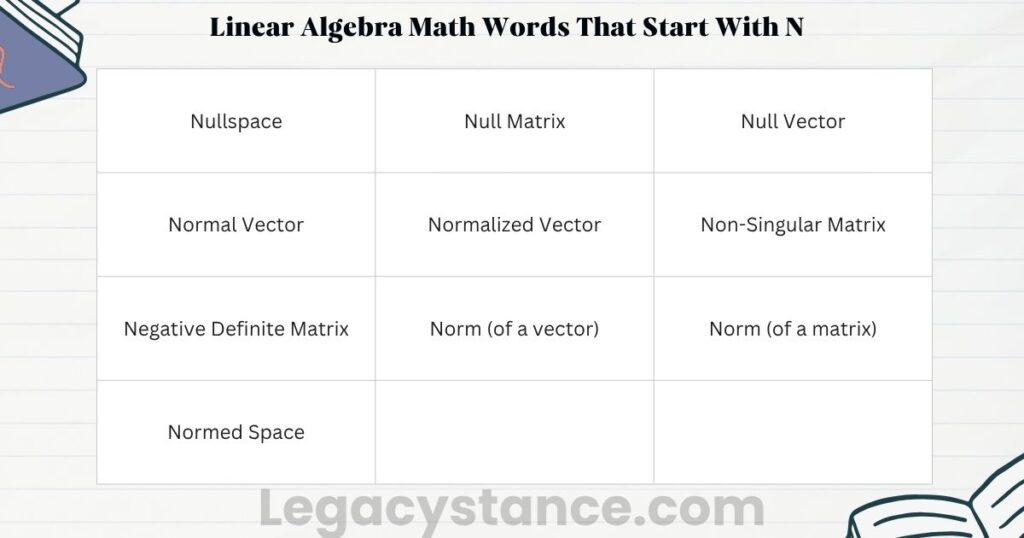
Nullspace
Meaning: The set of all vectors that a matrix maps to the zero vector when multiplied.
Example: If Ax = 0 has solutions other than x = 0, those solutions form the nullspace of A.
Why it matters: The nullspace reveals key properties of a matrix and is fundamental to solving linear systems.
Null Matrix
Meaning: A matrix where every single entry is zero. Also called the zero matrix.
Example: A 2×2 null matrix has four entries, all equal to 0.
Why it matters: The null matrix acts as the additive identity in matrix addition — adding it to any matrix leaves that matrix unchanged.
Null Vector
Meaning: A vector where all components are zero, giving it a magnitude of zero.
Example: In 3D space, the null vector is (0, 0, 0).
Why it matters: The null vector is the additive identity in vector spaces. It appears in linear algebra, physics, and computer graphics.
Normal Vector
Meaning: A vector that is perpendicular to a surface or plane at a given point.
Example: For the flat plane z = 5, the normal vector points straight up: (0, 0, 1).
Why it matters: Normal vectors are used in 3D geometry, computer graphics (for lighting calculations), and calculus on surfaces.
Normalized Vector
Meaning: A vector that has been rescaled so its length (magnitude) equals exactly 1. Also called a unit vector.
Example: The vector (3, 4) has magnitude 5. Divide each component by 5 to get the normalized vector (0.6, 0.8).
Why it matters: Normalized vectors are used in physics, computer graphics, and machine learning wherever direction matters more than magnitude.
Non-Singular Matrix
Meaning: A square matrix whose determinant is not zero. It has an inverse.
Example: If det(A) ≠ 0, then A is non-singular and you can find A⁻¹.
Why it matters: Only non-singular matrices can be inverted, which is required to solve many systems of linear equations.
Negative Definite Matrix
Meaning: A symmetric matrix where every nonzero vector produces a negative result when used in the quadratic form xᵀAx.
Example: If xᵀAx < 0 for all nonzero x, then A is negative definite.
Why it matters: Negative definite matrices appear in optimization problems to identify maximum points.
Norm (of a vector)
Meaning: The length or magnitude of a vector, calculated using the Pythagorean theorem extended to n dimensions.
Example: The norm of (3, 4) is √(3² + 4²) = √25 = 5.
Why it matters: Norms measure size in vector spaces and are used in machine learning, physics, and data science.
Norm (of a matrix)
Meaning: A measure of the overall size or magnitude of a matrix — several different definitions exist.
Example: The Frobenius norm adds up the squares of all entries and takes the square root.
Why it matters: Matrix norms are used to measure how much a matrix distorts vectors, which matters in numerical stability and machine learning.
Normed Space
Meaning: A vector space equipped with a norm — a way to measure the length of every element.
Example: The set of all real numbers with absolute value as the norm is a normed space.
Why it matters: Normed spaces provide the framework for defining distance, convergence, and continuity in advanced mathematics.
Abstract Algebra Math Words That Start With N
Nilpotent
Meaning: A matrix or algebraic element is nilpotent if raising it to some positive power gives zero.
Example: If N² = 0 for a matrix N, then N is nilpotent.
Why it matters: Nilpotent elements reveal the structure of rings and algebras and appear in the study of differential equations.
Noether’s Theorem
Meaning: A fundamental result stating that every continuous symmetry of a physical system corresponds to a conservation law in mathematics and physics.
Example: The fact that physical laws don’t change over time corresponds directly to conservation of energy — a result of Noether’s theorem.
Why it matters: Emmy Noether’s theorem connects abstract algebra to physics in a profound way. It’s considered one of the most important mathematical results of the 20th century.
Normal Subgroup
Meaning: A subgroup H of a group G that stays unchanged when conjugated by any element of G — meaning gHg⁻¹ = H for all g in G.
Example: In any abelian (commutative) group, every subgroup is a normal subgroup.
Why it matters: Normal subgroups allow the construction of quotient groups — a foundational tool in group theory.
Neutral Element
Meaning: The element in a mathematical operation that leaves any other element unchanged. Also called the identity element.
Example: 0 is the neutral element for addition. 1 is the neutral element for multiplication.
Why it matters: Every algebraic structure is defined partly by its neutral element. Identifying it is the first step in understanding any new algebraic system.
Noncommutative Algebra
Meaning: An algebraic system where the order of operations matters — a × b ≠ b × a.
Example: Matrix multiplication is noncommutative. AB does not always equal BA.
Why it matters: Most arithmetic is commutative, so noncommutativity is surprising and important. It appears in quantum mechanics, matrix theory, and modern physics.
Graph Theory and Applied Math Words That Start With N
Node
Meaning: A point in a graph or network where lines or edges meet.
Example: In a road map, every intersection is a node.
Why it matters: Nodes are the basic building blocks of graph theory, used in routing, networking, social analysis, and computer science.
Network Graph
Meaning: A diagram made of nodes connected by edges, used to model relationships or connections.
Example: A map of airline routes between cities is a network graph.
Why it matters: Network graphs are used to solve problems in transportation, telecommunications, biology, and social media analysis.
Nodal Analysis
Meaning: A method for analyzing electrical circuits by applying equations at each node (junction point).
Example: Engineers use nodal analysis to find voltages at each point in a circuit.
Why it matters: Nodal analysis is a core technique in electrical engineering and applied linear algebra.
N-Tuple
Meaning: An ordered list of exactly N elements.
Example: (2, 5, 8, 1) is a 4-tuple.
Why it matters: N-tuples are fundamental in coordinate systems, databases, and computer science. A 3D coordinate (x, y, z) is a 3-tuple.
N-Dimensional Space
Meaning: A mathematical space with N independent directions or axes, generalizing 2D and 3D space.
Example: Machine learning models often work in spaces with thousands of dimensions.
Why it matters: N-dimensional spaces allow mathematicians to extend geometry and analysis far beyond what can be physically visualized.
Number Theory Math Words That Start With N
Number Theory
Meaning: The branch of mathematics studying the properties and relationships of integers, especially prime numbers.
Example: Proving that there are infinitely many prime numbers is a classic number theory result.
Why it matters: Number theory is the foundation of modern cryptography, which secures internet banking and private communication.
Number Field
Meaning: An extension of the rational numbers that forms a field — a set closed under addition, subtraction, multiplication, and division.
Example: The set of all numbers of the form a + b√2 where a and b are rational is a number field.
Why it matters: Number fields are studied in algebraic number theory and are connected to solving Diophantine equations.
Number Partition
Meaning: A way of writing a positive integer as a sum of positive integers, where order doesn’t matter.
Example: The partitions of 4 are: 4, 3+1, 2+2, 2+1+1, 1+1+1+1.
Why it matters: Partition theory is a rich area of combinatorics and number theory with deep connections to physics and algebra.
Number Base
Meaning: The number of unique digits used in a positional numeral system.
Example: Base 10 uses digits 0–9. Base 2 (binary) uses only 0 and 1.
Why it matters: Every computer operates in binary (base 2). Understanding number bases is essential for computer science.
Numeral System
Meaning: A writing system for expressing numbers. Different cultures developed different numeral systems.
Example: Roman numerals, Arabic numerals, and binary are all numeral systems.
Why it matters: Numeral systems determine how numbers are recorded, communicated, and calculated.
Rare and Specialized Math Words That Start With N
Napier’s Bones
Meaning: A manual calculating device invented by John Napier in the early 1600s — a set of numbered rods used to perform multiplication and division mechanically.
Why it matters: Napier’s bones were an early calculator. Napier also invented logarithms, fundamentally changing how scientists calculated for centuries.
Napierian Logarithm
Meaning: The original logarithm system created by John Napier — closely related to the modern natural logarithm but defined slightly differently.
Why it matters: Napierian logarithms were created to turn multiplication into addition, revolutionizing navigation and astronomy calculations.
Neighborhood (Topology)
Meaning: A set of points surrounding a given point — every point within some small distance of it.
Example: All points within 0.01 units of the point x = 3 form a neighborhood of 3.
Why it matters: Neighborhoods define what it means for a function to be continuous in topology and real analysis.
Non-Euclidean Geometry
Meaning: Geometry that modifies or abandons Euclid’s parallel postulate. Two main types: spherical (no parallel lines) and hyperbolic (infinitely many parallel lines through a point).
Example: On the surface of a globe, the shortest path between two cities follows a curve — spherical geometry, not flat Euclidean geometry.
Why it matters: Non-Euclidean geometry underpins Einstein’s general theory of relativity and is essential in modern physics and cosmology.
Nonstandard Analysis
Meaning: A branch of mathematics that rigorously defines infinitely small (infinitesimal) and infinitely large numbers using formal logic.
Why it matters: Abraham Robinson developed this in the 1960s to give a rigorous foundation to the informal infinitesimal reasoning Newton and Leibniz originally used in calculus.
Non-Measurable Set
Meaning: A set of real numbers that cannot be assigned a consistent size or measure in the standard mathematical framework.
Why it matters: Non-measurable sets require the axiom of choice to construct and revealed deep limitations in mathematical measure theory, influencing how mathematicians think about size and infinity.
Necklace Problem
Meaning: A combinatorics problem counting distinct arrangements of colored beads on a circular necklace, where rotations and reflections count as identical.
Example: How many distinct 6-bead necklaces can you make with 2 colors? Symmetry reduces the count significantly.
Why it matters: The necklace problem introduces Burnside’s lemma and the mathematics of symmetry group actions — important in combinatorics and algebra.
Normal Form
Meaning: A standardized way of writing an expression, matrix, or equation so it can be compared easily with others.
Example: Row echelon form is a normal form for matrices. Scientific notation is a normal form for very large or small numbers.
Why it matters: Normal forms simplify comparison, analysis, and computation across many areas of mathematics.
Normalized Form
Meaning: A representation rescaled or rewritten to meet a standard. For numbers: standard scientific notation. For vectors: scaled to magnitude 1.
Example: 0.0082 in normalized scientific notation is 8.2 × 10⁻³.
Why it matters: Normalized forms appear in scientific notation, floating-point computing, and machine learning preprocessing.
Napier’s Constant
Meaning: Another name for the mathematical constant e ≈ 2.71828…, named in honor of John Napier’s work on logarithms.
Why it matters: e is one of the five most important constants in mathematics and is the base of the natural logarithm.
Real-World Applications of Math Words That Start With N
Medicine and Research: Normal distribution, null hypothesis, negative correlation, and nonparametric tests appear in every clinical study. When a study reports statistical significance, these are the tools behind that conclusion.
Engineering: Numerical integration, numerical stability, Newton’s method, nodal analysis, and normal vectors are used to model everything from circuits to aircraft.
Technology: Node, network graph, N-dimensional space, null matrix, normalized form, and noncommutative algebra underpin databases, search algorithms, and machine learning.
Finance: Net change, net present value, net profit, nominal value, natural logarithm, and negative correlation are used daily in banking, investment, and economic forecasting.
Physics: Newton (unit), net displacement, net area, Noether’s theorem, and non-Euclidean geometry connect mathematics directly to how the physical world behaves.
Architecture and Design: Nonagon, net of a solid, non-collinear points, normal vector, and N-dimensional modeling appear in structural design and 3D software.
Tips for Remembering N Math Terms
- Use the prefix as a clue. Words starting with “null” almost always mean zero or empty. Words starting with “non” mean the absence of some property. These patterns cut your memorization work in half.
- Group by field. Learn normal distribution, null hypothesis, and negative correlation together — they all live in statistics and connect to each other.
- Draw the concept. Normal distribution becomes unforgettable after you draw the bell curve. Nested parentheses make more sense when you circle each layer in a different color.
- Write one example sentence. Don’t just read the definition — use the word. Write “The null set contains no elements” in your own notebook.
- Flashcards with examples, not just definitions. One side: the term. Other side: definition + one example. Review daily for a week.
Commonly Confused N Math
Natural number vs. Whole number vs. Integer
- Natural numbers: 1, 2, 3, 4… (no zero in most definitions)
- Whole numbers: 0, 1, 2, 3…
- Integers: …, −2, −1, 0, 1, 2…
These overlap but are not the same set. Students frequently mix them.
Numerator vs. Denominator
- Numerator = top number
- Denominator = bottom number
Memory trick: the Denominator is Down.
Null set vs. Zero
- The null set {} has no elements at all.
- Zero is a number.
- {0} is a set containing zero — and it is not empty.
Negative correlation vs. No correlation
- Negative correlation: two variables move in opposite directions.
- No correlation: they have no relationship at all.
These are entirely different outcomes.
Normal distribution vs. Normal line
- Normal distribution: a statistics concept about how data clusters around a mean.
- Normal line: a geometry/calculus concept meaning perpendicular to a curve.
Same word. Completely different meanings.
Net displacement vs. Total distance
- Total distance: the full path traveled.
- Net displacement: the straight-line change from start to end.
Walk 10 meters forward, then 4 back: total distance = 14 meters, displacement = 6 meters.
Read also:
60+ Math Words That Start With O
95+ Math Words That Start With P
FAQ’s about Math Words That Start With N
1. How can I remember math vocabulary more easily?
The best approach is to connect each term to an example. Instead of memorizing a definition alone, write a simple sentence or solve a small problem using the word. Drawing diagrams for geometry terms and creating flashcards with examples can also improve long-term recall.
2. Why do many math terms start with “non” or “null”?
These prefixes often describe the absence of a property. For example, nonlinear means “not linear,” while null set means a set with no elements. Recognizing these prefixes can help you understand unfamiliar terms more quickly.
3. Are advanced terms like Noether’s theorem and nonstandard analysis useful for beginners?
Not immediately. Most students won’t encounter these concepts until university-level mathematics or physics. However, learning what they mean can spark curiosity and show how broad and fascinating mathematics becomes beyond school-level topics.
4. What branches of math use N words the most?
Many N terms appear in algebra, geometry, statistics, calculus, number theory, linear algebra, and graph theory. Some, such as negative number and numerator, are used across nearly every area of mathematics, while others belong to specialized fields.
Conclusion
This guide covers 108+ genuine math words that start with N — from natural number and numerator to nilpotent and Noether’s theorem. Every term belongs in mathematics. Nothing was included to pad the count.
The easiest terms appear in elementary and middle school. The advanced terms carry students into calculus, statistics, linear algebra, and abstract algebra. The rare terms satisfy genuine curiosity about where mathematics goes at its deepest levels.
Come back to this list whenever a term shows up in class, homework, or reading and you need a quick, clear explanation.