
Learning Long Words That Start With E can make reading, writing, and speaking much easier. These words appear in school lessons, books, science topics, and everyday conversations. Some are common, while others are used in academic or professional settings.
This guide brings together useful Long E Words with simple meanings and examples. Whether you’re a student, teacher, parent, or language learner, you’ll find words that help build vocabulary without feeling overwhelmed.
Master Word List — 90+ Long Words That Start With E
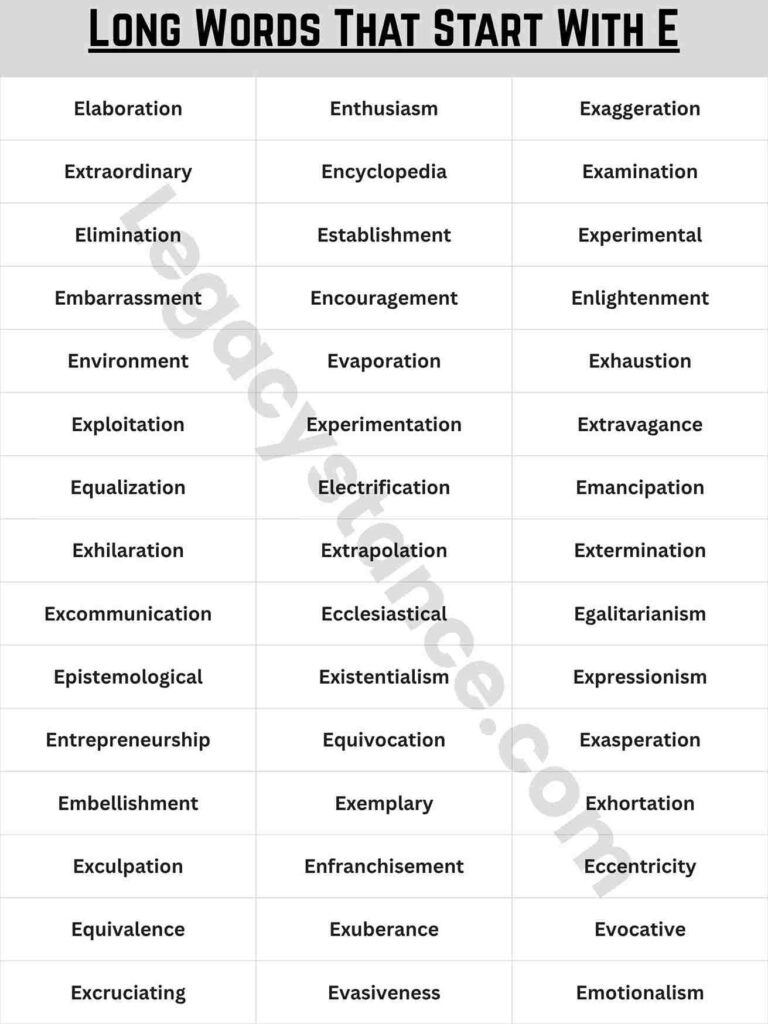
Elaboration
Adding extra detail to make something clearer.
She gave a full elaboration of her plan before the meeting.
Enthusiasm
Strong excitement or deep interest in something.
He studied every night with real enthusiasm.
Exaggeration
Saying something is bigger, worse, or better than it actually is.
Calling the test impossible was pure exaggeration.
Extraordinary
Far beyond what is normal or expected.
She had an extraordinary ability to recall details.
Encyclopedia
A reference work covering a wide range of subjects.
He found the answer in an old encyclopedia.
Examination
A formal test or a careful inspection of something.
The examination covered all three chapters.
Elimination
Removing or completely getting rid of something.
The elimination of spelling errors improved her grade.
Establishment
An organization, or the act of creating something officially.
The establishment of the library took two years.
Experimental
Relating to testing or trying something out.
The experimental treatment showed early promise.
Embarrassment
A feeling of shame or awkward self-consciousness.
His mistake caused visible embarrassment.
Encouragement
Words or actions that give someone confidence to keep going.
Her teacher’s encouragement made a real difference.
Enlightenment
Gaining deep knowledge or clear understanding.
Reading philosophy gave him a sense of enlightenment.
Environment
The natural world that surrounds and supports living things.
Protecting the environment is a shared responsibility.
Evaporation
The process of a liquid changing into vapor or gas.
Evaporation happens faster on hot, dry days.
Exhaustion
A state of extreme physical or mental tiredness.
After the long hike, exhaustion hit them all at once.
Exploitation
Using people or resources unfairly for personal gain.
The documentary exposed the exploitation of workers.
Experimentation
The process of running tests to discover or confirm something.
Experimentation in the lab led to the breakthrough.
Extravagance
Spending or doing far more than is reasonable or necessary.
The extravagance of the dinner surprised every guest.
Equalization
The process of making things equal or balanced.
Equalization of school funding is still debated widely.
Electrification
The process of supplying electricity to a place or system.
Electrification of the village changed daily life completely.
Emancipation
Freedom from control, restriction, or legal ownership.
Emancipation gave millions of people their basic rights.
Exhilaration
A feeling of strong happiness, energy, and excitement.
The climb gave her a powerful sense of exhilaration.
Extrapolation
Using known data to estimate or predict unknown results.
Extrapolation helped scientists predict the population trend.
Extermination
The complete destruction or removal of a group or species.
Pest extermination protected the entire harvest.
Excommunication
Formally removing a person from a religious community.
Excommunication was once used as a serious punishment.
Ecclesiastical
Relating to the Christian church or its officials.
The priest wore full ecclesiastical robes at the ceremony.
Egalitarianism
The belief that all people deserve equal rights and treatment.
Egalitarianism shaped the foundation of the new constitution.
Epistemological
Relating to the theory and study of human knowledge.
Epistemological questions ask how we know what we truly know.
Existentialism
A philosophy centered on individual freedom, choice, and meaning.
Existentialism became widely popular among postwar writers.
Expressionism
An art movement that focuses on emotional experience over realistic depiction.
Expressionism changed how artists communicated inner feelings on canvas.
Entrepreneurship
The process of starting, building, and running a new business.
Entrepreneurship demands creativity, patience, and financial planning.
Equivocation
Using unclear or vague language deliberately to mislead someone.
His equivocation during the interview raised suspicion.
Exasperation
A feeling of intense frustration or annoyance.
She dropped her pen in clear exasperation.
Embellishment
A decorative addition or a detail added to make something more appealing.
Every sentence in the letter had some form of embellishment.
Exemplary
Good enough to serve as a model for others to follow.
Her exemplary attendance earned her school recognition.
Exhortation
A strong appeal or urgent encouragement to act.
The coach’s exhortation before the final game fired up the team.
Exculpation
The act of officially clearing someone of blame or guilt.
New evidence led to his full exculpation.
Enfranchisement
Giving a person or group the right to vote or legal freedom.
Enfranchisement of women changed the course of political history.
Eccentricity
Behavior or thinking that is unusual or different from the norm.
His eccentricity made him memorable to every student.
Equivalence
The state of being equal in value, meaning, or importance.
Mathematical equivalence is shown using an equals sign.
Exuberance
Showing overflowing energy, cheerfulness, and enthusiasm.
The children’s exuberance filled every corner of the playground.
Evocative
Strongly bringing feelings, images, or memories to mind.
The old photograph was deeply evocative.
Excruciating
Extremely intense or unbearable, usually describing pain.
The wait for the results was excruciating.
Evasiveness
The habit of avoiding direct answers or clear statements.
Her evasiveness during questioning made everyone suspicious.
Emotionalism
Placing too much weight on feelings over logic or reasoning.
Emotionalism in public debate often weakens the argument.
Encapsulation
Enclosing something within a covering or presenting it as a brief summary.
Her encapsulation of the chapter helped the whole class review quickly.
Effectuate
To bring something about or cause it to happen through action.
Strong policies will effectuate lasting change over time.
Explicable
Able to be explained clearly.
The error was fully explicable once the data was reviewed.
Emblematic
Serving as a clear symbol or representation of something.
The red poppy is emblematic of remembrance.
Emulative
Marked by the desire to match or equal someone admired.
Her emulative approach helped her master the writing style quickly.
Extemporaneous
Done or spoken without any preparation or planning.
His extemporaneous speech impressed every person in the room.
Ennui
A deep feeling of boredom, emptiness, and dissatisfaction.
A long summer with nothing to do brought on a heavy ennui.
Expurgation
Removing parts of a text considered offensive or harmful.
Expurgation of the manuscript took the editor several weeks.
Expostulation
A firm verbal protest or strong objection.
His expostulation changed nothing about the final decision.
Equestrian
Relating to horse riding or horse-riding competitions.
She trained at an equestrian center every weekend.
Evolutionism
The scientific view that species change and develop over time.
Evolutionism is supported by fossil records and genetic evidence.
Expeditious
Done quickly and with good organization.
The expeditious delivery impressed the client greatly.
Exorcism
A religious ritual intended to drive out evil spirits.
The exorcism scene was the most dramatic moment in the film.
Ethereal
Extremely delicate, light, and almost otherworldly in quality.
The music had a soft, ethereal tone throughout.
Exemplification
The use of a specific example to explain a broader idea.
Her exemplification of the rule made it easy to understand.
Exorbitance
The state of being far beyond what is reasonable or fair.
The exorbitance of the price shocked every buyer at the auction.
Extraterrestrial
Originating from or existing outside planet Earth.
Scientists continue to search for extraterrestrial signs of life.
Epidermis
The outermost protective layer of skin.
The epidermis shields the body from external damage.
Epigenetics
The study of changes in gene activity not caused by DNA sequence changes.
Epigenetics is reshaping how scientists understand inherited disease.
Entomology
The scientific study of insects.
Entomology reveals how insects affect and support ecosystems.
Endocrinology
The branch of medicine that studies hormones and glands.
Endocrinology covers conditions like diabetes and thyroid disorders.
Encephalitis
Inflammation of the brain, usually caused by infection.
Encephalitis can develop from a viral infection if left untreated.
Electrolysis
A chemical process that uses electricity to drive a reaction.
Electrolysis splits water into hydrogen and oxygen gases.
Epidemiology
The scientific study of how diseases spread through populations.
Epidemiology helped health officials track the source of the outbreak.
Erythrocyte
A red blood cell that carries oxygen through the body.
Each erythrocyte lives for roughly 120 days in the bloodstream.
Eukaryote
An organism whose cells contain a distinct nucleus.
Humans, plants, and fungi are all eukaryotes.
Ethnography
The study of human cultures through direct observation and participation.
Ethnography often requires the researcher to live within the community being studied.
Exoskeleton
A hard outer structure that supports and protects an animal’s body.
Crabs and beetles rely on an exoskeleton for protection.
Extraversion
A personality trait marked by being outgoing, talkative, and energized by social contact.
High extraversion means a person thrives in group settings.
Eigenvalue
A specific number that arises in matrix equations in mathematics.
The eigenvalue calculation is a standard topic in linear algebra.
Enantiomorph
A molecule that is a non-superimposable mirror image of another.
Enantiomorphs can behave completely differently inside the human body.
Embolization
A medical procedure that intentionally blocks a blood vessel.
Embolization is used to cut off blood supply to certain tumors.
Electrochemical
Relating to chemical reactions produced by electricity or that produce electricity.
Batteries operate through an electrochemical process.
Exceptionalism
The belief that something or someone is uniquely superior to others.
National exceptionalism often shapes foreign policy decisions.
Egalitarian
Believing in and working toward equal rights for all people.
The egalitarian policy gave every student access to the same resources.
Epidemiological
Relating to the study of how diseases move through populations.
Epidemiological research guided the entire public health response.
Elaborateness
The quality of being highly detailed and complex in design or structure.
The elaborateness of the architecture drew visitors from far away.
Evidentiality
A grammatical feature that shows how the speaker knows something.
Evidentiality is built directly into the grammar of some languages.
Extralinguistic
Referring to factors that exist outside the language system itself.
Gestures and facial expressions are extralinguistic forms of communication.
Exponentiation
The mathematical operation of raising one number to the power of another.
Exponentiation is introduced in most middle school math programs.
Enantiodromia
The tendency of something to turn into its opposite over time.
Enantiodromia is a concept used in Jungian psychology.
Epiphenomenon
A secondary effect that occurs alongside a main event but does not cause it.
Some argue that consciousness is an epiphenomenon of brain activity.
Eschatological
Relating to the end of the world or final events of history.
Eschatological themes appear throughout religious texts worldwide.
Ethnocentrism
Judging other cultures by the standards of your own culture.
Ethnocentrism makes it harder to understand different ways of life.
Ecclesiasticism
Strong attachment to the traditions and authority of the church.
Ecclesiasticism influenced much of medieval European politics.
Equivocal
Open to more than one interpretation; deliberately unclear.
His equivocal answer left everyone unsure of his position.
Expropriating
Taking property from an owner, usually by government authority.
The state began expropriating unused land for public housing.
Etymological
Relating to the origin and historical development of words.
An etymological study of the word reveals its Greek roots.
Euphemism
A mild or indirect word used in place of a harsh or blunt one.
“Passed away” is a common euphemism for died.
Evidentiary
Relating to evidence, especially within a legal context.
The evidentiary hearing was scheduled for the following Tuesday.
Extraversion
A tendency to focus on and gain energy from the outside world and other people.
People with high extraversion usually enjoy large social gatherings.
Exceptionality
The state or quality of being unusual or standing apart from the norm.
The exceptionality of her performance earned a standing ovation.
Ecclesiastic
A member of the clergy or someone connected to the church.
The ecclesiastic delivered a long and formal address to the council.
Long E Words for Kids
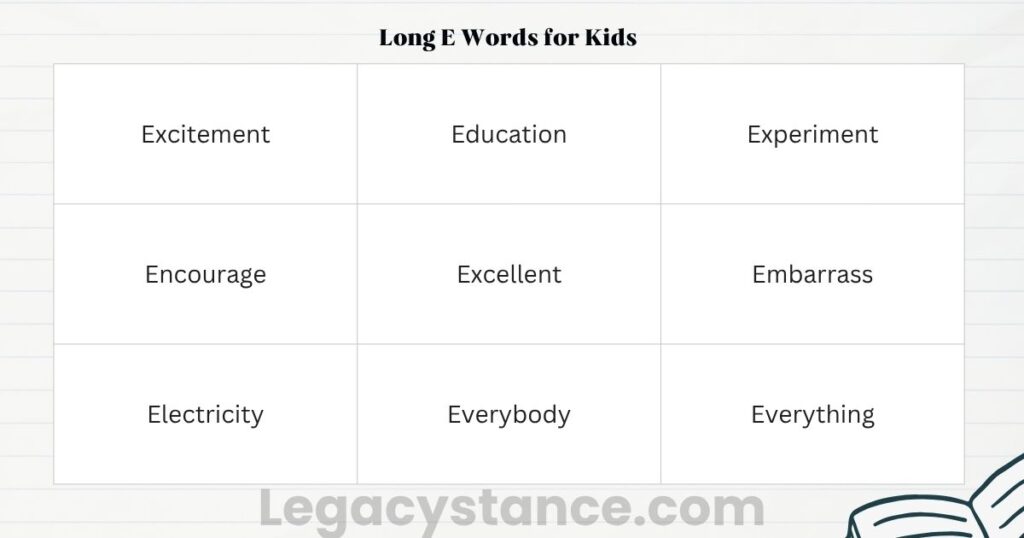
These are easier long E words suited for younger learners.
- Excitement — a strong feeling of being eager and happy
- Education — the process of learning, especially in school
- Experiment — a test done to find out or discover something
- Encourage — to give someone the confidence to try
- Excellent — very good, better than average
- Embarrass — to make someone feel awkward or uncomfortable
- Electricity — the energy that powers lights and machines
- Everybody — every single person
- Everything — all things together
- Everywhere — in every place
Example: The science experiment showed the class how electricity moves through a circuit.
Academic Long Words That Start With E

These appear in essays, textbooks, and formal writing.
- Elaboration
- Establishment
- Experimentation
- Exemplification
- Equalization
- Emancipation
- Egalitarianism
- Epistemological
- Entrepreneurship
- Existentialism
- Enlightenment
- Extrapolation
- Evidentiary
- Etymological
- Eschatological
These words appear in thesis statements, research papers, and academic discussions. Students preparing for standardized exams will likely encounter most of them.
Scientific Long Words That Start With E
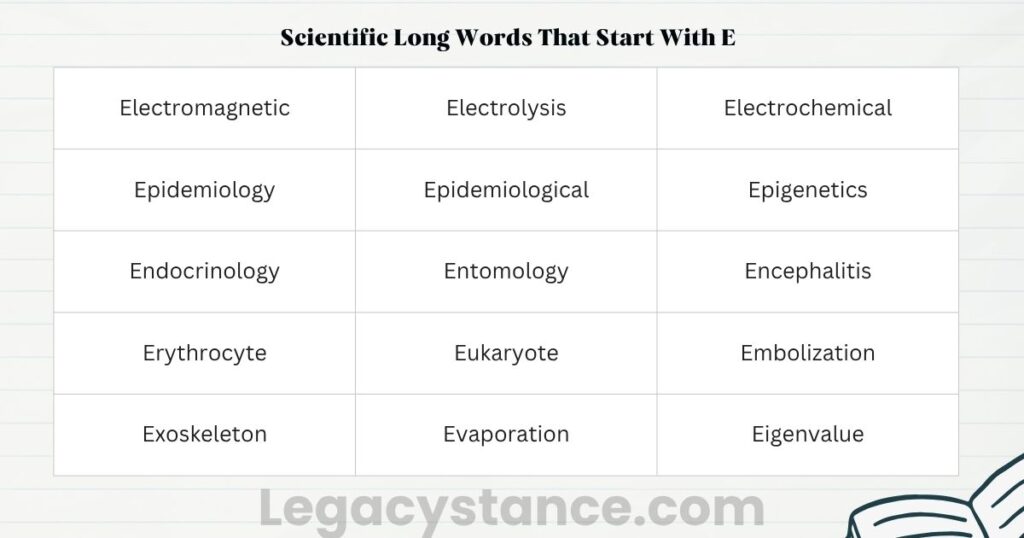
These come from biology, chemistry, physics, and medicine.
- Electromagnetic
- Electrolysis
- Electrochemical
- Epidemiology
- Epidemiological
- Epigenetics
- Endocrinology
- Entomology
- Encephalitis
- Erythrocyte
- Eukaryote
- Embolization
- Exoskeleton
- Evaporation
- Eigenvalue
- Enantiomorph
Example: Epidemiology is the branch of science that studies how diseases move through and affect entire populations.
Rare Long Words That Start With E
Real English words that most people have never come across.
- Evidentiality — a grammatical feature marking how the speaker knows something
- Extralinguistic — referring to things that exist outside language itself
- Expostulation — a firm verbal protest or objection
- Eigenvalue — a specific value produced in a matrix equation
- Enantiomorph — a mirror-image molecular structure
- Exculpation — officially clearing someone of blame
- Effectuate — to cause something to happen through deliberate action
- Expurgation — removing harmful or offensive content from a text
- Enantiodromia — the tendency of things to shift into their opposite
- Epiphenomenon — a side effect that appears alongside but does not cause the main event
- Eschatological — relating to beliefs about the end of the world
- Ecclesiasticism — strong attachment to church tradition and authority
8-Letter Long Words That Start With E
- Ethereal
- Euphoria
- Equivocal (9)
- Evocative (9)
10-Letter Long Words That Start With E
- Exhaustion
- Enthusiasm
- Equivalent
- Expeditious (11)
12-Letter Long Words That Start With E
- Exaggeration
- Embellishment (13)
- Establishment
- Enlightenment
- Encouragement
- Exasperation
15+ Letter Long Words That Start With E
- Excommunication (15)
- Epistemological (15)
- Electrochemical (15)
- Epidemiological (15)
- Entrepreneurship (16)
- Extraterrestrial (16)
- Electroencephalography (22)
Long E Words Pronunciation Guide
| Word | Pronunciation |
| Extemporaneous | ex-TEM-puh-RAY-nee-us |
| Epistemological | eh-PIS-teh-muh-LOJ-ih-kul |
| Electromagnetic | ih-LEK-troh-mag-NET-ik |
| Epidemiological | ep-ih-DEE-mee-uh-LOJ-ih-kul |
| Egalitarianism | ih-GAL-ih-TAIR-ee-uh-NIZ-um |
| Existentialism | eg-ZIS-TEN-shuh-liz-um |
| Extraterrestrial | EK-struh-tuh-RES-tree-ul |
| Encephalitis | en-SEF-uh-LY-tis |
| Equivocation | ih-KWIV-uh-KAY-shun |
| Excommunication | EK-skuh-myoo-nih-KAY-shun |
| Enantiomorph | en-AN-tee-oh-morf |
| Eschatological | es-KAT-uh-LOJ-ih-kul |
Long E Word Origins
Knowing where a word came from helps you remember and guess the meaning of new words.
- Emancipation — from Latin emancipare, meaning to set free from ownership
- Encyclopedia — from Greek enkuklios paideia, meaning general or rounded education
- Epidemiology — from Greek epi (upon) + demos (people) + logos (study)
- Existentialism — from Latin existere, meaning to stand out or to exist
- Electrolysis — from Greek elektron (electricity) + lysis (a loosening or breaking apart)
- Enlightenment — from Old English lēoht (light), with the prefix en meaning to cause or put into
- Encephalitis — from Greek enkephalos, meaning brain
- Entomology — from Greek entomon, meaning insect
- Eschatological — from Greek eskhatos, meaning last or furthest
- Euphemism — from Greek euphemismos, meaning to use good or favorable words
Once you recognize roots like epi, demos, logy, ex, en, and extra, unfamiliar long words become much easier to break apart and understand.
Long E Related Word Families
Learning one word often unlocks a whole group.
Exaggeration family
- Exaggerate (verb)
- Exaggerated (adjective)
- Exaggeratedly (adverb)
- Exaggerator (noun)
Enlightenment family
- Enlighten (verb)
- Enlightened (adjective)
- Enlightening (adjective)
- Enlightener (noun)
Epidemiology family
- Epidemic (noun)
- Epidemiologist (noun)
- Epidemiological (adjective)
Existence family
- Exist (verb)
- Existent (adjective)
- Existential (adjective)
- Existentialism (noun)
- Existentialist (noun)
Common Mistakes about Long E Words
Exceptionalism vs. Exceptionality
Exceptionalism means believing something is uniquely superior. Exceptionality means the quality of being unusual or outstanding. They are not interchangeable.
Eminent vs. Imminent
Eminent means well-respected and prominent. Imminent means something is about to happen very soon. Swapping these two changes your sentence completely.
Euphemism vs. Euphuism
A euphemism is a polite word used in place of a blunt one. Euphuism is an overly ornate writing style from the 16th century. They sound similar but mean entirely different things.
Existential vs. Existentialism
Existential describes something touching on existence or survival. Existentialism is the full philosophical movement. Using one when you mean the other shifts the meaning.
Electrolysis vs. Electrolytics
Electrolysis is the process itself. Electrolytics refers to substances that conduct electricity in solution. In chemistry writing, these carry different meanings.
Learning Tips
Long words become manageable once you break them into parts.
Take epidemiological:
- epi = upon
- demo = people
- logi = study
- cal = relating to
That gives you: relating to the study of what falls upon people. That is exactly what epidemiology covers.
Three habits that work:
Keep a vocabulary notebook. Write the word, meaning, and one sentence you create yourself. Your own sentence sticks better than a printed example.
Say the word aloud. Long words feel less intimidating after you have said them a few times. Pronunciation and spelling both improve together.
Use it the same day. If you learn exhilaration in the morning, use it once before the day ends. A single real use fixes the word in memory far better than re-reading it ten times.
Mini Quiz about Long E Words
Question 1: Which word means the belief that all people deserve equal rights?
- A. Eccentricity
- B. Egalitarianism
- C. Exaggeration
Answer: B
Question 2: What does evaporation describe?
- A. Extreme tiredness
- B. Liquid turning into vapor
- C. Removing someone from a church
Answer: B
Question 3: Which word refers to the scientific study of insects?
- A. Ethnography
- B. Endocrinology
- C. Entomology
Answer: C
Question 4: What does extemporaneous mean?
- A. Coming from outside Earth
- B. Done without any preparation
- C. Relating to the end of the world
Answer: B
Read also:
250+ Long Words That Start With C | With Meanings and Examples
100+ Long Words That Start With B: Meanings, Examples, and Vocabulary Lists
FAQs
What are the most useful long words that start with E for students?
Students often benefit from learning words they regularly see in textbooks and exams. Good examples include examination, environment, enthusiasm, encouragement, elaboration, and experiment. These words appear across many subjects and help improve both reading and writing skills.
How can I remember long E words more easily?
Break the word into smaller parts, learn its root meaning, and use it in your own sentence. Saying the word aloud and writing it down a few times also helps it stay in memory longer than simply reading it.
Which long E words are commonly used in science?
Science frequently uses words such as epidemiology, electrolysis, electromagnetic, endocrinology, epigenetics, and evaporation. These terms appear in biology, chemistry, physics, and health-related studies.
What is the longest word starting with E?
One of the longest commonly recognized E words is electroencephalography, a 22-letter medical term that refers to recording the brain’s electrical activity. While it is rarely used in everyday conversation, it is important in medicine and neuroscience.
Final Thoughts
Working through long words that start with E builds more than just spelling skills. It improves reading comprehension, strengthens academic writing, and helps you understand subjects from science to philosophy more deeply.
Start with the words that already feel familiar, then move into the categories that match what you actually read or study. Most of these words stop feeling long the moment you break them into their roots and use them even once in your own writing.