Learning math becomes much easier when you understand the language behind it. From simple terms like total and triangle to advanced ideas like tensor and topology, these Math Words That Start With T help students read problems, follow lessons, and build stronger math skills.
This guide brings together important T math vocabulary from different branches of mathematics. Each term includes a clear meaning, an example, and a practical explanation so learners can understand not just the word, but why it matters.
Quick List: All 53+ Math Words That Start With T
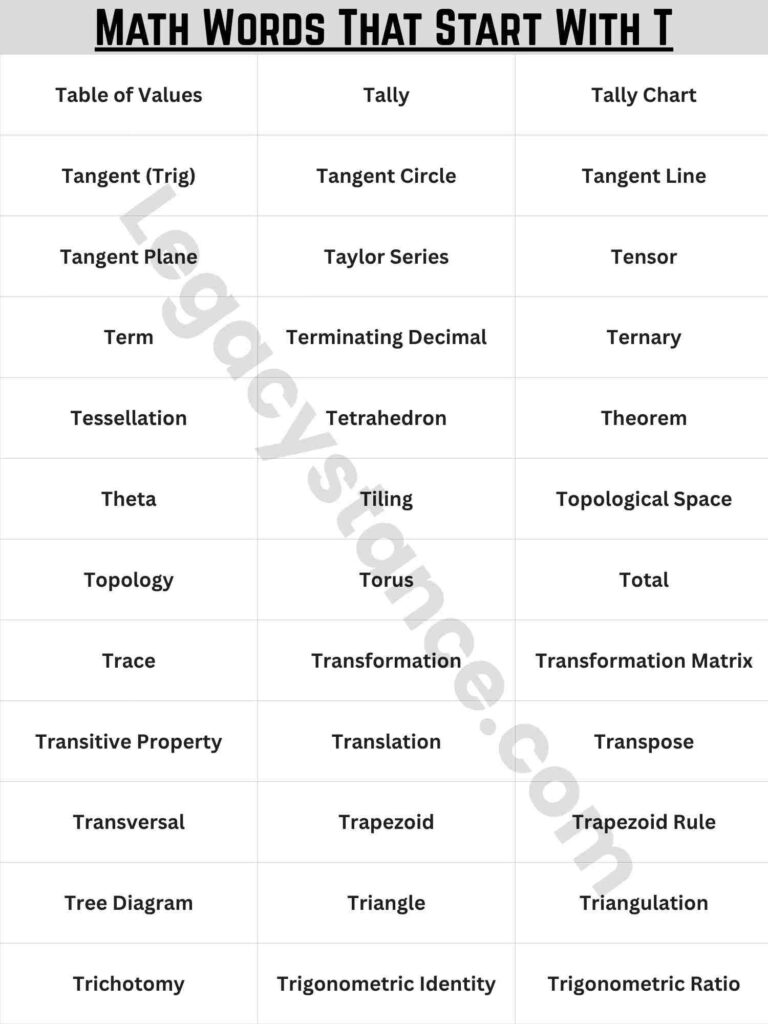
- Table of Values
- Tally
- Tally Chart
- Tangent (Trig)
- Tangent Circle
- Tangent Line
- Tangent Plane
- Taylor Series
- Tensor
- Term
- Terminating Decimal
- Ternary
- Tessellation
- Tetrahedron
- Theorem
- Theta
- Tiling
- Topological Space
- Topology
- Torus
- Total
- Trace
- Transformation
- Transformation Matrix
- Transitive Property
- Translation
- Transpose
- Transversal
- Trapezoid
- Trapezoid Rule
- Tree Diagram
- Triangle
- Triangulation
- Trichotomy
- Trigonometric Identity
- Trigonometric Ratio
- Trigonometry
- Trinomial
- Truncation
- Truth Table
- T-Distribution
- Terminal Point
- Ternary System
- Tessellation
- T-Norm
- Topological Space
- T-Test
- Turning Point
- Twin Primes
- Tychonoff Space
- Type I Error
- Type II Error
- Taxicab Geometry
- Transcendental Number
Common Math Words That Start With T
Table of Values
Meaning: A two-column chart listing input values (x) and their corresponding output values (y) for a function or equation.
Example: For y = 2x + 1, a table of values might show x = 1 → y = 3, x = 2 → y = 5, x = 3 → y = 7.
Why it matters: Students build tables of values before graphing any function. It makes abstract equations visible and concrete.
Tally
Meaning: A method of counting using marks — typically four vertical lines crossed by one diagonal to represent five.
Example: Counting 13 votes gives two groups of five (crossed marks) plus three extra vertical lines.
Why it matters: The simplest data collection tool students learn. It bridges counting and formal statistics.
Tally Chart
Meaning: A table that uses tally marks to record how often something occurs.
Example: A teacher records daily late arrivals for one week using a tally chart — each day gets its own row.
Why it matters: Tally charts organize raw data quickly before converting it into bar graphs or frequency tables.
Term
Meaning: A single number, variable, or product of numbers and variables in a mathematical expression. Terms are separated by + or − signs.
Example: In 3x² + 5x − 7, the three terms are 3x², 5x, and −7.
Why it matters: Identifying terms correctly is the foundation of simplifying, factoring, and solving algebraic expressions.
Terminating Decimal
Meaning: A decimal that ends after a finite number of digits — it does not repeat or go on forever.
Example: ¾ = 0.75 — it stops. Compare to ⅓ = 0.333…, which never ends.
Why it matters: Fractions whose denominators have only 2s and 5s as prime factors always produce terminating decimals. Students need this to compare and convert numbers confidently.
Theta (θ)
Meaning: A Greek letter used in mathematics to represent an unknown angle, especially in trigonometry and geometry.
Example: In sin(θ) = 0.5, theta represents the angle whose sine is 0.5, which is 30°.
Why it matters: Theta is the standard symbol for angles in trig. Students who don’t recognize it get confused reading formulas from day one.
Total
Meaning: The result of adding all given numbers together; another word for sum.
Example: The total of 14, 23, and 9 is 46.
Why it matters: In word problems, “total” is a signal to add. Recognizing vocabulary cues is a key problem-solving skill.
Trapezoid
Meaning: A four-sided polygon (quadrilateral) with exactly one pair of parallel sides, called the bases.
Example: A shape with a top base of 4 cm, a bottom base of 8 cm, and height of 5 cm has an area of ½ × (4 + 8) × 5 = 30 cm².
Why it matters: Area of a trapezoid appears constantly in geometry tests and real-life measurement problems.
Tree Diagram
Meaning: A branching diagram showing all possible outcomes of one or more events.
Example: Flipping a coin twice shows four branches: H-H, H-T, T-H, T-T.
Why it matters: Tree diagrams make probability visual and systematic. Students who struggle with counting rules often find these diagrams far easier to follow.
Triangle
Meaning: A polygon with three sides and three angles. Interior angles always sum to 180°.
Example: A triangle with sides 3, 4, and 5 is a right triangle because 3² + 4² = 5².
Why it matters: Triangles are the most studied shape in all of mathematics — central to geometry, trigonometry, proofs, and engineering.
Twin Primes
Meaning: A pair of prime numbers that differ by exactly 2.
Example: (11, 13), (17, 19), and (29, 31) are all twin prime pairs.
Why it matters: Twin primes appear in number theory. Whether infinitely many twin prime pairs exist is one of the oldest unsolved problems in mathematics.
Ternary
Meaning: A number system that uses base 3, meaning it uses only three digits: 0, 1, and 2.
Example: The number 9 in base 10 equals 100 in ternary (1 × 3² + 0 × 3 + 0 = 9).
Why it matters: Understanding different number bases strengthens place value concepts and prepares students for computer science, where binary and hexadecimal are also used.
Tessellation
Meaning: A pattern of one or more shapes that covers a flat surface completely with no gaps and no overlaps.
Example: Regular hexagons tile perfectly — like a honeycomb. Regular pentagons do not tile because their angles don’t add to 360° around a point.
Why it matters: Tessellations teach angle relationships, symmetry, and transformation. They also connect mathematics directly to art and architecture.
Tetrahedron
Meaning: A 3D solid with four triangular faces, four vertices, and six edges.
Example: A four-sided gaming die (d4) is a regular tetrahedron — every face is an equilateral triangle.
Why it matters: One of five Platonic solids. Studying it builds spatial reasoning skills and introduces students to the relationship between faces, edges, and vertices (Euler’s formula: F + V − E = 2).
Theorem
Meaning: A mathematical statement proven true through logical reasoning from accepted axioms and previously established results.
Example: The Pythagorean Theorem (a² + b² = c²) has been proven hundreds of different ways over centuries.
Why it matters: Every formula students use in geometry started as a theorem. Understanding the difference between a guess and a proven theorem is fundamental mathematical thinking.
Tiling
Meaning: Covering a surface using geometric shapes — same idea as tessellation, but the term is more commonly used in combinatorics and discrete math.
Example: How many ways can you tile a 2 × n grid using 1 × 2 dominoes? This is a classic combinatorics problem.
Why it matters: Tiling problems appear in competition math and discrete mathematics. They develop logical counting and pattern-recognition skills.
Transformation
Meaning: Any operation that changes the position, size, or shape of a geometric figure. The four main types are translation, reflection, rotation, and dilation.
Example: Reflecting triangle ABC across the y-axis is a transformation that produces a mirror image.
Why it matters: Transformations are the core of coordinate geometry. Students who understand this broad category make sense of all four types much more quickly.
Transitive Property
Meaning: If a = b and b = c, then a = c. Also applies to inequalities: if a < b and b < c, then a < c.
Example: If segment AB = segment BC, and segment BC = segment CD, then AB = CD.
Why it matters: Used in nearly every algebraic and geometric proof. It allows chains of equalities to be written without restating every step.
Translation
Meaning: A transformation that slides every point of a figure the same distance in the same direction — no rotating, no flipping.
Example: Moving point (2, 3) by vector (4, −1) gives the new point (6, 2).
Why it matters: The simplest transformation. Understanding it clearly makes rotation and reflection far easier to learn next.
Transpose
Meaning: A new matrix formed by flipping a given matrix over its main diagonal — rows become columns and columns become rows.
Example: If matrix A = [[1, 2], [3, 4]], then Aᵀ = [[1, 3], [2, 4]].
Why it matters: Transposes appear in solving systems of equations, computer graphics, machine learning, and physics.
Transversal
Meaning: A line that intersects two or more other lines at different points.
Example: When a transversal crosses two parallel lines, it creates eight angles — and those angles follow fixed rules (alternate interior angles are equal; co-interior angles add to 180°).
Why it matters: Transversal problems dominate the parallel lines unit. Students who know the angle relationships solve these problems in seconds.
Trichotomy
Meaning: A property of real numbers stating that for any two numbers a and b, exactly one of three things is true: a < b, a = b, or a > b.
Example: For 5 and 8, exactly one holds: 5 < 8.
Why it matters: One of the ordering axioms that holds the real number system together. It appears in logic and proof-writing courses.
Trigonometric Ratio
Meaning: A ratio comparing two sides of a right triangle relative to one of its acute angles. The three primary ratios are sine (opposite/hypotenuse), cosine (adjacent/hypotenuse), and tangent (opposite/adjacent).
Example: In a right triangle with opposite = 3 and hypotenuse = 5, sin(θ) = 3/5 = 0.6.
Why it matters: These ratios are the entry point to all of trigonometry. Every trig problem builds on them.
Trigonometry
Meaning: The branch of mathematics that studies the relationships between angles and sides of triangles.
Example: If you stand 50 meters from a building and measure the angle to the top as 40°, trigonometry lets you calculate the building’s height.
Why it matters: Trigonometry links geometry and algebra, and forms the foundation for calculus, physics, and engineering.
Trinomial
Meaning: A polynomial with exactly three terms.
Example: x² + 5x + 6 is a trinomial. It factors into (x + 2)(x + 3).
Why it matters: Factoring trinomials is one of the most heavily practiced skills in Algebra 1 and 2 — and a key step for solving quadratic equations.
Truncation
Meaning: Dropping digits after a certain decimal place without rounding — just cutting them off.
Example: Truncating 7.896 to two decimal places gives 7.89. Rounding would give 7.90. Different result.
Why it matters: Students often confuse truncation and rounding. The distinction matters in computing, engineering, and any precision-based calculation.
Truth Table
Meaning: A table listing every possible combination of true/false inputs for a logical statement, showing the resulting true/false output for each combination.
Example: For “P AND Q,” the statement is only true when both P and Q are true — the truth table confirms this in four rows.
Why it matters: Truth tables are the mathematical foundation of logic gate design. Every computer processor is built on these logical functions.
Advanced Math Words That Start With T
Tangent (Trigonometry)
Meaning: A trigonometric function equal to the opposite side divided by the adjacent side in a right triangle. Also defined as sin(θ)/cos(θ).
Example: tan(45°) = 1, because opposite and adjacent sides are equal at that angle.
Real-world use: Surveyors use the tangent ratio to calculate heights of structures from a known distance and measured angle.
Tangent Circle
Meaning: Two circles are tangent to each other if they touch at exactly one point. Internally tangent circles have one inside the other; externally tangent circles sit beside each other.
Example: Two circles with radii 3 and 5 are externally tangent if the distance between their centers is exactly 8 (3 + 5).
Real-world use: Appears in geometric construction problems and mechanical engineering when designing gears and pulleys.
Tangent Line
Meaning: A straight line that touches a curve at exactly one point and has the same slope as the curve at that point.
Example: At x = 2, the curve y = x² has a tangent line with slope 4.
Real-world use: The tangent line concept is the foundation of derivatives in calculus — the basis for all rate-of-change calculations.
Tangent Plane
Meaning: The three-dimensional equivalent of a tangent line. A flat plane that touches a curved surface at exactly one point and matches the surface’s slope at that point.
Example: At any smooth point on a sphere, the tangent plane sits flush against the surface touching only at that single point.
Real-world use: Used in multivariable calculus, computer graphics (surface rendering), and physics simulations.
Taylor Series
Meaning: A way of expressing a function as an infinite sum of terms built from the function’s derivatives at a single point.
Example: eˣ = 1 + x + x²/2! + x³/3! + … — each added term makes the approximation more accurate.
Real-world use: Calculators and computers rely on Taylor series to compute values of sine, cosine, and eˣ numerically.
Tensor
Meaning: A mathematical object that generalizes scalars, vectors, and matrices to any number of dimensions, and transforms predictably when coordinates change.
Example: A scalar is a rank-0 tensor. A vector is rank-1. A matrix is rank-2. A stress field in 3D space is a rank-2 tensor with nine components.
Real-world use: Tensors are essential in general relativity, structural engineering, and modern machine learning frameworks like TensorFlow.
Topology
Meaning: The branch of mathematics studying properties of shapes that stay unchanged under continuous deformation — stretching or bending, but no cutting or gluing.
Example: A coffee mug and a donut are topologically identical because both have exactly one hole.
Real-world use: Used in network design, data analysis, and theoretical physics.
Topological Space
Meaning: A set with a defined collection of subsets (called open sets) satisfying three specific axioms. It generalizes the concept of “closeness” without needing actual distances.
Example: Every metric space (like the real number line) is a topological space, but not every topological space has a metric.
Real-world use: Studied in graduate-level pure mathematics and theoretical computer science.
Torus
Meaning: A doughnut-shaped 3D surface generated by rotating a circle around an axis in the same plane that doesn’t pass through the circle.
Example: A doughnut, an inflated inner tube, and a bagel are all real-world tori.
Real-world use: Appears in topology, string theory, and robotics path planning.
Trace (of a Matrix)
Meaning: The sum of all diagonal entries of a square matrix (from top-left to bottom-right).
Example: For the matrix [[3, 1], [0, 7]], the trace = 3 + 7 = 10.
Real-world use: Used in differential equations, quantum mechanics, and spectral graph theory.
Transcendental Number
Meaning: A real number that cannot be the root of any non-zero polynomial with rational coefficients.
Example: Both π and e are transcendental. √2 is irrational but not transcendental — it solves x² − 2 = 0.
Real-world use: Transcendental numbers are studied in advanced number theory. They represent a “higher level” of irrationality.
Transformation Matrix
Meaning: A matrix that, when multiplied by a vector, applies a specific geometric transformation — rotation, reflection, scaling, or shearing.
Example: The matrix [[0, −1], [1, 0]] rotates any point 90° counterclockwise around the origin.
Real-world use: Used everywhere in computer graphics, robotics, animation, and physics simulations.
Trapezoid Rule
Meaning: A numerical method for approximating the area under a curve by dividing it into trapezoids instead of rectangles.
Example: To estimate ∫₀⁴ x² dx, divide the region into trapezoids at equal intervals and sum their areas. The result is close to, but not exactly, the true integral.
Real-world use: Used in engineering and science when an exact integral is impossible or impractical to compute.
Triangulation
Meaning: A technique for determining an unknown location or distance by forming triangles and applying trigonometric principles.
Example: GPS systems use triangulation from multiple satellites to pinpoint a device’s location to within a few meters.
Real-world use: Used in surveying, navigation, cartography, and mobile phone positioning.
Trigonometric Identity
Meaning: An equation involving trigonometric functions that holds true for all valid values of the angle.
Example: sin²(θ) + cos²(θ) = 1 is true for every angle θ without exception.
Real-world use: Identities simplify complex trig expressions in calculus, wave physics, and electrical engineering.
T-Distribution
Meaning: A probability distribution used in statistics when sample sizes are small and the population standard deviation is unknown. It has heavier tails than the normal curve.
Example: Testing whether a new drug works on 10 patients — not 10,000 — requires the t-distribution, not the normal distribution.
Real-world use: Nearly every small-scale scientific study and clinical trial uses the t-distribution for hypothesis testing.
T-Norm
Meaning: A function used in fuzzy logic that generalizes the logical AND operation to values between 0 and 1, not just strict true/false.
Example: In a fuzzy system, “somewhat hot AND somewhat humid” might have a combined truth value calculated using a t-norm function.
Real-world use: Used in artificial intelligence, control systems, and decision-making algorithms.
T-Test
Meaning: A statistical hypothesis test used to determine whether the means of two groups are significantly different from each other.
Example: A researcher uses a t-test to decide if students who studied with music scored meaningfully differently from those who studied in silence.
Real-world use: One of the most commonly used tests in scientific research, social science, and quality control.
Turning Point
Meaning: A point on a graph where the function changes from increasing to decreasing, or from decreasing to increasing. Also called a local maximum or local minimum.
Example: The parabola y = −x² + 4x reaches its turning point (maximum) at x = 2, where y = 4.
Real-world use: Economists model profit peaks. Engineers optimize design dimensions. Both require finding turning points.
Tychonoff Space
Meaning: In topology, a completely regular Hausdorff space — a space where points and closed sets can always be separated by a continuous function.
Example: Every metric space is a Tychonoff space. The real number line is one example.
Real-world use: Studied in graduate topology and functional analysis. Important for understanding compactness and product spaces.
Taxicab Geometry
Meaning: A non-Euclidean geometry where distance is measured only along grid lines — horizontally and vertically — not diagonally.
Example: In taxicab geometry, the distance from (0,0) to (3,4) is 3 + 4 = 7, not 5 (which is the Euclidean diagonal distance).
Real-world use: Models real city navigation where you can’t cut through buildings. Also used in computer image processing.
Type I Error
Meaning: In hypothesis testing, a Type I error occurs when you reject a null hypothesis that is actually true — a false positive.
Example: A medical test says a patient has a disease when they actually don’t. That is a Type I error.
Why it matters: Type I errors are controlled by the significance level (alpha) in any statistical test. Understanding this helps researchers avoid false conclusions.
Type II Error
Meaning: Failing to reject a null hypothesis that is actually false — a false negative.
Example: A medical test says a patient is healthy when they actually have the disease. That is a Type II error.
Why it matters: Type II errors relate to statistical power. A test that misses real effects is just as problematic as one that finds fake ones.
Terminal Point
Meaning: In vector geometry, the point where a vector ends — the tip of the arrow.
Example: A vector starting at (1, 2) and moving to (4, 6) has its terminal point at (4, 6).
Why it matters: Distinguishing initial points from terminal points is essential for vector addition, component form, and direction calculations.
Geometry Math Words That Start With T
- Triangle
- Trapezoid
- Tetrahedron
- Tessellation
- Tiling
- Transformation
- Translation
- Transversal
- Tangent Circle
- Taxicab Geometry
- Triangulation
- Torus
Algebra Math Words That Start With T
- Term
- Trinomial
- Transitive Property
- Trichotomy
- Table of Values
Trigonometry Math Words That Start With T
- Tangent
- Theta
- Trigonometric Ratio
- Trigonometric Identity
- Trigonometry
Calculus Math Words That Start With T
- Tangent Line
- Tangent Plane
- Taylor Series
- Trapezoid Rule
- Turning Point
Statistics Math Words That Start With T
- Tally
- Tally Chart
- T-Distribution
- T-Test
- Tree Diagram
- Type I Error
- Type II Error
Linear Algebra Math Words That Start With T
- Tensor
- Transpose
- Trace
- Transformation Matrix
Number Theory Math Words That Start With T
- Terminating Decimal
- Transcendental Number
- Twin Primes
- Truncation
- Ternary
Logic and Proof Math Words That Start With T
- Theorem
- Truth Table
- Transitive Property
- Trichotomy
- T-Norm
Real-World Applications
Construction and Engineering: Trigonometry, transversals, and transformation matrices are used to calculate angles, design structures, and verify measurements.
Medicine and Research: The t-distribution and t-test analyze whether treatments work. Type I and Type II errors determine how much a researcher can trust their own results.
Computer Science: Truth tables underpin every logic gate. Taylor series power numerical computation. Tensors run modern neural networks. Transformation matrices drive every 3D animation.
Navigation and Surveying: Triangulation — using triangle geometry — makes GPS, cartography, and satellite positioning possible.
Data Science: T-tests, tally charts, tree diagrams, and the t-distribution appear in data collection, hypothesis testing, and probability modeling daily.
Art and Architecture: Tessellations and tiling patterns appear in Islamic geometric art, M.C. Escher’s work, and modern tile design.
Commonly Confused T Math Words
Truncation vs. Rounding
Truncation cuts off digits without looking at what follows. Rounding adjusts the last kept digit up if the next one is 5 or higher. Truncating 3.789 to one place gives 3.7. Rounding gives 3.8. Different answers, different purposes.
Translation vs. Transformation
Transformation is the umbrella category covering translations, reflections, rotations, and dilations. A translation is one specific type. Calling a reflection a “translation” is one of the most common geometry mistakes students make.
Tangent (Trig) vs. Tangent Line (Calculus)
Same word, completely different contexts. The tangent ratio compares sides of a right triangle. A tangent line is a calculus concept describing the slope of a curve at one point. Students hitting calculus after trig sometimes muddle these.
Theorem vs. Formula
A theorem is a proven mathematical statement. A formula is an expression used to calculate something. The Pythagorean Theorem is the proven statement. a² + b² = c² is the formula that comes from it. Not all formulas come from theorems, and not all theorems produce formulas.
Type I Error vs. Type II Error
Type I = false positive (you see an effect that isn’t real). Type II = false negative (you miss an effect that is real). A simple way to remember: Type I is crying wolf. Type II is missing the wolf entirely.
T-Test vs. T-Distribution
The t-distribution is the probability curve. The t-test is the actual statistical test that uses that curve to reach a conclusion. One is the tool; the other is how you use it.
Tips for Remembering T Math Terms
- Tangent — think “touching.” A tangent line just barely touches the curve.
- Transversal — “trans” means crossing. A transversal crosses other lines.
- Tessellation — picture bathroom floor tiles fitting perfectly, zero gaps.
- Trinomial — “tri” = three. Like triangle, tripod, tricycle.
- Transpose — imagine flipping a matrix on its side like turning a page.
- Truncation — think of cutting a tree trunk short. You just stop. No rounding.
- Type I/Type II Errors — Type I cries wolf; Type II misses the wolf.
- Twin Primes — they come in pairs, always two apart, like twins born close together.
Read also:
45+ Math Words That Start With J
52+ Math Words That Start With S
FAQ’s about Math Words That Start With T
What are the most important math words that start with T for students?
For most students, the most useful T math words are term, total, triangle, trapezoid, theorem, tangent, trigonometry, translation, transversal, and tree diagram. These appear regularly in school math from elementary grades through high school.
How can learning math vocabulary improve problem-solving?
Many students struggle not because of the numbers, but because they do not understand the words in the question. Knowing key math terms helps you identify what the problem is asking and choose the correct method more quickly.
Which T math words are used in everyday life?
Several T words appear in real situations. Total is used when adding costs or scores, triangulation helps GPS systems find locations, t-tests are used in research studies, and tessellations appear in tile patterns, art, and architecture.
What is the difference between tangent in trigonometry and tangent line in calculus?
In trigonometry, tangent is a ratio that compares sides of a right triangle. In calculus, a tangent line touches a curve at one point and represents the curve’s slope at that location. They share the same name but describe different concepts.
Are advanced terms like tensor and topology useful for beginners?
Beginners do not need to master these topics right away, but seeing them can be helpful. They show how mathematics grows beyond school-level concepts and connects to fields such as physics, engineering, computer science, and data analysis.
Conclusion
These 53+ math words starting with T span the full range of the subject — from tally marks in elementary data lessons to tensors in graduate-level physics. Some appear in your very next homework assignment.
Others you won’t encounter for years. But knowing what they mean, and where they’re used, builds the kind of mathematical confidence that compound over time. Words are the entry point to ideas. Get the vocabulary right, and the math becomes far less intimidating.