Learning Math Words That Start With L can make math easier to understand and less intimidating. From basic terms like length and line to advanced ideas such as logarithm and Laplace transform, these words appear across many areas of mathematics.
Whether you’re a student building vocabulary, a parent helping with homework, or a teacher creating lessons, this collection provides clear explanations and practical examples to support confident learning.
Quick List: 100+ Math Words That Start With L
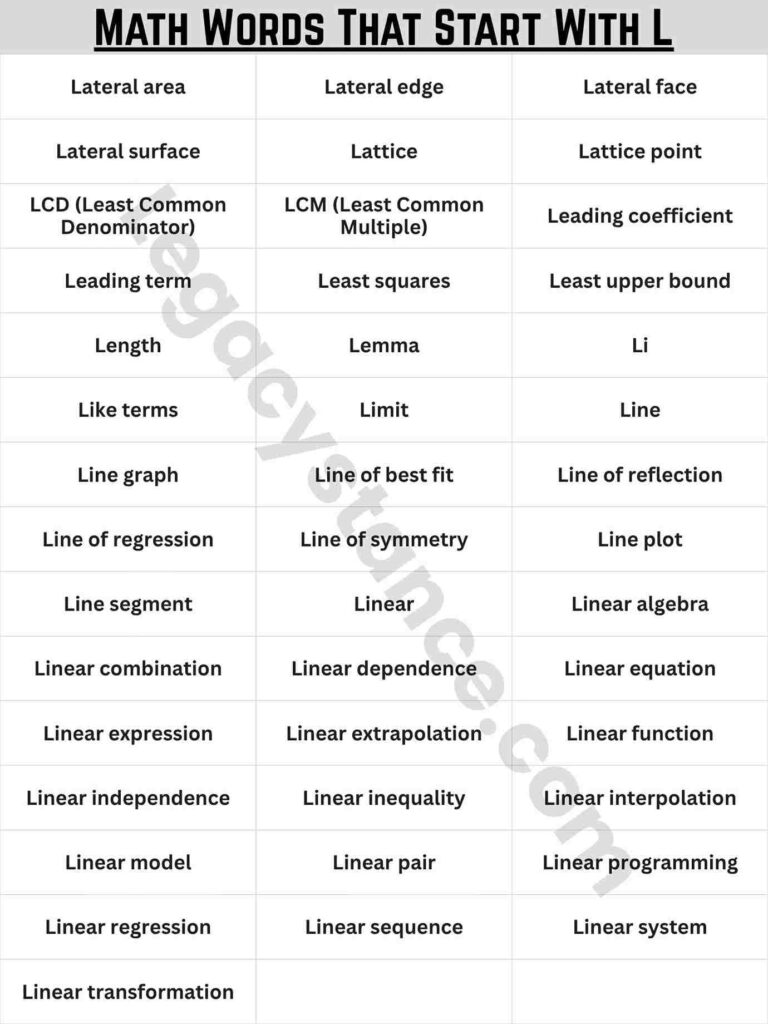
A–Le
- Lateral area
- Lateral edge
- Lateral face
- Lateral surface
- Lattice
- Lattice point
- LCD (Least Common Denominator)
- LCM (Least Common Multiple)
- Leading coefficient
- Leading term
- Least squares
- Least upper bound
- Length
- Lemma
Li
- Like terms
- Limit
- Line
- Line graph
- Line of best fit
- Line of reflection
- Line of regression
- Line of symmetry
- Line plot
- Line segment
- Linear
- Linear algebra
- Linear combination
- Linear dependence
- Linear equation
- Linear expression
- Linear extrapolation
- Linear function
- Linear independence
- Linear inequality
- Linear interpolation
- Linear model
- Linear pair
- Linear programming
- Linear regression
- Linear sequence
- Linear system
- Linear transformation
Lo
- Local maximum
- Local minimum
- Locus
- Logarithm
- Logarithmic equation
- Logarithmic function
- Logarithmic scale
- Long division
- Lower bound
- Lower extreme
- Lower limit
- Lower quartile (Q1)
- L’Hôpital’s Rule
Lu–Lz
- L-shaped figure
- Laplace transform
- Leibniz notation
- Linear congruence
- Linear recurrence
Common Math Words That Start With L
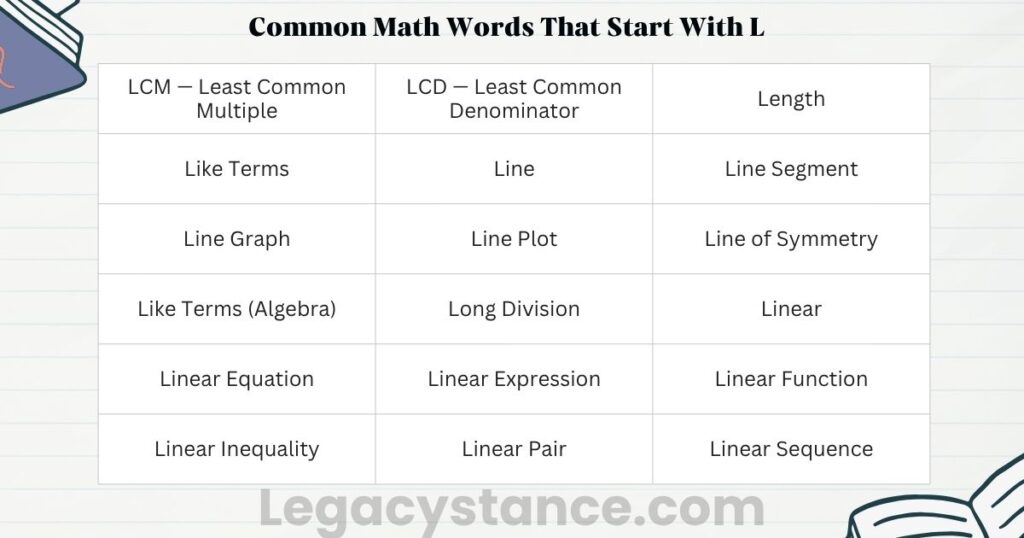
LCM — Least Common Multiple
Meaning: The smallest number that two or more numbers can divide into evenly.
Example: LCM of 4 and 6 is 12.
Why it matters: Used every time you add or subtract fractions with different denominators.
LCD — Least Common Denominator
Meaning: The LCM of two or more denominators. It gives fractions a shared base for addition and subtraction.
Example: LCD of 1/3 and 1/4 is 12.
Why it matters: Without it, fractions with different bottoms cannot be added directly.
Length
Meaning: The distance from one end of an object to the other along its longest side.
Example: A ruler is 30 centimeters in length.
Why it matters: Used in perimeter, area, volume, and distance problems at every level.
Like Terms
Meaning: Terms that share the same variable raised to the same power.
Example: In 3x + 5x + 7, the terms 3x and 5x are like terms → simplified to 8x + 7.
Why it matters: Combining like terms is the first step in simplifying any algebraic expression.
Line
Meaning: A straight path that extends in both directions forever, with no endpoints and no thickness.
Example: The x-axis on a coordinate grid is a line.
Why it matters: Lines are the base of all geometry, angles, and coordinate systems.
Line Segment
Meaning: A part of a line with two fixed endpoints and a measurable length.
Example: The side of a triangle is a line segment.
Why it matters: Every polygon is made of line segments. Used in perimeter and construction problems.
Line Graph
Meaning: A graph using connected points to show how data changes over time.
Example: A line graph tracking weekly rainfall shows wet and dry patterns clearly.
Why it matters: One of the most common graph types in school and real-world data reading.
Line Plot
Meaning: A simple graph where data values are shown as marks above a number line.
Example: Showing how many students scored 70, 80, or 90 on a test using X marks above each score.
Why it matters: Helps students visualize frequency of data quickly and simply.
Line of Symmetry
Meaning: A line that divides a shape into two identical mirror halves.
Example: A rectangle has 2 lines of symmetry. A circle has infinitely many.
Why it matters: Symmetry appears in geometry, art, and nature. It’s tested directly in many exams.
Like Terms (Algebra)
Already defined above. Note for advanced students: like terms also include matching radical expressions such as 2√3 and 5√3.
Long Division
Meaning: A written method of dividing large numbers step by step.
Example: 486 ÷ 6 = 81, worked out digit by digit using long division.
Why it matters: Builds number sense and is the foundation for dividing polynomials later in algebra.
Linear
Meaning: Relating to or resembling a straight line. In math, it means a relationship with a constant rate of change.
Example: A graph of y = 2x is linear — it forms a perfectly straight line.
Why it matters: The word “linear” appears in dozens of math terms. Understanding it unlocks a whole family of concepts.
Linear Equation
Meaning: An equation where the highest power of the variable is 1. Its graph is a straight line.
Example: 3x + 4 = 10 → x = 2.
Why it matters: The foundation of all algebra. Students solve these from middle school through college.
Linear Expression
Meaning: A math expression with variables to the first power only, no squares or higher.
Example: 5x − 3 and 2a + 4b are linear expressions.
Why it matters: Simplifying these prepares students to solve linear equations.
Linear Function
Meaning: A function in the form y = mx + b. It produces a straight-line graph.
Example: y = 4x + 2. Every time x increases by 1, y increases by 4.
Why it matters: Models constant rates of change — speed, cost, growth. One of the most applied math concepts.
Linear Inequality
Meaning: A statement comparing a linear expression to a value using <, >, ≤, or ≥.
Example: 2x + 1 > 7 → x > 3.
Why it matters: Used in real-life constraints, budgeting, and optimization problems.
Linear Pair
Meaning: Two adjacent angles formed on a straight line. They always add up to 180°.
Example: If one angle is 70°, its linear pair is 110°.
Why it matters: Used in geometry proofs and angle relationship problems.
Linear Sequence
Meaning: A number pattern where each term increases or decreases by the same fixed amount.
Example: 3, 7, 11, 15, 19 — each term adds 4.
Why it matters: Linear sequences introduce students to patterns, nth term formulas, and arithmetic progressions.
Line of Best Fit
Meaning: A straight line drawn through a scatter plot to represent the overall trend of the data.
Example: If taller students tend to score higher, the line of best fit slopes upward through those points.
Why it matters: Used to make predictions from data. A key concept in statistics and data science.
Line of Reflection
Meaning: The line that acts as a mirror during a geometric reflection. Each point flips to the opposite side, equal distance away.
Example: Reflecting a shape over the y-axis uses x = 0 as the line of reflection.
Why it matters: One of the four core geometric transformations tested in middle and high school.
Line of Regression
Meaning: A line (or curve) that best represents the relationship between two variables in a data set, calculated mathematically.
Example: A regression line for study hours vs. test scores estimates how much a student improves per hour studied.
Why it matters: Used in statistics, science, and economics to model and predict outcomes.
Lower Bound
Meaning: A value that is less than or equal to every element in a set.
Example: For the set {5, 8, 12}, both 4 and 5 are lower bounds. The greatest lower bound is 5.
Why it matters: Appears in calculus, analysis, and optimization — defines the minimum a quantity can reach.
Lower Extreme
Meaning: The smallest value in a data set. The left whisker tip in a box-and-whisker plot.
Example: In {3, 7, 9, 14, 20}, the lower extreme is 3.
Why it matters: One of the five key summary statistics alongside the upper extreme, quartiles, and median.
Lower Limit
Meaning: The smallest value in a class interval on a frequency table or histogram.
Example: In the group 40–50, the lower limit is 40.
Why it matters: Students need to identify lower limits when building frequency tables and reading histograms.
Lower Quartile (Q1)
Meaning: The median of the lower half of a data set. It sits at the 25th percentile.
Example: In {2, 4, 6, 8, 10, 12, 14}, Q1 = 4.
Why it matters: Used in box plots and the five-number summary. Shows where the bottom quarter of data sits.
Locus
Meaning: The complete set of all points satisfying a given condition.
Example: All points 4 units from a center point form a circle with radius 4. That circle is the locus.
Why it matters: Defines shapes by rules rather than appearance. Foundational in geometry proofs and conic sections.
Geometry Math Words That Start With L
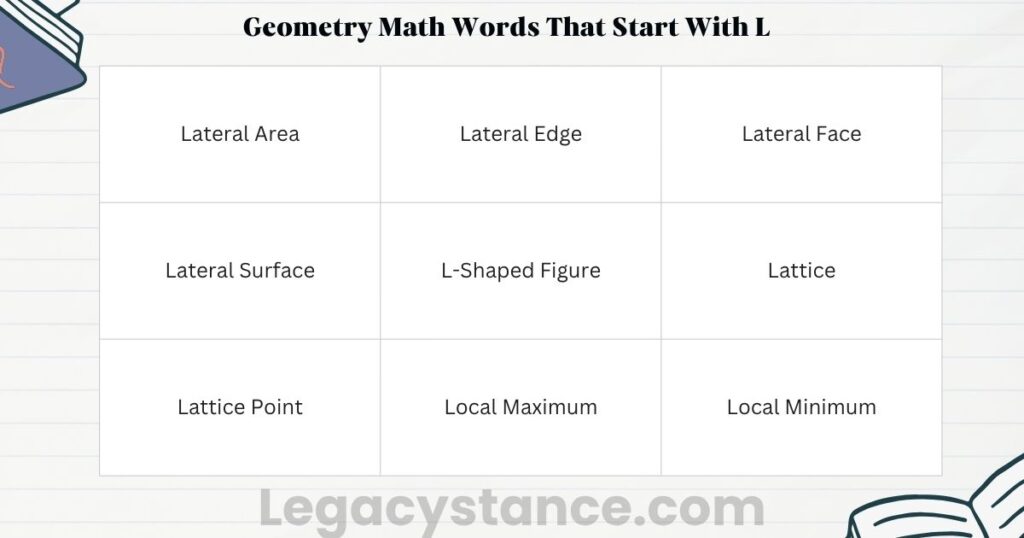
Lateral Area
Meaning: The surface area of only the sides of a 3D solid, excluding the base(s).
Example: The lateral area of a cylinder covers only the curved middle — not the top or bottom circles.
Why it matters: Used when calculating how much material wraps around a solid, like a food label on a can.
Lateral Edge
Meaning: An edge of a prism or pyramid that connects the bases or connects a base to the apex.
Example: In a triangular prism, the three edges connecting the two triangular bases are lateral edges.
Why it matters: Identifying lateral edges helps students correctly calculate lateral area and surface area.
Lateral Face
Meaning: A flat side of a prism or pyramid that is not a base.
Example: A square pyramid has four triangular lateral faces.
Why it matters: Students use lateral faces when unfolding 3D nets and solving surface area problems.
Lateral Surface
Meaning: The total curved or flat area running along the sides of a solid, connecting the bases.
Example: On a cone, the lateral surface is the slanted area from the base circle up to the tip.
Why it matters: Calculated separately from base area in surface area problems.
L-Shaped Figure
Meaning: A polygon shaped like the letter L, formed by two overlapping or joined rectangles.
Example: An L-shaped room is split into two rectangles to calculate its total floor area.
Why it matters: A real-life area problem type students see constantly in geometry.
Lattice
Meaning: A regular grid of evenly spaced points extending in all directions.
Example: Standard graph paper is a visual lattice.
Why it matters: Used in number theory, coordinate geometry, and Pick’s Theorem for area on grids.
Lattice Point
Meaning: A point on a coordinate grid where both x and y are integers.
Example: (3, −2) is a lattice point. (1.5, 4) is not.
Why it matters: Appears in grid geometry, counting problems, and number theory results.
Local Maximum
Meaning: A point on a graph where the function value is higher than all nearby points, but not necessarily the highest overall.
Example: A hill on a rolling landscape — it’s the highest point locally, but a taller mountain may exist elsewhere.
Why it matters: Calculus students find local maxima using derivatives to solve optimization problems.
Local Minimum
Meaning: A point where the function value is lower than all surrounding nearby points.
Example: The bottom of a valley on a curve — locally the lowest point.
Why it matters: Used alongside local maximum in analyzing function behavior and solving real-world minimum problems.
Statistics Math Words That Start With L
Least Squares
Meaning: A method that finds the best-fit line by minimizing the total of the squared distances from each data point to the line.
Example: When a calculator auto-fits a regression line, it uses least squares.
Why it matters: The standard method behind linear regression. Used in data science, economics, and research.
Linear Regression
Meaning: A statistical method that models the relationship between two variables with a straight-line equation.
Example: Predicting a student’s test score based on hours studied using the equation ŷ = mx + b.
Why it matters: One of the most used tools in data analysis, research, and forecasting.
Linear Model
Meaning: A mathematical model that assumes a straight-line relationship between variables.
Example: A shop owner uses a linear model to estimate costs: total cost = 5n + 20, where n is the number of items.
Why it matters: Linear models are the simplest and most common predictive tool in applied mathematics.
Linear Extrapolation
Meaning: Using a linear trend to predict values beyond the known data range.
Example: If sales grow by 50 units per month for six months, extrapolating predicts sales in month 10.
Why it matters: Useful for forecasting, but students must understand it becomes less reliable the farther beyond the data you go.
Linear Interpolation
Meaning: Estimating a value between two known data points using a straight-line assumption.
Example: If you know temperatures at 2 PM and 4 PM, you can interpolate to estimate the 3 PM temperature.
Why it matters: Used in science labs, engineering tables, and any time data is measured at intervals.
Advanced Mathematics Terms Starting With L
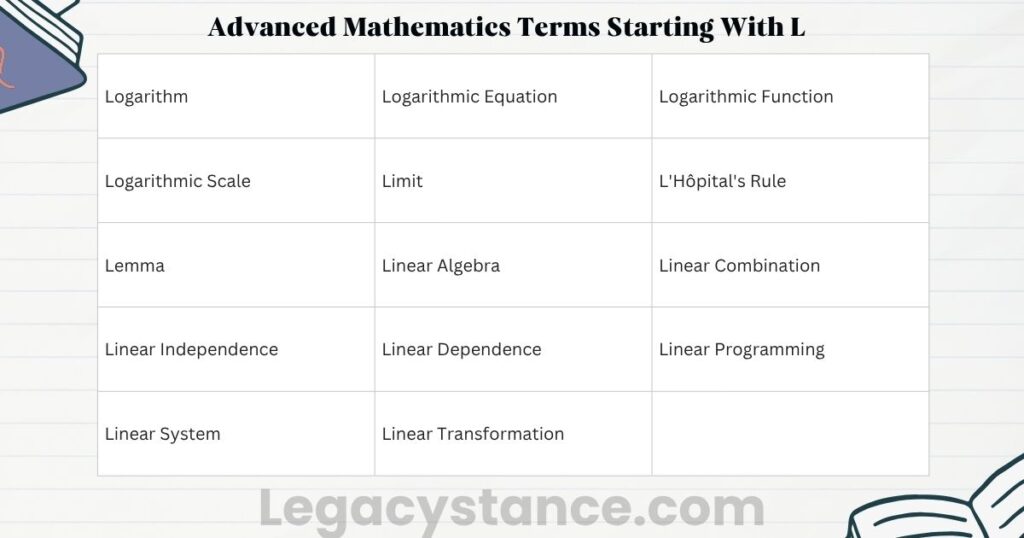
Logarithm
Meaning: The power to which a base must be raised to reach a given number. If bˣ = y, then log_b(y) = x.
Example: log₁₀(1000) = 3 because 10³ = 1000.
Why it matters: Reverses exponentiation. Used in science, computing, finance, and any field involving very large or very small numbers.
Logarithmic Equation
Meaning: An equation that contains a logarithm with the unknown variable.
Example: log₂(x) = 5 → x = 2⁵ = 32.
Why it matters: Solving these requires understanding both logarithm rules and exponential relationships.
Logarithmic Function
Meaning: A function of the form f(x) = log_b(x), the inverse of an exponential function.
Example: f(x) = log₁₀(x). When x = 100, f(x) = 2.
Why it matters: Models phenomena that grow quickly at first then slow down — sound levels, learning curves, population growth.
Logarithmic Scale
Meaning: A scale where each equal step represents multiplication by a fixed factor rather than addition.
Example: The Richter scale. A magnitude 7 earthquake is 10 times stronger than magnitude 6 — not just 1 unit stronger.
Why it matters: Makes it possible to display data spanning enormous ranges on one readable graph.
Limit
Meaning: The value a function or sequence approaches as the input gets arbitrarily close to a point.
Example: As x → 2, f(x) = x² approaches the limit of 4.
Why it matters: The entire foundation of calculus. Derivatives and integrals are both defined using limits.
L’Hôpital’s Rule
Meaning: A calculus rule for finding limits of fractions where both numerator and denominator approach 0 or ∞. Take the derivative of both parts and evaluate again.
Example: lim(x→0) [sin(x)/x] = lim(x→0) [cos(x)/1] = 1.
Why it matters: Resolves indeterminate forms like 0/0 or ∞/∞ that would otherwise be unsolvable directly.
Lemma
Meaning: A smaller proven result used as a stepping stone to prove a larger theorem.
Example: The Triangle Lemma helps prove properties used in larger geometric theorems.
Why it matters: In formal mathematics and proofs, lemmas do the supporting work. They appear in advanced courses and competitions.
Linear Algebra
Meaning: The branch of mathematics dealing with vectors, matrices, and systems of linear equations.
Why it matters: Powers computer graphics, AI, physics simulations, and economics. One of the most applied areas of modern mathematics.
Linear Combination
Meaning: An expression formed by multiplying each variable or vector by a scalar (constant) and summing the results.
Example: 3x + 2y is a linear combination of x and y.
Why it matters: Central to solving systems of equations and understanding vector spaces.
Linear Independence
Meaning: A set of vectors where no vector can be written as a combination of the others.
Example: The vectors (1, 0) and (0, 1) are linearly independent — neither is a scaled version of the other.
Why it matters: Determines the dimension of a vector space and whether a system of equations has a unique solution.
Linear Dependence
Meaning: A set of vectors where at least one can be expressed as a combination of the others.
Example: (2, 4) and (1, 2) are linearly dependent — one is exactly twice the other.
Why it matters: Dependent vectors mean a system has infinitely many solutions or no unique solution.
Linear Programming
Meaning: A method of finding the best outcome (maximum profit or minimum cost) given a set of linear constraints.
Example: A factory uses linear programming to decide how many of two products to make to maximize profit.
Why it matters: Widely used in business, logistics, and operations research.
Linear System
Meaning: A set of two or more linear equations with the same variables, solved simultaneously.
Example: x + y = 5 and x − y = 1 → x = 3, y = 2.
Why it matters: Linear systems model real-world situations with multiple unknown quantities.
Linear Transformation
Meaning: A function between vector spaces that preserves addition and scalar multiplication.
Example: Rotating a shape on a coordinate grid by 90° is a linear transformation.
Why it matters: The core concept in linear algebra. Used in computer graphics, data science, and quantum physics.
Least Upper Bound
Meaning: The smallest value that is greater than or equal to every element in a set. Also called the supremum.
Example: For the set {1, 1.5, 1.9, 1.99…}, the least upper bound is 2, even if 2 is not in the set.
Why it matters: A foundational concept in real analysis and calculus. It defines completeness of the real number system.
Laplace Transform
Meaning: A technique that converts a function of time into a function of a complex variable, turning differential equations into algebraic ones.
Why it matters: Used in engineering, control systems, and physics to solve problems that calculus alone cannot handle easily.
Leibniz Notation
Meaning: The notation for calculus developed by Gottfried Leibniz — dy/dx for derivatives and ∫ for integrals.
Example: dy/dx means “the derivative of y with respect to x.”
Why it matters: The standard notation in most calculus courses worldwide. Essential for reading and writing calculus.
Linear Congruence
Meaning: An equation of the form ax ≡ b (mod n), asking which integers x satisfy the relationship.
Example: 3x ≡ 6 (mod 9) has solutions x ≡ 2 (mod 3).
Why it matters: Found in number theory, cryptography, and modular arithmetic.
Linear Recurrence
Meaning: A sequence where each term is defined as a linear combination of previous terms.
Example: The Fibonacci sequence: each term = sum of the two before it. That is a linear recurrence.
Why it matters: Appears in discrete mathematics, computer algorithms, and financial modeling.
Where These Math Words Are Used in Real Life
Architecture and Construction
- Length, lateral area, lateral surface → calculating materials for walls, roofs, and pipes
Finance and Business
- Linear programming → maximizing profit within budget constraints
- Linear model, linear regression → forecasting sales and expenses
Science and Engineering
- Logarithmic scale → measuring earthquakes, sound intensity, pH
- Laplace transform → solving circuit and mechanical system equations
- Limit, L’Hôpital’s Rule → calculating instantaneous rates in physics
Technology and Computing
- Linear algebra, linear transformation → powering AI, graphics engines, and machine learning
- Linear congruence, lattice → used in cryptography and cybersecurity
Everyday Problem Solving
- LCM, LCD → adding fractions, scheduling recurring events
- Long division → understanding how division works at its core
- Line of best fit → reading charts, understanding trends
Tips for Remembering Math Words That Start With L
- Group by theme. Learn “line,” “line segment,” “linear,” and “line of symmetry” together — they all share the same root idea.
- Use the word in a sentence. Writing “the lower quartile of my data is 12” is more memorable than rereading the definition.
- Draw it. Line of symmetry, locus, linear pair, and lattice all make more sense when sketched.
- Connect inverses. Logarithm and exponent are inverses. Learn them side by side.
- Separate the statistics L words. Lower bound, lower limit, lower extreme, and lower quartile all relate to the bottom of a data set but measure different things. Create a small comparison chart.
Commonly Confused L Math Words
Line vs. Line Segment vs. Ray
A line has no endpoints. A segment has two. A ray has one endpoint and extends forever in one direction.
LCM vs. LCD
LCM is for whole numbers. LCD applies that same idea specifically to denominators in fractions.
Linear Function vs. Linear Equation
A linear equation is solved for a specific value. A linear function describes a rule over all inputs.
Logarithm vs. Exponent
These are inverses. 2⁴ = 16 is an exponent statement. log₂(16) = 4 is the logarithm form of the same fact.
Lower Quartile vs. Lower Extreme
Lower extreme = the smallest single value. Lower quartile = the midpoint of the lower half of the data.
Lateral Area vs. Total Surface Area
Lateral area covers only the sides. Total surface area includes the bases as well.
Local Maximum vs. Absolute Maximum
A local maximum is the highest nearby point. The absolute maximum is the highest point across the entire function.
Linear Independence vs. Linear Dependence
Independent vectors give unique directions — none is a combination of the others. Dependent vectors overlap or repeat information.
Limit vs. Value
A limit is what a function approaches near a point. The value is what the function actually equals at that point. They are sometimes different.
Read also:
108+ Math Words That Start With N
90+ Math Words That Start With M
FAQs about Math Words That Start With L
Which Math Words That Start With L are most important for beginners?
Students should start with words they see often in class, such as length, line, line segment, LCM, LCD, like terms, and linear equation. These terms appear regularly in elementary and middle school math lessons.
How can I remember difficult math terms more easily?
Try using each word in a sentence, drawing diagrams, creating flashcards, or grouping related words together. For example, learning line, line graph, line segment, and line of symmetry as a group helps build stronger connections.
Are advanced terms like logarithm and limit useful outside school?
Yes. Logarithms are used in science, engineering, computing, and finance. Limits are essential in calculus and help describe changing quantities in fields such as physics, economics, and technology.
What’s the easiest way to tell similar math words apart?
Focus on their purpose. For example, LCM finds the smallest common multiple of numbers, while LCD applies that idea specifically to fraction denominators. Comparing similar terms side by side often makes the differences clearer.
Conclusion
This guide covers 100+ genuine math words starting with L — from basic terms like length, line, and LCM to advanced concepts like limit, logarithm, linear transformation, and Laplace transform. The words range across arithmetic, geometry, algebra, statistics, calculus, and higher mathematics. Every term here is real, relevant, and used in actual math classrooms and careers. Building this vocabulary makes every math topic clearer, and that clarity is what turns confusion into confidence.