Learning math becomes much easier when you understand the vocabulary behind each concept. This guide to Math Words That Start With P brings together important terms from arithmetic, geometry, algebra, statistics, calculus, and number theory in one place.
Each word includes a simple meaning and practical context, making it easier for students, parents, and teachers to build confidence, improve understanding, and connect mathematical ideas to real-world situations.
Quick List: All Math Words That Start With P
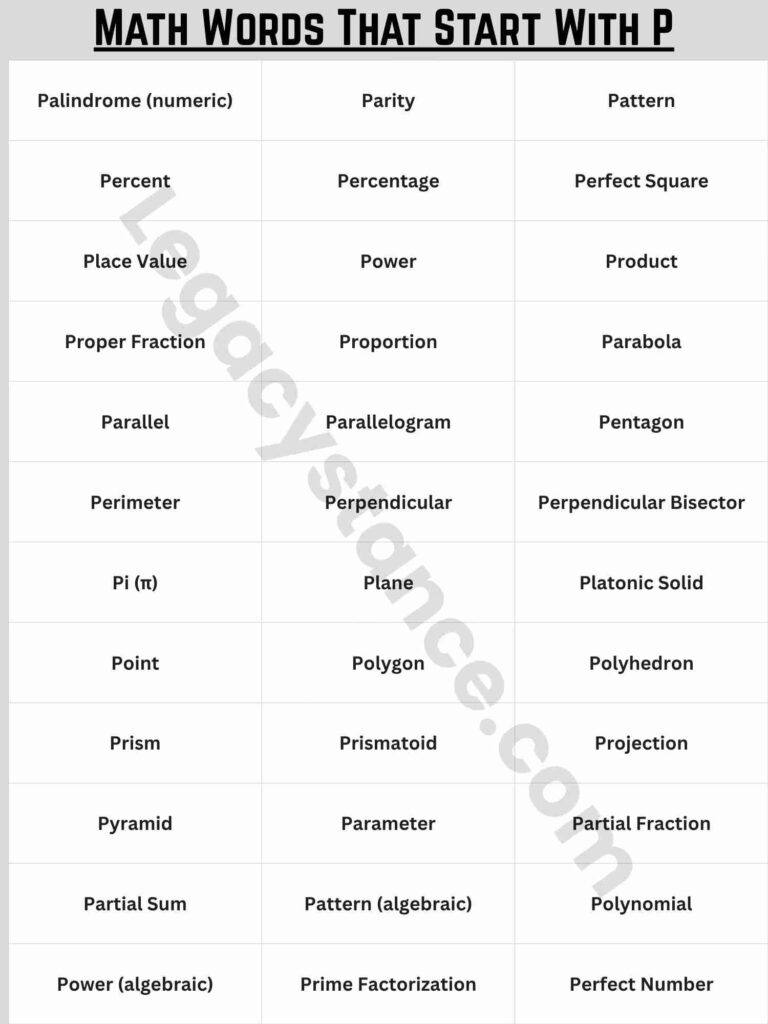
Foundation and arithmetic:
- Palindrome (numeric)
- Parity
- Pattern
- Percent
- Percentage
- Perfect Square
- Place Value
- Power
- Product
- Proper Fraction
- Proportion
Geometry:
- Parabola
- Parallel
- Parallelogram
- Pentagon
- Perimeter
- Perpendicular
- Perpendicular Bisector
- Pi (π)
- Plane
- Platonic Solid
- Point
- Polygon
- Polyhedron
- Prism
- Prismatoid
- Projection
- Pyramid
Algebra:
- Parameter
- Partial Fraction
- Partial Sum
- Pattern (algebraic)
- Polynomial
- Power (algebraic)
- Prime Factorization
Number Theory:
- Perfect Number
- Prime Number
- Prime Gap
- Pseudoprime
- Pythagorean Triple
Statistics and Data:
- P-value
- Percentile
- Percentile Rank
- Pie Chart
- Platykurtic
- Population
- Population Mean
- Population Variance
- Probability
- Probability Distribution
- Probability Tree
Combinatorics:
- Pascal’s Triangle
- Permutation
- Pigeonhole Principle
Calculus and Analysis:
- Parametric Equation
- Partial Derivative
- Polar Coordinates
- Power Series
- Product Rule
Logic and Proof:
- Proof
- Proof by Contradiction
- Proof by Induction
Advanced and Specialized:
- Parallelepiped
- Penrose Tiling
- Planar Graph
- Polar Form (complex numbers)
- Polynomial Regression
- Prismatoid
- Projective Geometry
Common Math Words That Start With P
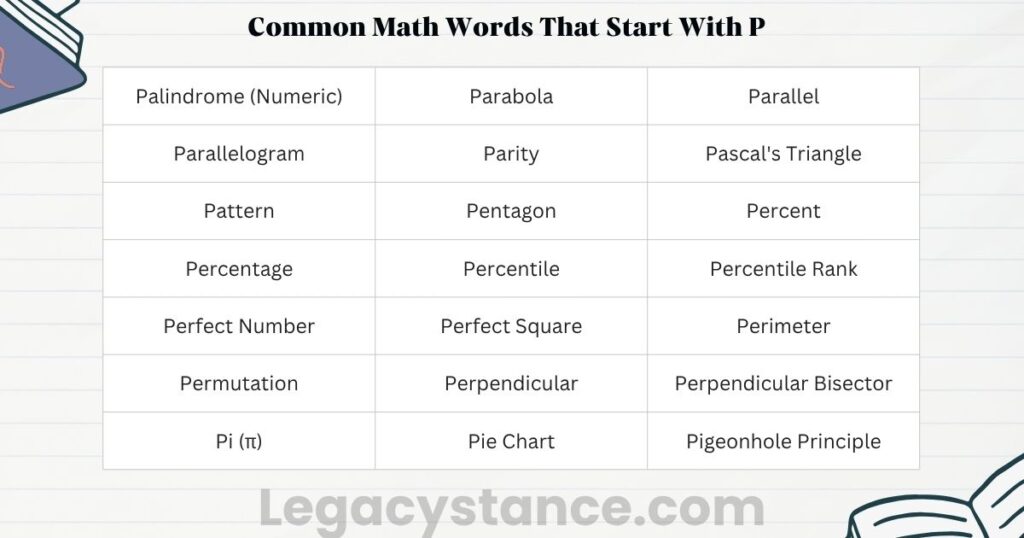
Palindrome (Numeric)
Meaning: A number that reads the same forward and backward.
Example: 121, 1331, and 90909 are numeric palindromes.
Why it matters: Palindromes appear in number theory puzzles, patterns, and recreational mathematics.
Parabola
Meaning: A U-shaped curve produced by a quadratic function. Every parabola has a vertex (its turning point) and an axis of symmetry.
Example: The graph of y = x² is the simplest parabola — it opens upward, with its vertex at the origin.
Why it matters: Parabolas describe real-world motion. A thrown ball, a water fountain arc, and a satellite dish all follow parabolic shapes.
Parallel
Meaning: Two or more lines, segments, or planes that never intersect and remain the same distance apart indefinitely.
Example: The two rails of a train track are parallel.
Why it matters: Parallel lines are central to geometry proofs, coordinate systems, and understanding angle relationships formed by transversals.
Parallelogram
Meaning: A four-sided flat shape with two pairs of parallel, equal-length opposite sides.
Example: A tilted rectangle where opposite sides stay equal is a parallelogram. Rectangles, rhombuses, and squares are all special parallelograms.
Why it matters: The area formula (base × height) and the properties of its angles are foundational geometry skills.
Parity
Meaning: Whether a number is even or odd. Even numbers have even parity; odd numbers have odd parity.
Example: 14 has even parity. 19 has odd parity.
Why it matters: Parity is used in number theory, computer error-checking, and determining divisibility quickly.
Pascal’s Triangle
Meaning: A triangular number arrangement where each entry is the sum of the two entries directly above it. Row 0 starts with just 1.
Example: The first five rows: 1 / 1 1 / 1 2 1 / 1 3 3 1 / 1 4 6 4 1
Why it matters: Pascal’s Triangle generates binomial coefficients, reveals patterns in powers of 2, connects to Fibonacci numbers, and appears in probability calculations.
Pattern
Meaning: A sequence of numbers, shapes, or values that follow a predictable rule.
Example: 2, 4, 8, 16, 32 is a pattern where each term doubles.
Why it matters: Identifying patterns is the basis of algebra. Students use pattern recognition to write expressions, predict terms, and understand sequences.
Pentagon
Meaning: A polygon with exactly five sides and five angles.
Example: A regular pentagon has all equal sides and all interior angles equal to 108°.
Why it matters: Pentagons appear in geometry studies of polygons, tessellations, and even in biology (flowers, starfish).
Percent
Meaning: A ratio out of 100. The word itself comes from Latin meaning “per hundred.”
Example: 72% means 72 out of every 100, which equals 0.72 as a decimal.
Why it matters: Percentages appear in every area of applied math — discounts, interest rates, tax, test scores, and statistics.
Percentage
Meaning: The actual value calculated when a percent is applied to a number.
Example: 20% of 150 = 30. The percentage here is 30.
Why it matters: Students often confuse “percent” (the rate) with “percentage” (the resulting value). Knowing both is essential for solving real-world problems.
Percentile
Meaning: The value below which a given percentage of data in a distribution falls.
Example: If you score at the 88th percentile, 88% of test-takers scored below you.
Why it matters: Percentiles are the standard way to compare individual measurements against a full population — used in standardized tests, growth charts, and salary data.
Percentile Rank
Meaning: The percentage of values in a data set that fall at or below a specific value.
Example: A student whose score is higher than 60 out of 100 students has a percentile rank of 60.
Why it matters: Percentile rank and percentile are related but distinct — one is a position, the other is the value at that position.
Perfect Number
Meaning: A positive integer that equals the sum of all its divisors excluding itself.
Example: 6 = 1 + 2 + 3. The next perfect number is 28 = 1 + 2 + 4 + 7 + 14.
Why it matters: Perfect numbers are extremely rare. Only 51 are known. They have been studied since ancient Greece and remain an active area of number theory research.
Perfect Square
Meaning: An integer that is the product of another integer multiplied by itself.
Example: 49 is a perfect square because 7 × 7 = 49. Others include 1, 4, 9, 16, 25, 36, 64, 81, 100.
Why it matters: Recognizing perfect squares speeds up simplifying square roots, solving quadratics, and factoring expressions.
Perimeter
Meaning: The total length of the boundary around a 2D shape.
Example: A rectangle with sides 6 and 4 has perimeter = 2(6 + 4) = 20 units.
Why it matters: Perimeter is used in construction, landscaping, framing, and nearly every practical measurement problem.
Permutation
Meaning: An ordered arrangement of items from a set. Order matters — different sequences count as different permutations.
Example: Arranging 3 students out of 5 for ranked positions: P(5,3) = 5 × 4 × 3 = 60 arrangements.
Why it matters: Permutations are used in probability, scheduling, cryptography, and counting problems where sequence is significant.
Perpendicular
Meaning: Two lines or segments that meet at exactly 90 degrees.
Example: The corner of a square is formed by two perpendicular sides.
Why it matters: Perpendicular relationships appear in the Pythagorean Theorem, coordinate geometry, vector math, and structural engineering.
Perpendicular Bisector
Meaning: A line that crosses a segment at its midpoint at a 90-degree angle.
Example: The perpendicular bisector of a segment from (0,0) to (6,0) passes through (3,0) vertically.
Why it matters: In triangles, the three perpendicular bisectors meet at the circumcenter, which is equidistant from all three vertices.
Pi (π)
Meaning: The ratio of a circle’s circumference to its diameter — approximately 3.14159. It is irrational, meaning its decimal never ends or repeats.
Example: Circumference of a circle with diameter 10 = π × 10 ≈ 31.42 units.
Why it matters: Pi appears in circle and sphere formulas, wave equations, probability theory, and Euler’s identity. It is arguably the most famous constant in mathematics.
Pie Chart
Meaning: A circular graph divided into slices, where each slice represents a proportion of the total.
Example: If 25% of a class prefers science, that interest gets a slice covering one-quarter of the circle.
Why it matters: Pie charts are one of the most widely used tools for displaying categorical data visually.
Pigeonhole Principle
Meaning: If more items are placed into fewer containers than there are items, at least one container must hold more than one item.
Example: If 13 socks are placed into 12 drawers, at least one drawer holds 2 socks.
Why it matters: The Pigeonhole Principle is used in combinatorics and proofs to show that certain outcomes are mathematically inevitable.
Place Value
Meaning: The value that a digit holds based on its position within a number.
Example: In 3,472 — the 3 represents 3,000; the 4 represents 400; the 7 represents 70; the 2 represents 2.
Why it matters: Place value is the foundation of our entire number system. Without it, addition, subtraction, multiplication, and division cannot work correctly.
Planar Graph
Meaning: A graph that can be drawn on a flat plane with no edges crossing each other.
Example: A triangle with three vertices and three edges is a planar graph.
Why it matters: Planar graphs are used in circuit design, map coloring, and network routing.
Plane
Meaning: A flat two-dimensional surface that extends infinitely in all directions, with no thickness.
Example: A flat floor, extended infinitely, represents a mathematical plane.
Why it matters: Most geometry students study happens on a plane. The coordinate plane is the setting for graphing equations and shapes.
Platonic Solid
Meaning: A convex 3D solid where every face is the same regular polygon and the same number of faces meet at each vertex. Exactly five exist: tetrahedron, cube, octahedron, dodecahedron, icosahedron.
Example: A standard 6-sided die is a cube — one of the five Platonic Solids.
Why it matters: Platonic Solids appear in molecular chemistry, crystallography, architecture, and game design.
Platykurtic
Meaning: A statistical distribution with a flatter, wider peak and thinner tails compared to a normal distribution. It has negative excess kurtosis.
Example: A uniform distribution where all outcomes are equally likely is platykurtic.
Why it matters: Kurtosis measures the “tailedness” of a distribution. Platykurtic distributions produce fewer extreme outliers than a normal curve.
Point
Meaning: An exact location in space with no size, length, or dimension. Represented by a dot and labeled with a capital letter.
Example: Point A at coordinates (4, 7) on a coordinate grid.
Why it matters: Every geometric figure starts with points. Lines, segments, rays, and shapes are all built from collections of points.
Polar Coordinates
Meaning: A system for locating a point using its distance from the origin (r) and its angle from the positive x-axis (θ), instead of x and y values.
Example: The polar point (r=5, θ=90°) corresponds to Cartesian coordinates (0, 5).
Why it matters: Polar coordinates simplify equations for spirals, circles, and waves. They’re essential in radar systems, navigation, and physics.
Polar Form (Complex Numbers)
Meaning: A way of expressing a complex number using its magnitude and angle rather than its real and imaginary parts: r(cos θ + i sin θ), or r·e^(iθ).
Example: The complex number 3 + 3i in polar form is 3√2 · (cos 45° + i sin 45°).
Why it matters: Polar form makes multiplication and division of complex numbers far easier than rectangular form.
Polygon
Meaning: A closed, flat shape with three or more straight sides.
Example: Triangles (3 sides), quadrilaterals (4 sides), pentagons (5 sides), and hexagons (6 sides) are all polygons. A circle is not a polygon.
Why it matters: Polygons are the central objects of plane geometry. Students classify them, find their perimeters, calculate their areas, and sum their interior angles.
Polyhedron
Meaning: A three-dimensional solid with flat polygonal faces, straight edges, and vertices.
Example: A cube has 6 square faces, 12 edges, and 8 vertices. Euler’s formula (F + V − E = 2) applies to all convex polyhedra.
Why it matters: Students calculate surface area and volume of polyhedra. Euler’s formula itself is a beautiful result connecting three basic properties of any solid.
Polynomial
Meaning: An algebraic expression made of variables and coefficients using addition, subtraction, and multiplication — with whole-number exponents only.
Example: 4x³ − 2x² + 7x − 1 is a polynomial with four terms (a polynomial of degree 3).
Why it matters: Polynomials are central to algebra. Students add, subtract, multiply, factor, and graph them across years of coursework.
Polynomial Regression
Meaning: A statistical method that models a curved relationship between a variable and an outcome using a polynomial equation rather than a straight line.
Example: Fitting a parabola to data that curves upward then downward requires polynomial regression, not linear regression.
Why it matters: When real-world data follows a curve, linear regression fails. Polynomial regression handles complex patterns in science and economics.
Population
Meaning: The complete set of individuals or items being studied in a statistical analysis.
Example: All adults in a country would be the population for a national health study.
Why it matters: Distinguishing population from sample is the foundation of statistics. It determines how data is collected, analyzed, and generalized.
Population Mean (μ)
Meaning: The true arithmetic average of a measurable trait across an entire population, denoted by the Greek letter mu (μ).
Example: The average height of every student in a school district — not just one class — is a population mean.
Why it matters: Population mean is a fixed parameter. In practice it’s usually estimated using sample data, because measuring every member of a large population is rarely possible.
Population Variance (σ²)
Meaning: The average of the squared distances between each data point and the population mean. It measures how spread out data is across the full population.
Example: If most students score very close to the mean on a test, variance will be small. If scores are scattered widely, variance will be large.
Why it matters: Variance is used to calculate standard deviation and is fundamental to statistical inference.
Power
Meaning: The result of multiplying a number by itself a given number of times. The number being multiplied is the base; how many times is the exponent.
Example: 3⁵ = 3 × 3 × 3 × 3 × 3 = 243. The base is 3, the power is 5.
Why it matters: Powers underpin scientific notation, compound interest, exponential growth, and most of advanced mathematics.
Power Series
Meaning: An infinite series where each term contains a variable raised to increasing whole-number powers, multiplied by coefficients: Σ aₙ(x − c)ⁿ.
Example: The power series for eˣ is 1 + x + x²/2! + x³/3! + x⁴/4! + …
Why it matters: Power series allow mathematicians to represent complex functions as sums of simpler polynomial terms. They’re essential in calculus, physics, and engineering approximations.
Prime Factorization
Meaning: Breaking a number into a product of its prime factors.
Example: 60 = 2 × 2 × 3 × 5 = 2² × 3 × 5
Why it matters: Prime factorization is the method used to find the GCF and LCM of numbers, and it underpins most of number theory.
Prime Gap
Meaning: The difference between two consecutive prime numbers.
Example: Between 23 and 29, the prime gap is 6.
Why it matters: Prime gaps grow larger as numbers increase. Understanding how and why they grow is an active research area connecting number theory to cryptography.
Prime Number
Meaning: A whole number greater than 1 with exactly two factors — 1 and itself.
Example: 2, 3, 5, 7, 11, 13, 17, 19, 23 are the first nine primes. 2 is the only even prime.
Why it matters: Primes are the building blocks of all whole numbers. Every integer greater than 1 is either prime or a product of primes. They are also the foundation of modern internet encryption.
Prism
Meaning: A 3D solid with two identical, parallel polygonal bases joined by rectangular lateral faces.
Example: A triangular prism has two triangular bases and three rectangular sides. A Toblerone box approximates this shape.
Why it matters: Prism volume = base area × height. Surface area requires summing all faces. These formulas appear consistently in geometry courses.
Prismatoid
Meaning: A polyhedron where all vertices lie in one of two parallel planes. It generalizes prisms, pyramids, and wedges.
Example: A wedge shape where one base is a rectangle and the other is an edge (a line segment) is a prismatoid.
Why it matters: The prismatoid volume formula — V = (h/6)(A₁ + 4Aₘ + A₂) — gives exact volumes for many complex solids that are otherwise difficult to calculate.
Probability
Meaning: A number between 0 and 1 expressing how likely an event is to occur. 0 = impossible. 1 = certain.
Example: Drawing a red card from a standard deck has probability 26/52 = 0.5.
Why it matters: Probability underpins statistics, science experiments, insurance pricing, game theory, and machine learning. It is the mathematics of uncertainty.
Probability Distribution
Meaning: A function or table showing all possible outcomes of a random variable and the probability associated with each outcome.
Example: Rolling a standard die: each face (1–6) has probability 1/6. This uniform distribution describes every possible outcome.
Why it matters: Probability distributions are the foundation of statistics. The normal distribution, binomial distribution, and Poisson distribution all describe how different types of outcomes spread across a population.
Probability Tree
Meaning: A branching diagram showing all possible outcomes of sequential events and their combined probabilities along each path.
Example: Flipping a coin twice: the tree branches into H and T, then each branches again — showing HH, HT, TH, TT each with probability 1/4.
Why it matters: Probability trees make complex multi-step probability problems visual and systematic, especially when events are not equally likely.
Product
Meaning: The result of multiplying two or more numbers or expressions.
Example: The product of 9 and 7 is 63.
Why it matters: “Product” is one of the most frequently used math vocabulary words in word problems. Students must recognize it as a signal to multiply.
Product Rule
Meaning: A calculus rule for differentiating two functions multiplied together: d/dx[f(x)g(x)] = f'(x)g(x) + f(x)g'(x).
Example: Derivative of x² · sin(x) = 2x · sin(x) + x² · cos(x)
Why it matters: The product rule is one of the core differentiation techniques students use throughout calculus.
Projection
Meaning: The shadow or image of one figure cast onto another surface or axis, typically along perpendicular lines.
Example: Projecting vector a onto vector b gives the component of a in the direction of b.
Why it matters: Projection is used in linear algebra, computer graphics, engineering, and physics — anywhere that 3D objects are represented in 2D.
Proof
Meaning: A logical argument that establishes the truth of a mathematical statement using accepted axioms, definitions, and previously proven theorems.
Example: Proving that the sum of angles in any triangle equals 180° using parallel lines and a transversal.
Why it matters: Proof is the mechanism by which mathematics advances. It transforms reasonable guesses into permanent truths.
Proof by Contradiction
Meaning: A logical method that assumes the opposite of what you want to prove, then shows that this assumption leads to an impossibility.
Example: To prove √2 is irrational: assume it is rational (p/q in lowest terms), then derive a contradiction showing p and q must both be even — impossible if the fraction is in lowest terms.
Why it matters: Proof by contradiction is a powerful technique used throughout mathematics, especially in number theory and analysis.
Proof by Induction
Meaning: A two-step method for proving a statement about all natural numbers. First prove it for n = 1 (base case). Then prove that if it holds for n = k, it must hold for n = k + 1 (inductive step).
Example: Proving that 1 + 2 + 3 + … + n = n(n+1)/2 for all positive integers n.
Why it matters: Mathematical induction is the standard tool for proving statements that apply to infinitely many cases.
Proper Fraction
Meaning: A fraction where the numerator is smaller than the denominator, giving a value less than 1.
Example: 3/8 and 5/11 are proper fractions. 9/4 is not — that is an improper fraction.
Why it matters: Understanding proper vs. improper fractions is foundational for fraction arithmetic and converting between fractions and mixed numbers.
Proportion
Meaning: An equation stating that two ratios are equal.
Example: 3/9 = 5/15 is a proportion. Cross-multiplying confirms it: 3 × 15 = 9 × 5 = 45.
Why it matters: Proportions are used in scaling drawings, solving unit conversions, adjusting recipes, comparing prices, and interpreting maps.
Pseudoprime
Meaning: A composite (non-prime) number that passes a specific mathematical primality test and behaves like a prime in that test context.
Example: 341 passes Fermat’s primality test for base 2, yet 341 = 11 × 31 is composite.
Why it matters: Pseudoprimes expose the limitations of certain primality tests and have implications for cryptographic security.
P-value
Meaning: The probability of obtaining a result at least as extreme as the one observed, assuming the null hypothesis is true. A smaller p-value indicates stronger evidence against the null hypothesis.
Example: A drug trial yields a p-value of 0.03 — meaning there’s only a 3% chance of seeing these results if the drug actually had no effect.
Why it matters: P-values are the standard measure of statistical significance in scientific research, clinical trials, and social science studies.
Pyramid
Meaning: A 3D solid with a polygonal base and triangular faces that rise to meet at a single point called the apex.
Example: A square pyramid has a square base and four triangular faces. Volume = (1/3) × base area × height.
Why it matters: Pyramid calculations are standard in geometry courses and architectural math. The (1/3) factor surprises students — it’s worth understanding why it appears.
Pythagorean Theorem
Meaning: In any right triangle, the square of the hypotenuse equals the sum of the squares of the other two sides: a² + b² = c².
Example: A right triangle with legs 5 and 12 has hypotenuse √(25 + 144) = √169 = 13.
Why it matters: The Pythagorean Theorem is one of the most used formulas in all of mathematics — it appears in geometry, coordinate distance, physics, construction, and navigation.
Pythagorean Triple
Meaning: A set of three positive integers (a, b, c) satisfying a² + b² = c², forming the sides of a right triangle with whole-number dimensions.
Example: (3, 4, 5), (5, 12, 13), (8, 15, 17), (7, 24, 25) are all Pythagorean Triples.
Why it matters: Pythagorean Triples give exact right triangles — no decimals, no rounding. They’re invaluable in geometry problems and construction planning.
Advanced and Specialized Math Words That Start With P
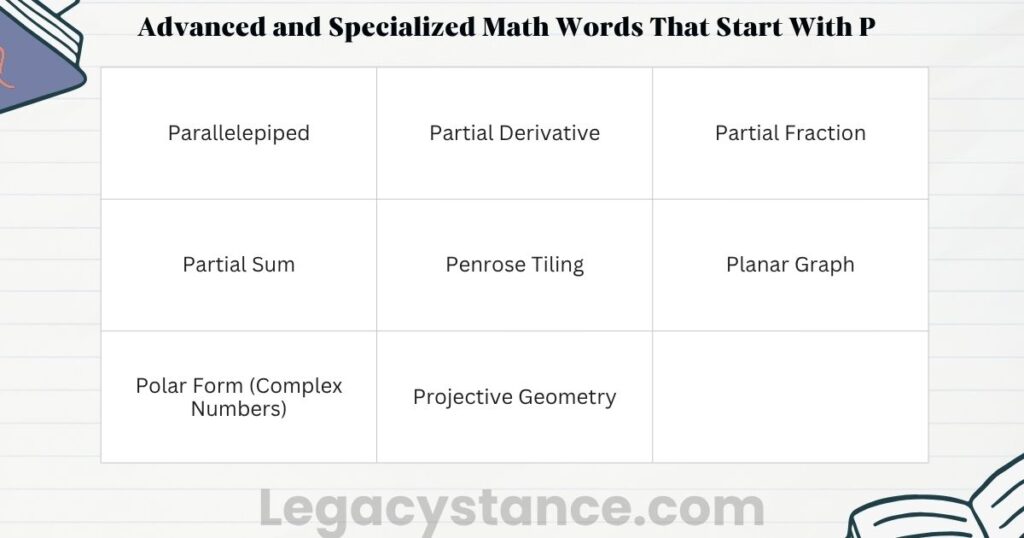
Parallelepiped
Meaning: A 3D figure where all six faces are parallelograms. Think of it as a skewed rectangular box.
Example: A box where the top face is shifted sideways from the bottom, so no two faces are rectangles.
Math branch: 3D Geometry
Partial Derivative
Meaning: The derivative of a multi-variable function with respect to one variable, while all other variables are treated as constants.
Example: For f(x, y) = 3x²y, the partial derivative with respect to x is 6xy.
Math branch: Multivariable Calculus
Partial Fraction
Meaning: A technique for decomposing a complex rational expression into simpler fractions with lower-degree denominators.
Example: (7x + 1)/[(x + 1)(x + 3)] can be written as A/(x + 1) + B/(x + 3) and solved for A and B.
Math branch: Algebra / Calculus
Partial Sum
Meaning: The sum of the first n terms of a sequence or series, rather than the full infinite sum.
Example: The partial sum of the first 4 terms of 1 + 1/2 + 1/4 + 1/8 = 15/8.
Math branch: Series / Calculus
Penrose Tiling
Meaning: A non-repeating (aperiodic) pattern that covers a plane using two or more tile shapes, never forming a periodic repeat unit.
Example: Roger Penrose discovered tilings using two rhombus shapes that cover an infinite plane without any pattern repeating.
Math branch: Geometry / Topology
Planar Graph
Meaning: A graph that can be drawn in a plane with no two edges crossing.
Example: The map of any city where roads don’t overlap (ignoring overpasses) is approximately a planar graph.
Math branch: Graph Theory
Polar Form (Complex Numbers)
Meaning: Expressing a complex number using its magnitude r and angle θ: r(cos θ + i sin θ). Also written as re^(iθ).
Math branch: Complex Analysis
Projective Geometry
Meaning: A branch of geometry studying properties that remain unchanged under projective transformations — including perspective — where parallel lines may meet at a “point at infinity.”
Math branch: Advanced Geometry
Subject-Specific Category Summary
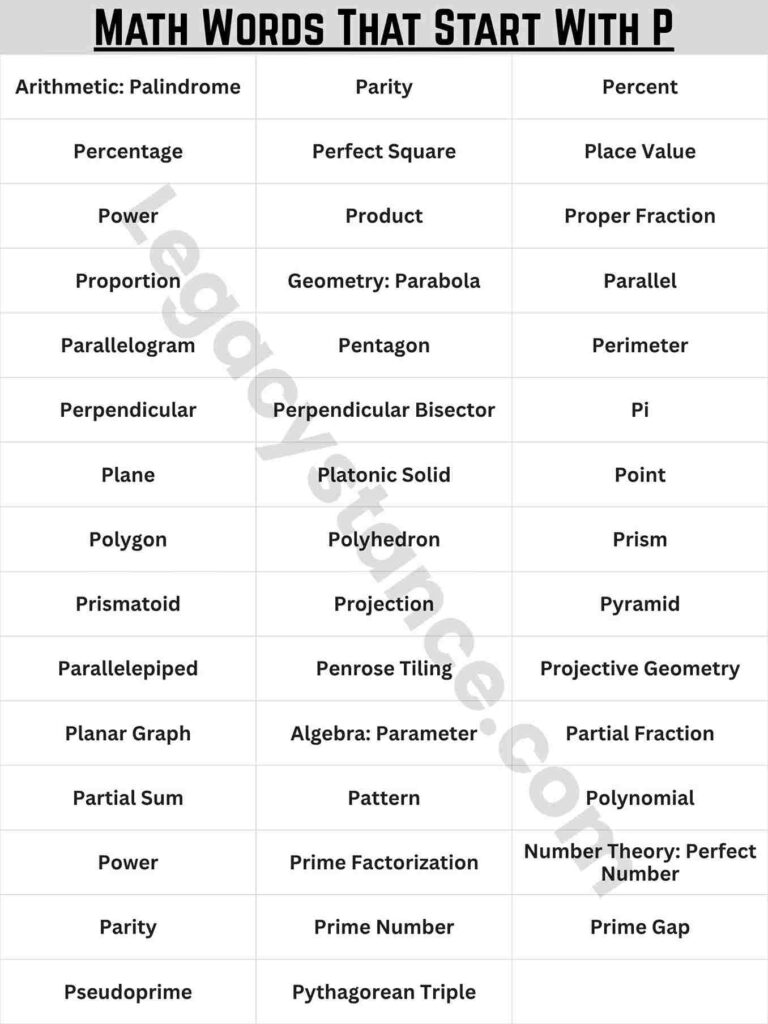
Arithmetic: Palindrome, Parity, Percent, Percentage, Perfect Square, Place Value, Power, Product, Proper Fraction, Proportion
Geometry: Parabola, Parallel, Parallelogram, Pentagon, Perimeter, Perpendicular, Perpendicular Bisector, Pi, Plane, Platonic Solid, Point, Polygon, Polyhedron, Prism, Prismatoid, Projection, Pyramid, Parallelepiped, Penrose Tiling, Projective Geometry, Planar Graph
Algebra: Parameter, Partial Fraction, Partial Sum, Pattern, Polynomial, Power, Prime Factorization
Number Theory: Perfect Number, Parity, Prime Number, Prime Gap, Pseudoprime, Pythagorean Triple
Statistics: P-value, Percentile, Percentile Rank, Pie Chart, Platykurtic, Population, Population Mean, Population Variance, Probability, Probability Distribution, Probability Tree, Polynomial Regression
Combinatorics: Pascal’s Triangle, Permutation, Pigeonhole Principle
Calculus: Parametric Equation, Partial Derivative, Partial Sum, Polar Coordinates, Power Series, Product Rule
Logic: Proof, Proof by Contradiction, Proof by Induction
Math Words That Start With P of Real-World Applications
Construction and engineering: Perimeter, area, the Pythagorean Theorem, prisms, and pyramids are used every day in buildings, roads, and physical design.
Internet security: Prime numbers and their factorizations protect encrypted communication. RSA encryption — used in every secure website — depends on the difficulty of factoring products of large primes.
Science and medicine: P-values, probability distributions, and population statistics determine whether research findings are real or just coincidence. Clinical trials, vaccines, and drug approvals all rely on these tools.
Technology: Polar coordinates guide radar and GPS systems. Power series enable computers to calculate trigonometric and exponential functions quickly. Polynomial regression models curved data in machine learning.
Finance: Percentages, proportions, and powers calculate interest rates, loan payments, investment growth, and inflation adjustments.
Commonly Confused Math Words That Start With P
Percent vs. Percentile
Percent is a ratio out of 100. Percentile is a position in a ranked data set. Scoring 85% on a test and scoring at the 85th percentile are different things. You could score 85% while only reaching the 60th percentile if other students scored similarly high.
Permutation vs. Combination
Both count arrangements, but order matters in permutations and does not in combinations. Selecting a president, secretary, and treasurer from a group is a permutation. Selecting three people for a committee with equal roles is a combination.
Polygon vs. Polyhedron
A polygon is flat and two-dimensional (square, triangle, hexagon). A polyhedron is solid and three-dimensional (cube, pyramid, octahedron). The suffix “-gon” signals 2D; “-hedron” signals 3D.
Prime vs. Perfect Number
A prime number has exactly two factors: 1 and itself. A perfect number’s proper divisors sum to itself. These are entirely separate properties. The number 6 is perfect but not prime. The number 7 is prime but not perfect.
Population Mean vs. Sample Mean
Population mean (μ) is the true average for an entire group — usually unknown and estimated. Sample mean (x̄) is the average calculated from a subset. Statistical inference is largely the process of using x̄ to estimate μ.
Read more:
80+ Math Words That Start With H
100+ Math Words That Start With I
FAQ’s about Math Words That Start With P
Why should students learn math vocabulary instead of just formulas?
Formulas help solve problems, but vocabulary helps you understand what the problem is asking. Knowing terms like perimeter, probability, or polynomial makes lessons, homework, and tests much easier to follow.
Which Math Words That Start With P are most important for beginners?
Students should start with common terms such as place value, percent, product, power, proper fraction, perimeter, parallel, and prime number. These appear regularly in elementary and middle school math.
How can I remember difficult math terms more easily?
Focus on learning words in categories rather than memorizing long lists. Group geometry words together, study statistics terms separately, and connect each word to a real example. Using the terms in practice problems also improves memory.
Are these math words used outside the classroom?
Yes. Many are part of everyday life. Percentages are used in shopping and finance, probability helps with predictions and risk, perimeter is useful in construction, and population statistics guide decisions in science, healthcare, and business.
Conclusion
Math vocabulary starting with P spans the full range of the discipline — from place value and percent in early arithmetic, through polygons and the Pythagorean Theorem in geometry, polynomials and parametric equations in algebra and calculus, all the way to proofs by induction and p-values in advanced mathematics and statistics.
Every term in this guide is genuinely mathematical and accurately defined. Use it as a reference when a P-word stops you mid-problem, as a study tool before a test, or as a complete vocabulary resource for any level of math coursework.