Learning Tools That Start With R is useful for anyone working with construction, woodworking, mechanics, plumbing, electrical work, or DIY projects. From a simple ruler used in school to a rotary hammer used on concrete jobs, these tools solve real problems every day. Knowing the right tool name also makes shopping, learning trades, and following instructions much easier.
This guide brings together practical R tools with short, clear explanations that are easy to understand. Whether you’re building a beginner toolbox, studying technical vocabulary, or working in a professional trade, these tools cover everything from basic hand tools to advanced industrial equipment in one organized place.
Quick List: Common Tools That Start With R
- Ratchet
- Rasp
- Reamer
- Reciprocating saw
- Ring spanner
- Ripping bar
- Rivet gun
- Rod saw
- Rotary hammer
- Router
- Rubber mallet
- Ruler
- Random orbital sander
- Rebar cutter
- Right-angle drill
- Rock drill
- Rope
- Ratcheting screwdriver
- Paint roller
- Rafter square
Basic Hand Tools That Start With R
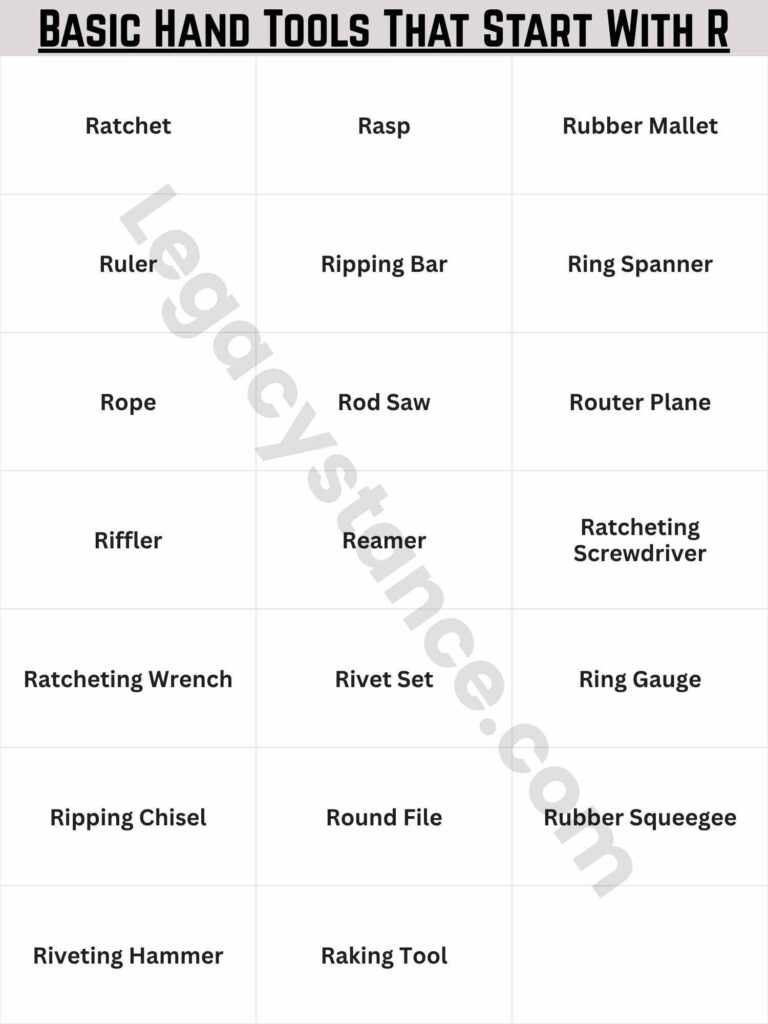
Ratchet
Type: Socket-driving hand tool Tightens or loosens bolts using a back-and-forth motion without repositioning. Available in 1/4″, 3/8″, and 1/2″ drive sizes. Found in every home toolbox and garage.
Rasp
Type: Wood-shaping hand tool Coarse-toothed tool for removing wood material quickly. Used on curves, edges, and rough surfaces before filing or sanding. Comes in flat, half-round, and round profiles.
Rubber Mallet
Type: Non-marring hammer Delivers impact without scratching or cracking the surface. Used for tile setting, furniture assembly, and woodworking joints.
Ruler
Type: Measuring tool Marks straight lines and measures distances. A steel ruler doubles as a cutting guide. Used across woodworking, tailoring, engineering, and classrooms.
Ripping Bar
Type: Pry tool Flat steel bar with a curved claw for pulling nails, prying boards, and demolition work. Standard on renovation and construction sites.
Ring Spanner
Type: Fixed-end wrench Closed circular end wraps fully around a nut or bolt. More grip and less slip than an open-end wrench. Used in tight spaces where ratchets don’t fit.
Rope
Type: Flexible securing tool Used for lifting, tying, anchoring, and load securing. Nylon for shock absorption, polyester for outdoor durability, manila for traditional use.
Rod Saw
Type: Cutting tool Cylindrical tungsten carbide blade that fits a standard hacksaw frame. Cuts curves in tile, glass, and plastic. Used by tile installers for pipe and outlet cutouts.
Router Plane
Type: Hand plane Cuts and cleans recesses, grooves, and dadoes in wood by hand. Used in traditional joinery and furniture restoration.
Riffler
Type: Specialty file Double-ended file with curved cutting surfaces. Reaches concave shapes and tight corners. Used by sculptors, metalworkers, and detailed woodcarvers.
Reamer
Type: Hole-finishing tool Enlarges or smooths existing holes to exact dimensions. Machinists and plumbers use reamers for precision hole finishing and pipe-end preparation.
Ratcheting Screwdriver
Type: Hand screwdriver Drives and removes screws without lifting between turns. Direction switch toggles between tightening and loosening. Faster than a standard screwdriver for repetitive work.
Ratcheting Wrench
Type: Combination wrench Standard wrench profile with a built-in ratcheting box end. No repositioning needed between turns. Popular in engine bays and tight assembly work.
Rivet Set
Type: Forming tool Used with a hammer to shape and seat rivets correctly. Used in blacksmithing, leatherwork, and traditional metal fabrication.
Ring Gauge
Type: Measurement tool Checks the outside diameter of round objects or verifies bore sizes. Used in machining and quality inspection.
Ripping Chisel
Type: Demolition chisel Wide, flat chisel used to strip flooring, break apart old joints, and pry materials apart. Heavier than a woodworking chisel.
Round File
Type: Filing tool Cylindrical file for enlarging holes, smoothing curved edges, and filing inside contours. Used in metalworking, woodworking, and general repair.
Rubber Squeegee
Type: Surface tool Flexible rubber blade for spreading adhesives, clearing water, or applying coatings evenly. Used by tilers, painters, and window cleaners.
Riveting Hammer
Type: Specialty hammer Lightweight hammer for driving and shaping rivets. Narrow face reaches into tight spots. Used in boilermaking, aircraft work, and traditional metal fabrication.
Raking Tool
Type: Garden/masonry hand tool Pulls material across a surface — soil in landscaping, mortar in bricklaying. Different designs for different trades.
Mechanic Tools That Start With R
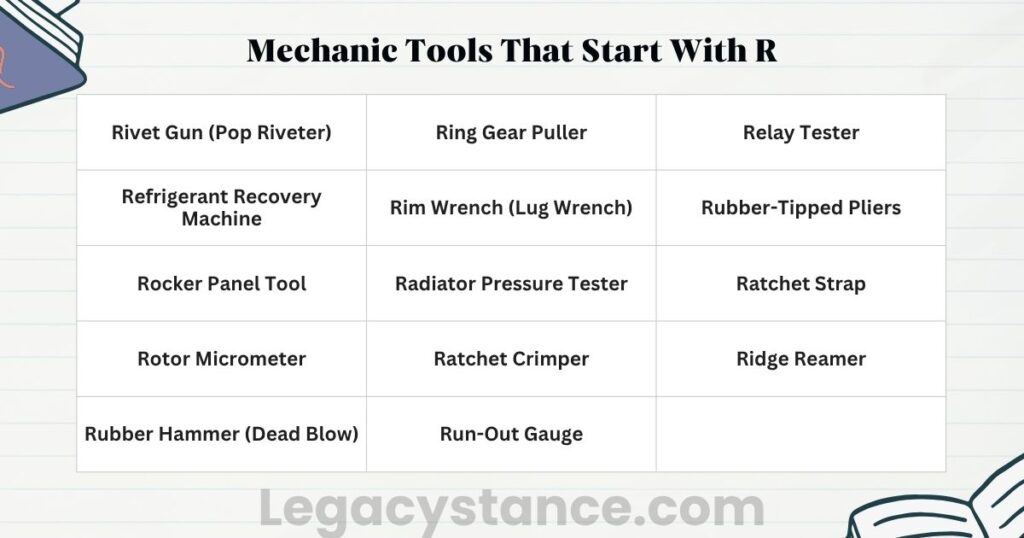
Rivet Gun (Pop Riveter)
Type: Fastening tool Drives pop rivets through sheet material to create permanent joints. Squeeze the handles — the tool expands the rivet and locks it in place. Used in auto body, sheet metal, and aircraft work.
Ring Gear Puller
Type: Gear removal tool Pulls ring gears off differentials and transmissions evenly without damage. Used in axle and transmission service.
Relay Tester
Type: Electrical diagnostic tool Tests automotive relays for proper function. Identifies faults in fuel pumps, cooling fans, and lighting circuits without dismantling components.
Refrigerant Recovery Machine
Type: HVAC service tool Removes refrigerant from AC systems safely before repairs. Required by law in most countries — refrigerant cannot be released into the atmosphere.
Rim Wrench (Lug Wrench)
Type: Wheel fastening tool Loosens and tightens wheel lug nuts. Cross or L-shape gives hand leverage. Included with every vehicle for roadside tire changes.
Rubber-Tipped Pliers
Type: Specialty pliers Rubber-coated jaws grip polished or chrome parts without scratching. Used by plumbers and fine mechanics.
Rocker Panel Tool
Type: Body repair tool Shapes and reforms the lower steel body panels on vehicles. Used with dollies and body hammers in auto body shops.
Radiator Pressure Tester
Type: Cooling system diagnostic tool Pressurizes the cooling system to find leaks — cracked hoses, bad radiator caps, or weeping radiators — without running the engine.
Ratchet Strap
Type: Load securing tool Webbing strap with a ratchet mechanism for tying down cargo on trucks and trailers. Used by truckers, movers, and equipment transporters.
Rotor Micrometer
Type: Brake measurement tool Measures brake rotor thickness precisely. Mechanics check against minimum spec before deciding to resurface or replace.
Ratchet Crimper
Type: Electrical crimping tool Crimps terminals onto conductors. The ratchet ensures full crimp depth before releasing — preventing incomplete connections. Used by auto electricians and panel builders.
Ridge Reamer
Type: Engine service tool Removes the wear ridge at the top of cylinder bores before piston removal. Prevents piston ring damage during engine disassembly.
Rubber Hammer (Dead Blow)
Type: Specialty mallet Shot-filled rubber or plastic head eliminates rebound. Used for assembly work and panel beating where bounce would cause problems.
Run-Out Gauge
Type: Precision measurement tool Measures how much a rotating shaft, disc, or wheel deviates from true rotation. Used in wheel alignment, brake service, and precision machining.
Construction Tools That Start With R
Rotary Hammer
Type: Heavy masonry power tool Combines rotation and high-impact piston action to drill concrete, brick, and stone. Far more powerful than a standard hammer drill.
Rock Drill
Type: Heavy drilling tool Bores into bedrock, stone, and hard ground. Pneumatic versions use compressed air; hydraulic versions use fluid pressure. Used in mining, quarrying, and tunneling.
Rebar Cutter
Type: Steel cutting tool Cuts reinforcing steel bars cleanly to length. Handheld for small bars; electric or hydraulic for heavy structural rebar.
Rebar Bender
Type: Steel forming tool Bends rebar into hooks, stirrups, and custom angles using a pin-and-lever system. Always used alongside a rebar cutter on concrete jobs.
Reciprocating Saw
Type: Demolition power tool Cuts wood, metal, pipe, and plaster with rapid back-and-forth blade action. The go-to tool for demolition, rough-in cuts, and cutting in confined spaces.
Road Plate
Type: Traffic management tool Thick steel plate placed over open trenches to let vehicles pass safely during underground utility work.
Paint Roller
Type: Surface coating tool Applies paint or primer to large flat surfaces quickly. Short nap for smooth walls, thick nap for rough masonry. Used with extension poles for ceilings.
Rafter Square (Speed Square)
Type: Layout and marking tool Triangular tool for marking angles and checking 90-degree cuts. Carpenters use it for rafter layouts, stair stringers, and framing angles.
Rammer (Plate Compactor)
Type: Ground compaction tool Compacts soil, gravel, and base material before pouring concrete or laying pavers. Jumping-jack style for trenches; plate compactor for open areas.
Rolling Scaffolding
Type: Elevated work platform Wheeled scaffold tower that moves across floors without disassembly. Used by painters and drywall finishers on large interior jobs.
Roof Cutter
Type: Roofing power tool Cuts through shingles, membrane, and roof decking during replacement or repair. Creates clean openings for vents, skylights, and hatches.
Rotary Mixer (Paddle Mixer)
Type: Mixing tool Paddle-head attachment for a heavy drill. Mixes mortar, grout, concrete, and adhesives. Faster and more consistent than hand mixing.
Ridge Cap Tool
Type: Roofing tool Bends and shapes ridge cap shingles or metal ridge flashing to the correct roof angle. Used by roofers for watertight ridge finishing.
Rod Level
Type: Surveying tool A long, graduated staff held vertically by a surveyor’s assistant. The engineer reads the level rod through a transit or level to measure elevation differences.
Roof Bracket
Type: Safety and access tool Steel bracket that hooks over roof shingles and supports a plank for safe footing on sloped roofs. Used by roofers and chimney workers.
Rivet Buster
Type: Pneumatic demolition tool Air-powered chisel tool for shearing old rivets off steel structures during demolition or repair. Used in structural steel work and bridge maintenance.
Measuring & Precision Tools That Start With R
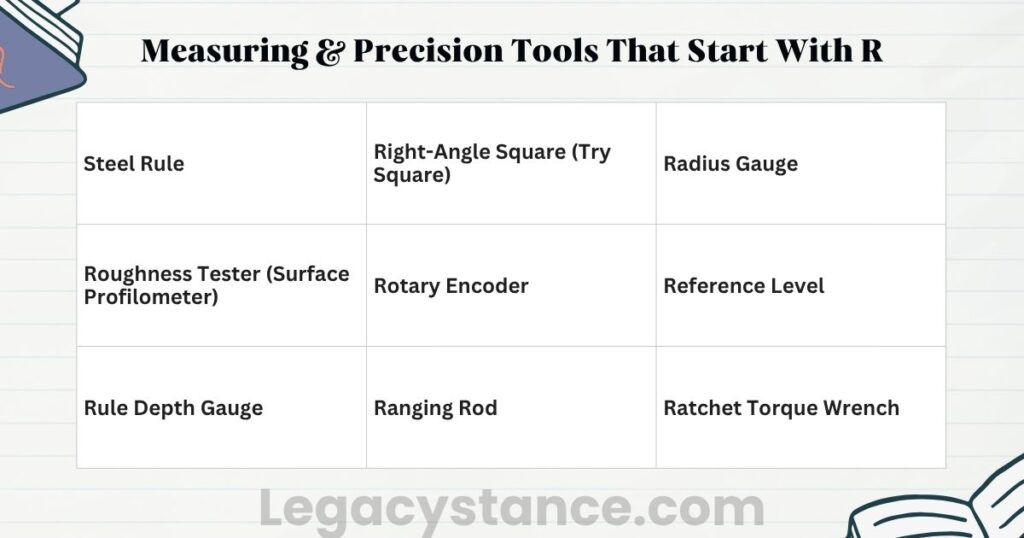
Steel Rule
Type: Precision measuring tool More accurate than a standard ruler. Machinists use steel rules to measure in 1/64″ or 0.5mm increments. Also used as a scribing guide.
Right-Angle Square (Try Square)
Type: Accuracy checking tool Verifies that surfaces and joints are exactly 90 degrees. Used in woodworking, metalworking, and carpentry.
Radius Gauge
Type: Profile measurement tool Set of curved templates for measuring concave and convex radii on machined parts. Used in machining and quality control.
Roughness Tester (Surface Profilometer)
Type: Surface measurement tool Measures microscopic surface texture on machined or ground parts. Used in precision manufacturing quality control.
Rotary Encoder
Type: Position measurement device Tracks rotation and converts it to digital position or speed data. Used in CNC machines, robotics, and automation systems.
Reference Level
Type: Precision alignment tool High-accuracy spirit level used for calibrating machine tools and aligning large equipment. More accurate than a standard builder’s level.
Rule Depth Gauge
Type: Depth measurement tool Sliding steel rule that measures the depth of holes, slots, and recesses. Used in machining and woodworking.
Ranging Rod
Type: Surveying tool Brightly colored pole held vertically at survey points to mark locations and measure distances in the field. Used by surveyors and civil engineers.
Ratchet Torque Wrench
Type: Torque measurement tool Tightens fasteners to a specified torque value and clicks or stops when that value is reached. Critical for engine assembly, wheel bolts, and structural connections.
Power Tools That Start With R
Random Orbital Sander
Type: Power sanding tool Sanding pad moves in random ellipses, eliminating visible scratch marks. Produces a finish-ready surface for staining or painting. Preferred over sheet sanders for wood finishing.
Right-Angle Drill
Type: Compact power drill Chuck sits at 90 degrees to the body for drilling in confined spaces — inside cabinets, between studs, and behind appliances. Used by electricians and plumbers constantly.
Rotary Tool (Dremel-Type)
Type: Multi-function power tool Small handheld tool accepting cutting, grinding, polishing, and engraving accessories. Used for detailed, small-scale work in hobbies, jewelry, and repair.
Random Orbital Polisher
Type: Auto detailing power tool Applies and buffs polish and wax without swirl marks. The random motion protects painted surfaces. Used by auto detailers for paint correction and protection.
Rotary Hammer Drill
Type: Masonry power tool Heavier version of a standard drill with switchable modes: drill only, hammer-drill, and chisel. Drills concrete and masonry efficiently.
Reciprocating Jigsaw
Type: Curved cutting power tool Up-and-down blade action cuts curves, shapes, and internal cutouts in wood, metal, and plastic. Used for sink cutouts, shaped trim, and curved panel work.
Router Table
Type: Stationary woodworking tool Router mounts upside-down beneath a flat table. Workpiece is guided over the bit for controlled, repeatable profiling cuts. Used in cabinet shops.
Rotary Sander (Disc Sander)
Type: Power sanding tool Spins a sanding disc at high speed. Removes material faster than an orbital sander. Used for rough shaping and edge work on wood and metal.
Rope Saw (Pocket Chainsaw)
Type: Portable cutting tool A flexible chain with cutting teeth pulled back and forth by two handles. Cuts branches and wood in remote or confined locations where a chainsaw won’t fit.
Rotary Planer
Type: Surface preparation tool Rotary drum fitted with carbide cutters strips old paint, adhesive, and coatings from concrete floors. Used in flooring and surface preparation work.
Specialized Industrial Tools That Start With R
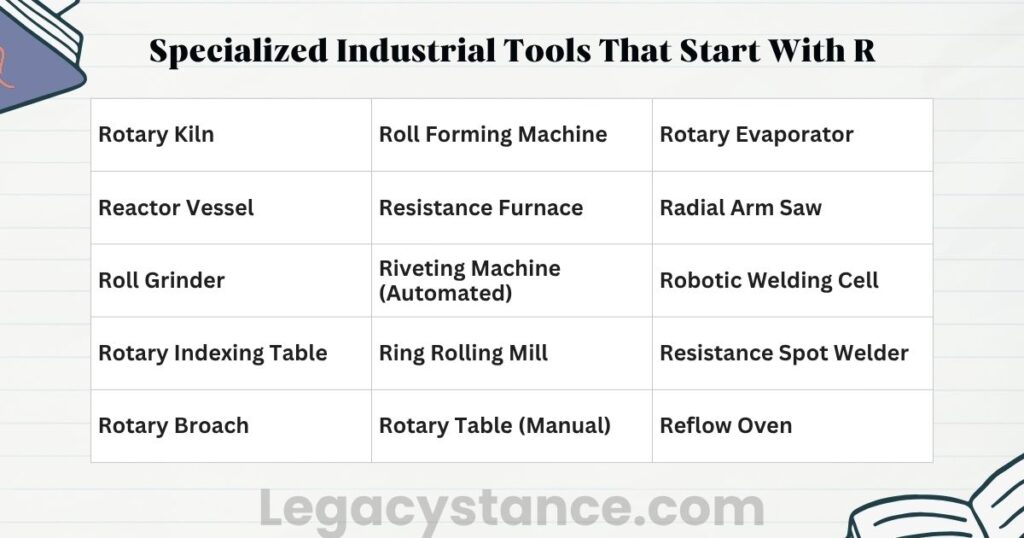
Rotary Kiln
Type: Industrial thermal processing equipment Large rotating cylindrical furnace for high-temperature material processing. Used in cement production, lime burning, and mineral refining.
Roll Forming Machine
Type: Sheet metal forming equipment Bends sheet metal continuously through a series of rollers to produce a consistent cross-section profile. Makes roofing sheets, steel studs, and guttering at high volume.
Rotary Evaporator
Type: Laboratory instrument Removes solvents from samples under reduced pressure using gentle heat and rotation. Used in chemistry, pharmaceutical research, and food science.
Reactor Vessel
Type: Chemical processing equipment Pressure vessel for controlled chemical reactions under specific temperature and pressure. Used in petrochemical plants and pharmaceutical manufacturing.
Resistance Furnace
Type: Industrial heating equipment Generates heat by passing electrical current through resistance elements. Used for heat treatment, annealing, and materials processing.
Radial Arm Saw
Type: Stationary woodworking saw Ceiling-mounted arm carries the blade across the workpiece. Used in production shops for fast, repetitive crosscutting of long boards.
Roll Grinder
Type: Precision grinding machine Restores the surface finish and geometry of industrial rollers used in steel mills, paper mills, and printing equipment.
Riveting Machine (Automated)
Type: Industrial fastening equipment Drives and sets rivets automatically at high production speed. Used in aircraft manufacturing and large-scale metal fabrication.
Robotic Welding Cell
Type: Automated welding system Robotic arms programmed to weld metal components with speed and precision beyond manual capability. Standard in automotive and structural steel manufacturing.
Rotary Indexing Table
Type: CNC machining component Rotates workpieces to precise angles between machining operations. Allows a CNC machine to work multiple faces of a part in one setup.
Ring Rolling Mill
Type: Metal forming equipment Rolls heated metal rings to reduce wall thickness and increase diameter. Used in manufacturing bearing races, flanges, and pressure vessel rings.
Resistance Spot Welder
Type: Sheet metal joining equipment Joins overlapping sheet metal by passing electrical current through two contact points. Creates a weld nugget without filler material. Standard in auto body manufacturing.
Rotary Broach
Type: Machining tool Creates non-round holes — hexagons, squares, splines — in a single pass on a lathe or CNC machine. Used in fastener and precision parts manufacturing.
Rotary Table (Manual)
Type: Machining accessory Mounts on a milling machine table and rotates the workpiece for cutting arcs, circles, and angular features. Used in tool rooms and machine shops.
Reflow Oven
Type: Electronics manufacturing equipment Melts solder paste on circuit boards to bond surface-mount components permanently. Used in PCB assembly and electronics manufacturing.
Safety Tools & Equipment That Start With R
Respirator
Type: Respiratory protection Filters dust, fumes, and chemical vapors. Half-face for general trades; full-face for chemical and spray environments. Worn by woodworkers, painters, welders, and construction workers.
Rubber Gloves (Insulated)
Type: Hand protection Protects against electrical shock, chemicals, or biological exposure. Voltage-rated versions for electricians; chemical-resistant versions for labs.
Rescue Hook
Type: Emergency retrieval tool Grabs, moves, or secures loads and people in rescue and height-work operations. Rated to specific load capacities.
Reflective Vest (Hi-Vis Vest)
Type: High-visibility PPE Makes workers visible to vehicles in low-light conditions. Required on roads, construction sites, and warehouses.
Rope Grab
Type: Fall arrest device Clamps onto a vertical lifeline and travels with the worker. Locks instantly in a fall. Used in roofing, tower work, and elevated construction.
Radiation Dosimeter
Type: Radiation monitoring device Worn by workers in nuclear, medical imaging, and industrial radiography environments. Tracks cumulative radiation exposure.
Roll-Up Safety Barrier
Type: Temporary hazard marking tool Flexible barrier that unrolls to cordon off hazardous areas quickly. Used on roads, job sites, and warehouses.
Roof Anchor Point
Type: Fall protection equipment Fixed anchor installed on a roof structure to which a safety harness lanyard is attached. Required for safe roof work above a certain height in most safety regulations.
Rescue Tripod
Type: Confined space rescue equipment Three-legged frame positioned over manholes or confined space entries. Used with a winch to lower rescuers or raise injured workers safely.
ROPS (Roll-Over Protection Structure)
Type: Heavy equipment safety system Steel frame or cab structure on tractors, loaders, and construction machines that protects the operator if the machine rolls over.
Woodworking Tools That Start With R
Rabbet Plane
Type: Hand plane Cuts rabbets — stepped recesses along the edge of a board. Used in door and window joinery, drawer construction, and frame making.
Rebating Router Bit
Type: Router accessory Cuts a stepped rebate along a wood edge. Used with an electric router for joinery and cabinet work.
Rip Saw
Type: Hand saw Designed specifically for cutting wood along the grain. Fewer, larger teeth than a crosscut saw. Faster for ripping planks to width.
Router Bit Set
Type: Router accessories Collection of different profile bits for an electric router — round-over, chamfer, cove, flush-trim, and more. Expands the router’s capabilities significantly.
Ratchet Spokeshave
Type: Wood shaping tool Small plane-like tool for shaping curved surfaces and spokes. Used in chair making, wheel making, and curved joinery.
Rebate Saw
Type: Specialty hand saw Cuts rebates and shoulders in joints without a router. Used in traditional hand-tool woodworking for tenons and housing joints.
Plumbing Tools That Start With R
Pipe Reamer
Type: Pipe finishing tool Removes burrs from the inside of cut copper, steel, or plastic pipe. Produces a smooth bore for leak-free connections.
Ratchet Pipe Cutter
Type: Pipe cutting tool Ratchet-action cutter for copper and plastic pipe in tight spaces where a standard pipe cutter can’t rotate fully.
Radiator Key
Type: Plumbing bleed tool Small square key that opens the bleed valve on a radiator to release trapped air. Used in home heating system maintenance.
Rod (Drain Rod)
Type: Drain clearing tool Flexible rods that screw together and are pushed through blocked drains and sewer pipes. Plumbers use them to clear obstructions too deep for a plunger.
Rubber Plunger
Type: Drain clearing tool Creates suction and pressure to dislodge blockages in sinks, toilets, and drains. The most basic and common plumbing tool in any home.
Ratchet Pipe Threader
Type: Pipe threading tool Cuts threads onto steel or iron pipe ends using a ratchet action. Used by plumbers before screwing on fittings.
Electrical Tools That Start With R
Rotary Dimmer Switch Tool
Type: Electrical fitting tool Used to install and adjust rotary dimmer controls in lighting circuits. Requires a small flat-blade screwdriver for terminal adjustment.
Raceway Tool
Type: Cable management tool Used to cut, fit, and install plastic or metal cable raceways (trunking) on walls. Electricians use these for neat surface-mounted wiring installations.
Resistance Tester (Ohmmeter)
Type: Electrical measurement tool Measures electrical resistance in circuits and components. Used to check for continuity, shorts, and open circuits in wiring and components.
RCD Tester
Type: Electrical safety testing tool Tests whether a residual current device (RCD/GFCI) trips correctly within the required time when a fault is simulated. Used by electricians during installation and safety inspections.
Ring Main Tester
Type: Circuit testing tool Checks ring circuit wiring for correct connections, polarity, and insulation resistance. Used during electrical installation inspections.
Digital & Software Tools That Start With R
Revit
Type: BIM software Building Information Modeling tool for architects and structural engineers. Designs buildings in 3D with embedded data — dimensions, materials, costs, and schedules.
ReCap (Autodesk ReCap)
Type: 3D scanning software Processes laser scan point cloud data into usable 3D models. Used by surveyors, architects, and engineers for as-built documentation.
R (Programming Language)
Type: Statistical computing tool Used for data analysis, statistical modeling, and visualization. Widely used in research, engineering, and data science.
RStudio
Type: Development environment Primary interface for writing and running R code. Used by data scientists and researchers.
Rhinoceros 3D (Rhino)
Type: 3D modeling software Handles complex curved surfaces for product design, jewelry, architecture, and industrial design.
Robot Framework
Type: Test automation tool Open-source framework for automating software testing and IT processes. Used by QA engineers and DevOps teams.
Rational ClearCase
Type: Version control software Manages source code changes across large enterprise software development projects.
ReSharper
Type: Code analysis tool Plugin for Visual Studio that analyzes C# and .NET code in real time, suggests improvements, and automates refactoring. Used by software developers.
Redis
Type: In-memory data tool Fast in-memory data store used as a cache, message broker, and database. Used by backend developers and system architects.
Rancher
Type: Container management tool Platform for managing Kubernetes clusters and containerized applications. Used by DevOps engineers and cloud architects.
Comparison: Similar R Tools
| Tool | Best For | Key Difference |
| Rotary Hammer vs Hammer Drill | Concrete drilling | Rotary hammer uses piston mechanism — far more impact force |
| Ratchet vs Ratcheting Wrench | Bolt fastening | Ratchet uses sockets; ratcheting wrench is a fixed-profile spanner |
| Rasp vs Round File | Wood shaping | Rasp removes more material; file gives a smoother, finer finish |
| Reciprocating Saw vs Jigsaw | Cutting | Reciprocating saw is for demolition; jigsaw is for shaped, controlled cuts |
| Random Orbital Sander vs Disc Sander | Sanding | Orbital leaves no swirl marks; disc removes material faster |
Best R Tools for Beginners
Starting a toolbox? These five R tools cover the widest range of tasks:
- Ratchet set — handles almost every nut and bolt job at home or on a vehicle
- Rubber mallet — protects surfaces during assembly and installation
- Ruler (steel) — accurate measuring for any project
- Ripping bar — removes nails, pries apart boards, handles light demolition
- Random orbital sander — produces a professional finish on wood projects
Safety Tips When Using R Tools
- Wear eye protection with any power tool — reciprocating saws, rotary hammers, and routers all throw debris
- Always secure the workpiece before cutting or drilling
- Inspect rope before load-bearing use — fraying or UV damage means it must be replaced
- Wear a respirator when cutting masonry, sanding wood, or working in dusty environments
- Ratchet straps must be rated above the load weight — always check the working load limit before use
Read also –
115+ Tools That Start With M: Hand, Mechanic & Professional Tools
125+ Tools That Start With J: Hand Tools, Power Tools & More
FAQs
What is the difference between a rotary hammer and a regular hammer drill?
A hammer drill creates impact through two ribbed discs engaging and disengaging — suitable for occasional light masonry. A rotary hammer uses a piston mechanism delivering far more energy per blow. For regular concrete drilling or chiseling, the rotary hammer is the right choice.
Can a reciprocating saw replace a hand saw?
For rough cuts and demolition — yes. For clean, precise cuts in finished woodwork — no. The aggressive blade action makes fine control difficult. Use a hand saw or miter saw where accuracy matters.
What is a rasp used for that a file can’t do?
A rasp removes wood material much faster with its coarser teeth. Files give a smoother, finer finish. Woodworkers typically rasp a surface to rough shape first, then follow with a file and sandpaper to refine it.
When should I use a rivet instead of a screw?
Rivets work when you can only access one side of the material and need a permanent joint — sheet metal panels, aircraft skins, or hollow sections. Screws are better when disassembly may be needed later.
Conclusion
From a rubber mallet in a kitchen renovation to a robotic welding cell in a car factory, tools starting with R cover every scale of work imaginable. This guide gives you 120+ real tool names with clear, practical descriptions — useful whether you’re building vocabulary, setting up a toolbox, studying for a trade, or just curious about what all those tools actually are.
Learn the tools relevant to your work first. The rest builds naturally from there.