
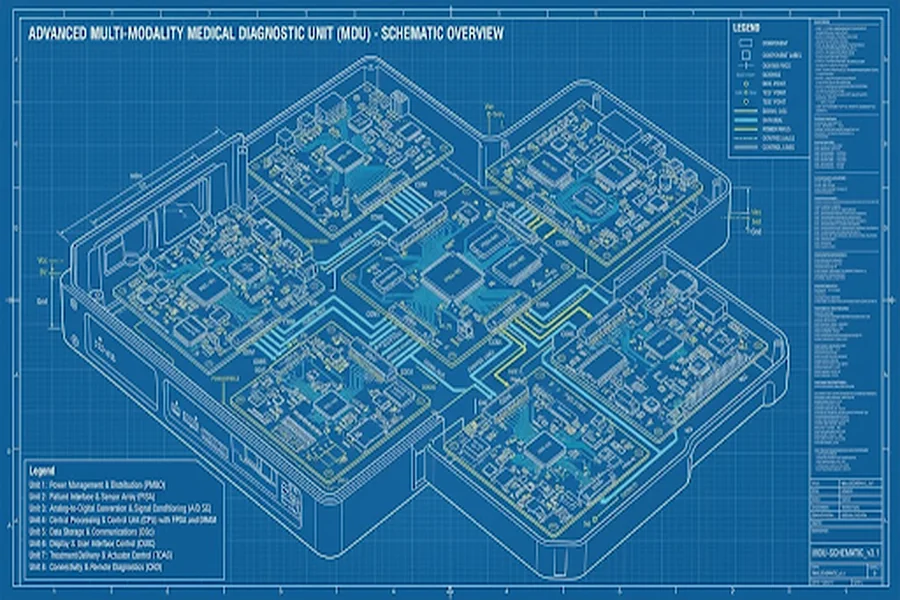
A modern medical device may look like a single piece of equipment, but inside its enclosure, several circuit boards can be working together. A patient monitor, infusion pump, or portable diagnostic instrument may use separate boards for processing, sensing, power management, displays, and communication. Coordinating these electronic assemblies can be challenging, which is why turnkey PCB assembly can play an important role in projects involving medical PCB assembly. The objective is not simply to manufacture individual boards, but to ensure they can be integrated into the intended device.
Why Medical Devices Often Need Multiple PCBs
Not every electronic function belongs on the same circuit board.
A processing board may require high-density components and high-speed interfaces, while a power board needs larger components, different clearances, and thermal management. A sensor interface board may need to sit close to the measurement location, while a display board must fit behind the user interface.
Separating these functions can offer practical advantages. Engineers can position boards where they are needed, isolate certain electrical functions, and accommodate different mechanical requirements.
However, a multi-board architecture also introduces more connections, assembly steps, and opportunities for integration problems.
The Connections Between Boards Matter
A circuit board rarely operates independently inside a medical device.
Board-to-board connectors, flexible cables, wire harnesses, and other interconnections carry power, signals, and communication data between electronic assemblies.
These connections must be compatible with the device’s mechanical layout and operating requirements.
For example, a connector that works during bench testing may become difficult to access after the enclosure is assembled. A cable may be too short for convenient installation, or its routing may interfere with nearby mechanical components.
These are not necessarily PCB design errors. They are integration problems that become visible when separate parts are brought together.
Different Boards May Require Different Assembly Processes
A multi-board medical product can contain several types of electronic assemblies.
The main control board may use fine-pitch SMT components, while the power board includes larger connectors, capacitors, and through-hole devices. A sensor board may be particularly sensitive to contamination, handling, or mechanical stress.
Manufacturing these boards together does not mean they should all follow identical production steps.
Depending on the design, medical PCB assembly may involve different soldering methods, inspection requirements, cleaning processes, and functional tests for each board.
Coordinating these differences is important when the assemblies eventually become part of the same product.
Integration Can Reveal Problems Individual Tests Miss
A board may pass its own functional test but behave differently after being connected to the rest of the device.
Power supply interactions, grounding arrangements, communication timing, cable routing, and electromagnetic interference can all influence system behavior.
For example, a measurement circuit may operate correctly on its own but experience additional noise when connected to a nearby switching power supply.
This does not mean individual PCB testing is unnecessary. It means board-level verification and system-level validation serve different purposes.
Both should be considered when planning how the finished equipment will be evaluated.
Coordinated Manufacturing Can Simplify Final Assembly
When several boards are produced for one device, their schedules and revisions need to remain aligned.
A change to the main controller may affect a sensor interface or cable connection. A new connector may require an updated harness. A firmware revision may change how two boards communicate.
Through turnkey PCB assembly, component sourcing, PCB fabrication, assembly, and agreed testing activities can be coordinated within a broader manufacturing workflow.
This approach can reduce the number of separate production handoffs, although successful integration still depends on clear engineering specifications, approved revisions, and defined responsibilities.
The Finished Device Is the Real Reference Point
The final product is more than the sum of its circuit boards.
PCB dimensions, connector positions, mounting holes, cable paths, enclosure clearances, and service access all influence how the assemblies fit together.
For medical equipment, the device manufacturer must also consider applicable safety, performance, and regulatory requirements. PCB manufacturing quality supports these objectives but does not replace the verification and validation required for the complete medical device.
Looking at the finished product early helps prevent individual boards from being optimized without considering how they will be installed and used.
Conclusion
Medical electronics often rely on several circuit boards performing different tasks within one compact system. Each board may have its own manufacturing requirements, but the finished device depends on how effectively they work together.
By coordinating turnkey PCB assembly with the specific requirements of medical PCB assembly, development teams can manage board-level production while keeping the larger integration picture in view. The result is a more organized path from separate electronic assemblies to a complete medical device.