Finding the right tool starts with knowing its name and purpose. This guide to Tools That Start With J brings together practical tools used in woodworking, mechanics, construction, metalworking, safety, and technology. Some are simple everyday items like jumper cables and jab saws, while others are specialized machines used in workshops and industrial settings.
Whether you are a student, DIY beginner, tradesperson, or tool collector, this list is built to be easy to scan and useful in real situations. Each tool includes a short explanation so you can quickly understand what it does, where it is used, and why it matters.
Quick List: Common Tools That Start With J
- Jack
- Jigsaw
- Jointer
- Jab saw
- Jack plane
- Jaw pliers
- Jumper cables
- Jeweler’s loupe
- Jeweler’s saw
- Japanese pull saw
- J-hook
- Jig
- Jointing trowel
- Joint compound knife
- Jaw wrench
- Jamb saw
- Jackhammer
- Joist hanger
- Jointing float
- Junction box knockout punch
Basic Hand Tools That Start With J
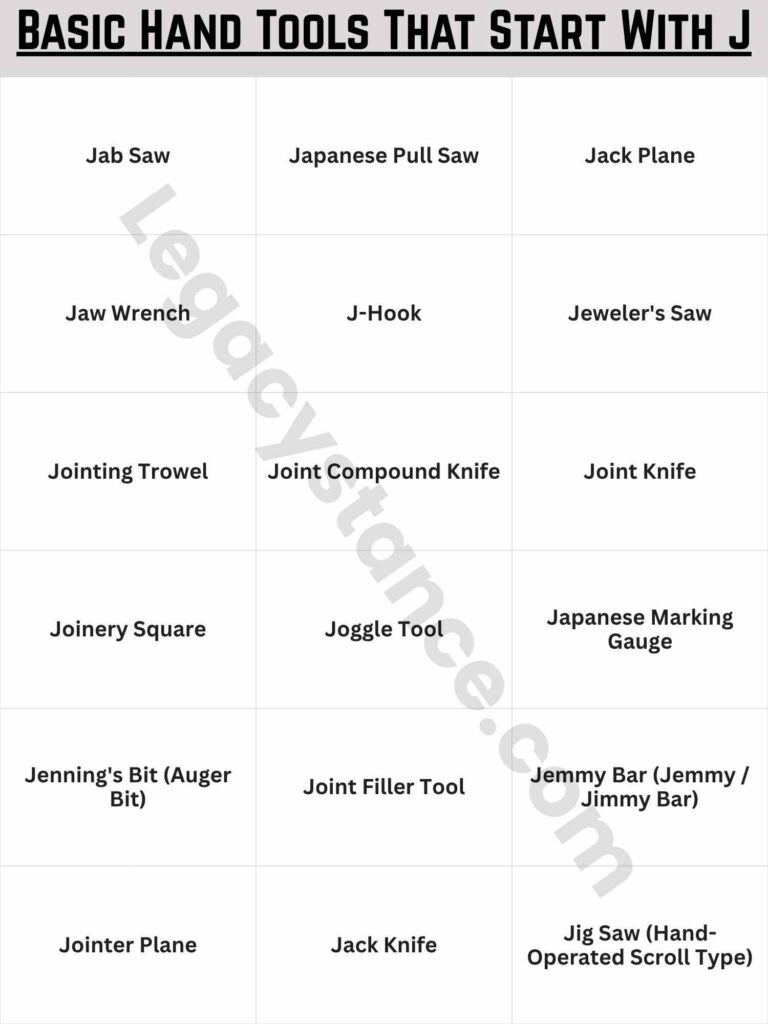
Jab Saw
Type: Hand saw A short, narrow saw with a pointed tip. Pierces drywall or thin wood directly without a pilot hole. Used for cutting outlet holes and small openings in walls.
Japanese Pull Saw
Type: Hand saw Cuts on the pull stroke for cleaner, thinner kerfs than a standard Western handsaw. Used in furniture making and finish carpentry for precision trimming.
Jack Plane
Type: Hand plane A medium-length bench plane for flattening and smoothing rough lumber. The workhorse plane — used before finer finishing planes.
Jaw Wrench
Type: Wrench Any wrench with opposing jaw faces — pipe wrenches, monkey wrenches, and adjustable wrenches all fall here. Grips nuts, bolts, and pipe fittings of varying sizes.
J-Hook
Type: Hanging hardware A J-shaped metal hook for hanging cables, pipes, conduit, or tools on walls, pegboards, and ceiling joists.
Jeweler’s Saw
Type: Hand saw A fine-frame saw holding a very thin blade under tension for cutting intricate shapes in thin metal, plastic, or wood. Used in metalsmithing and jewelry fabrication.
Jointing Trowel
Type: Masonry hand tool Fills and finishes mortar joints between bricks, stones, or tiles. Blade profiles vary — pointed, flat, or rounded — by joint style.
Joint Compound Knife
Type: Drywall hand tool Flat-bladed knife for spreading and feathering drywall mud. Available in 4-inch, 6-inch, and 10–12-inch widths for different coat stages.
Joint Knife
Type: Finishing hand tool A stiff, flat blade for applying putty, wood filler, and patching compound in small areas. Available from 1.5 to 6 inches wide.
Joinery Square
Type: Layout tool Verifies joints are cut at a true 90 degrees before glue-up. A joint even slightly off won’t close properly under clamps.
Joggle Tool
Type: Sheet metal hand tool Creates a small offset step in metal sheet so one panel overlaps another flush at a seam. Used in aircraft sheet metal and auto body fabrication.
Japanese Marking Gauge
Type: Layout tool A wooden or bamboo gauge that scores a precise line parallel to a board edge. The blade cuts rather than scratches, giving a sharper layout line for sawing and chiseling.
Jenning’s Bit (Auger Bit)
Type: Boring hand tool A spiral auger bit with a center screw and twin spurs for boring clean, deep holes in wood. Used with a brace (hand brace drill). Named after its inventor.
Joint Filler Tool
Type: Tile / masonry tool A rubber-edged tool for pressing grout or joint compound into gaps between tiles or masonry. Forces filler deep into joints for a solid, gap-free finish.
Jemmy Bar (Jemmy / Jimmy Bar)
Type: Pry tool A short, flat pry bar for levering, prying, and removing nails in tight spaces. Smaller than a full crowbar — fits where a larger bar won’t.
Jointer Plane
Type: Hand plane A long bench plane (22–24 inches) for flattening large surfaces and truing long board edges for glue joints. The length bridges low spots that shorter planes would follow.
Jack Knife
Type: Cutting hand tool A folding pocket knife used for marking, scoring, trimming, and general cutting tasks around a workshop. A basic but constantly useful tool.
Jig Saw (Hand-Operated Scroll Type)
Type: Hand saw A fine-toothed handsaw used for cutting curves and scroll patterns in thin wood or veneer. Precursor to the powered jigsaw — still used in model making and marquetry.
Mechanic Tools That Start With J
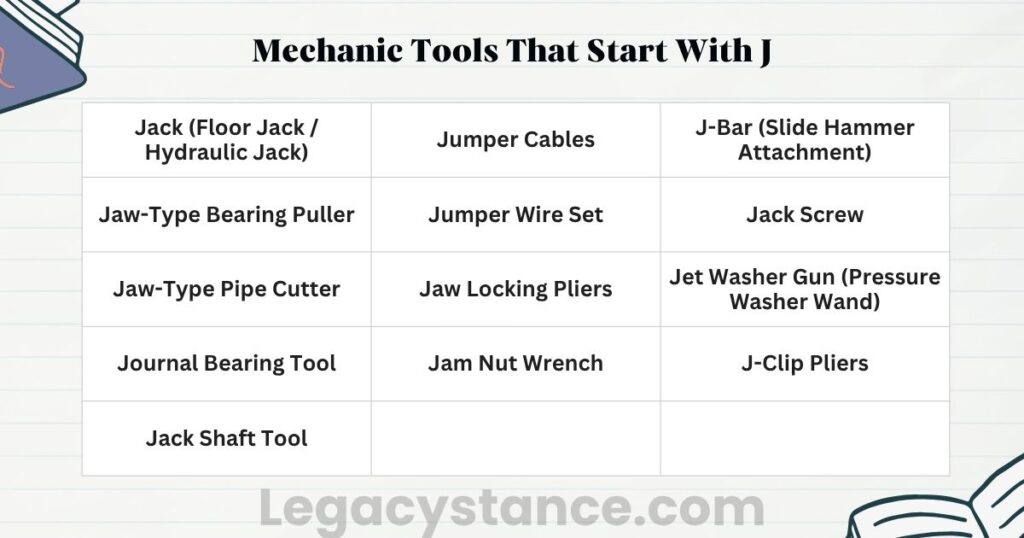
Jack (Floor Jack / Hydraulic Jack)
Type: Lifting equipment A hydraulic jack that lifts vehicles for undercar work by pumping a handle to build pressure. Rated by ton capacity — 2-ton for cars, 3-ton for trucks. Lifts only; jack stands hold the vehicle.
Jumper Cables
Type: Automotive electrical tool Connect a dead battery to a charged one to restart a vehicle. Connection sequence: positive to dead, positive to good, negative to good, then negative to unpainted metal ground on dead vehicle.
J-Bar (Slide Hammer Attachment)
Type: Auto body tool A J-shaped hook used with a slide hammer to pull dents from body panels. Inserts through holes in damaged panels; the hammer’s weight creates pulling force.
Jaw-Type Bearing Puller
Type: Mechanical extraction tool Grips a bearing’s race with two or three jaws while a central screw pushes against the shaft to extract cleanly. Used in transmission rebuilding and equipment maintenance.
Jumper Wire Set
Type: Automotive diagnostic tool Short wires with alligator clips for bridging circuits temporarily during electrical fault diagnosis. Connects components directly to power or ground to isolate faults.
Jack Screw
Type: Mechanical tool A threaded rod mechanism that converts rotation into linear force for lifting, pushing, or separating components. Used in engine alignment and machinery leveling.
Jaw-Type Pipe Cutter
Type: Plumbing tool Grips pipe between hardened jaws and uses a ratcheting mechanism to cut in tight spaces where a rotating cutter can’t complete a full revolution.
Jaw Locking Pliers
Type: Gripping tool Adjustable locking pliers that clamp and lock onto fasteners, pipes, and irregular shapes. Mechanics use them to hold parts or grip damaged, rounded fasteners.
Jet Washer Gun (Pressure Washer Wand)
Type: Automotive cleaning tool A high-pressure wand attachment for pressure washers used to clean engine bays, undercarriages, and wheels. Interchangeable nozzle tips control spray pattern and pressure.
Journal Bearing Tool
Type: Engine rebuild tool A specialty tool for measuring and fitting journal bearings in crankshafts and camshafts during engine rebuilding. Ensures correct bearing clearance for oil film.
Jam Nut Wrench
Type: Wrench A thin, low-profile wrench designed specifically to reach and turn jam nuts — the thin locking nuts used to secure adjustments on threaded rods, valves, and fittings.
J-Clip Pliers
Type: Fastening tool Pliers that crimp J-shaped metal clips used in wire mesh, cage assembly, and mesh fencing. The clips are placed in the jaw; squeezing bends them around the wire crossing.
Jack Shaft Tool
Type: Drivetrain tool Used to remove and install jack shafts — intermediate shafts found in industrial gearboxes, snowmobiles, and some power transmission systems.
Construction Tools That Start With J
Jackhammer
Type: Demolition power tool Breaks concrete, asphalt, and compacted ground through rapid piston impact. Pneumatic types run from a compressor; electric types suit enclosed spaces. Bit shapes — moil, chisel, spade — handle different tasks.
Jointing Float
Type: Concrete finishing tool Creates straight control joints (grooves) in concrete slabs while the concrete is still workable. Those grooves direct cracking to predictable locations.
Joist Hanger
Type: Structural framing hardware A galvanized metal bracket supporting floor joist and rafter ends against beams. Stronger than toe-nailing and often required by building code in seismic and wind zones.
Jamb Saw
Type: Flooring power tool Undercuts door frames so flooring slides underneath cleanly. The base plate rides on the flooring material to automatically set the correct cut height.
Junction Box Knockout Punch
Type: Electrical tool A punch-and-die set that creates clean holes in metal electrical boxes and panels for conduit entry.
Jig Welding Fixture
Type: Fabrication tool Holds workpieces in exact position during welding for consistent geometry across multiple assemblies. Also reduces heat distortion by restraining parts during cooling.
J-Channel Snips
Type: Siding installation tool Tin snips used to cut J-channel trim for vinyl siding installation around windows, doors, and corners.
Jet Pump (Pressure Washer Pump)
Type: Surface preparation tool High-pressure pump for cleaning concrete, stripping paint, and surface preparation before coatings. PSI and GPM together determine cleaning power.
Jib Crane
Type: Material handling equipment A small crane with a horizontal arm (jib) attached to a wall or floor-mounted column. Used in workshops and fabrication shops for lifting and positioning heavy materials short distances.
Jolting Compactor (Plate Compactor)
Type: Soil compaction tool A motorized plate that vibrates and compacts soil, gravel, or asphalt base material before paving or foundation work. Also called a plate compactor or vibratory compactor.
Jack Post (Adjustable Support Post)
Type: Structural support tool An adjustable steel post used to temporarily or permanently support beams, floor joists, or structures during construction or repair work.
Joint Raker
Type: Masonry tool A tool dragged along mortar joints to rake out mortar to a uniform depth before repointing. Creates a clean, consistent recess for fresh mortar application.
Jig Saw Table (Scroll Saw Table)
Type: Woodworking fixture A shop-built or purchased table that converts a handheld jigsaw into a stationary scroll saw by mounting it blade-up under the table surface.
Measuring and Precision Tools That Start With J
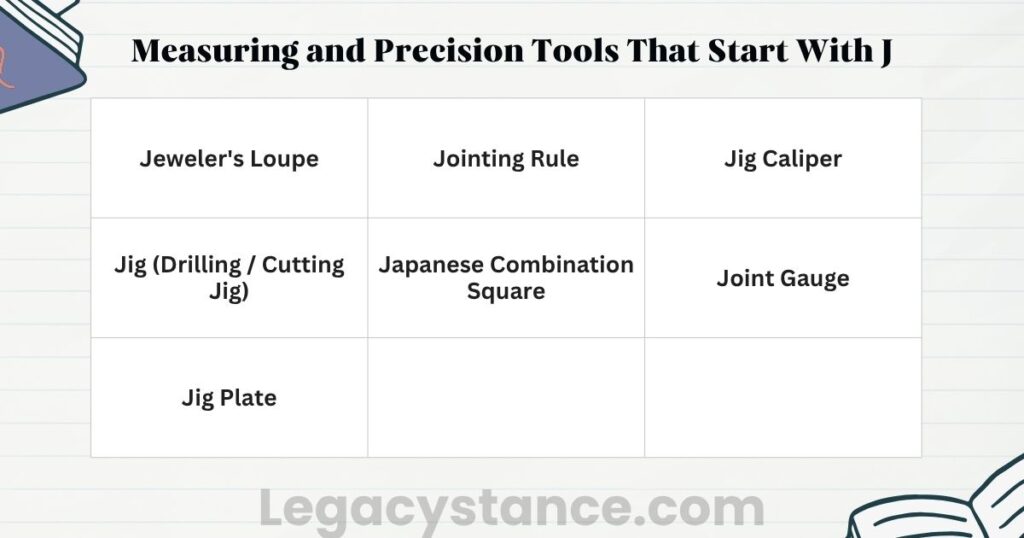
Jeweler’s Loupe
Type: Magnification tool A small folding magnifying lens (standard 10x) for examining gemstones, metalwork, coin detail, and electronics. Hold close to the eye; bring the object to the loupe.
Jointing Rule
Type: Straightedge / layout tool A long, rigid straightedge (3–6 feet) used by plasterers and bricklayers to check surface flatness and guide tools along a straight path.
Jig Caliper
Type: Precision measuring tool A specialty caliper used in tool and die making to measure hole spacing and feature distances on jig plates. Extended jaw configurations reach features standard calipers can’t.
Jig (Drilling / Cutting Jig)
Type: Repeatability tool A guide device that positions a cutting or drilling tool for repeatable, accurate results — pocket hole jigs, doweling jigs, shelf pin jigs, and dovetail jigs are common types.
Japanese Combination Square
Type: Layout and measuring tool A square, miter gauge, and depth gauge in one tool. Used in Japanese woodworking for marking, checking angles, and setting consistent depths across a workpiece.
Joint Gauge
Type: Masonry measuring tool A small gauge tool used to check mortar joint thickness in brickwork for consistency. Ensures uniform joint spacing that meets specification or building standard requirements.
Jig Plate
Type: Precision machining reference tool A hardened, ground steel plate with precisely located holes used as a reference base for building and aligning machining jigs and fixtures in tool room work.
Power Tools Tools That Start With J
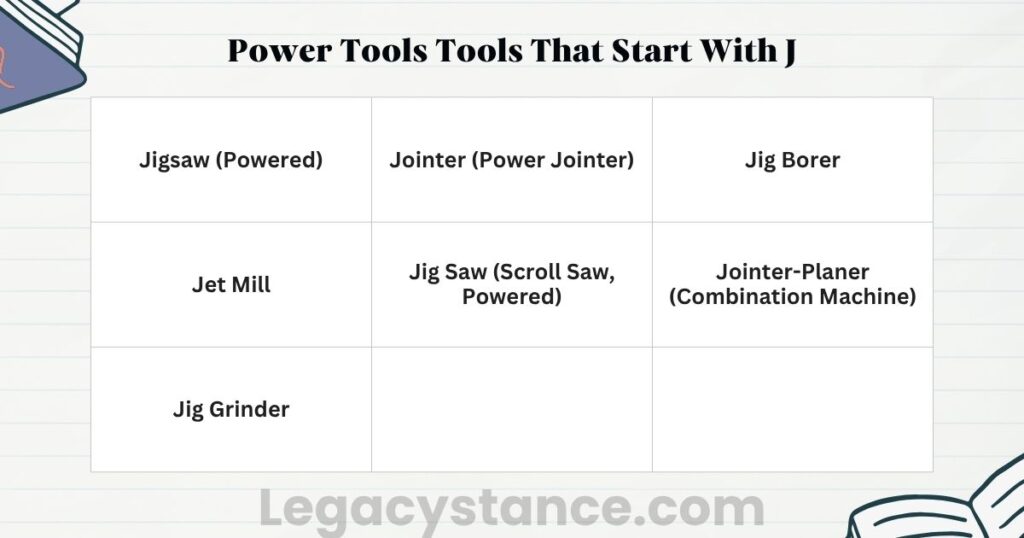
Jigsaw (Powered)
Type: Cutting power tool Up-and-down blade movement cuts curves, circles, and irregular shapes in wood, metal, plastic, and tile depending on blade type. Fine-tooth blades give clean cuts; coarse teeth cut faster with rougher edges.
Jointer (Power Jointer)
Type: Stationary woodworking machine Flattens one face or edge of a board over a spinning cutterhead. Creates the flat reference face needed before thickness planing. Light, repeated passes give better results than single aggressive cuts.
Jig Borer
Type: Precision stationary machine Drills and bores holes to extremely tight tolerances using a precise X-Y coordinate table for hole placement. Used by tool and die makers and mold makers — not a general workshop machine.
Jet Mill
Type: Industrial grinding machine Uses high-velocity air or steam to grind particles through collision rather than mechanical contact. Produces ultrafine powders for pharmaceutical, chemical, and materials industries.
Jig Saw (Scroll Saw, Powered)
Type: Stationary cutting machine A powered scroll saw where the workpiece moves across a stationary fine blade on a table. Used for detailed curve cutting in pattern work, sign making, and decorative woodwork.
Jointer-Planer (Combination Machine)
Type: Combination woodworking machine Combines a powered jointer and thickness planer in one machine. The jointer function flattens faces and edges; the planer function thicknesses boards to a consistent dimension.
Jig Grinder
Type: Precision grinding machine Grinds holes and internal surfaces to precise tolerances in hardened steel. Found in tool rooms for finishing dies, molds, and fixtures after heat treatment.
Professional and Specialty Tools That Start With J
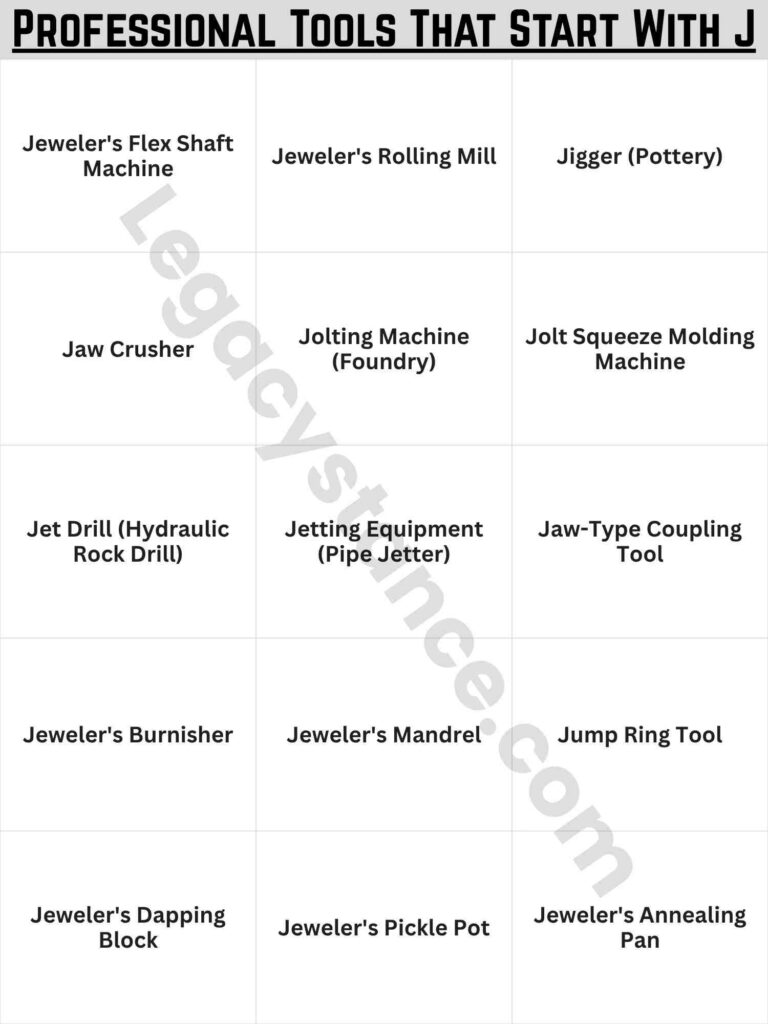
Jeweler’s Flex Shaft Machine
Type: Rotary power tool (professional) A hanging motor driving a flexible shaft connected to a lightweight handpiece for burs, grinding wheels, and polishing discs. More control than a handheld rotary tool for sustained precision metalwork.
Jeweler’s Rolling Mill
Type: Metalworking machine Passes metal stock between hardened rollers to reduce thickness, change cross-section, or texture surfaces. Used for rolling silver and gold sheet and impressing surface patterns.
Jigger (Pottery)
Type: Ceramic forming machine Shapes clay against a profile template while spinning on a rotating mold head. A commercial production tool for consistent bowls, plates, and cups.
Jaw Crusher
Type: Industrial size-reduction machine Breaks large rocks and concrete rubble between a fixed and moving jaw plate. Output size controlled by the gap at the jaw’s base. Used in quarrying, mining, and demolition.
Jolting Machine (Foundry)
Type: Sand mold compaction equipment Compacts foundry sand around a casting pattern by rapid vibration for uniform density and accurate detail before metal is poured.
Jolt Squeeze Molding Machine
Type: Foundry machine Combines jolting and squeezing operations to produce denser, more accurate sand molds than jolting alone. Used in medium-volume iron and aluminum casting production.
Jet Drill (Hydraulic Rock Drill)
Type: Mining tool Uses high-pressure water jets to cut through rock in mining and tunneling. Produces less silica dust than rotary drilling.
Jetting Equipment (Pipe Jetter)
Type: Drain maintenance tool High-pressure pump, hose reel, and nozzles that blast grease, root intrusions, and scale from drain lines. Forward jets break blockages; rear jets clean pipe walls.
Jaw-Type Coupling Tool
Type: Industrial maintenance tool Installs and removes jaw shaft couplings without damaging the flexible spider element between coupling halves. Used during planned machinery maintenance shutdowns.
Jeweler’s Burnisher
Type: Metalworking hand tool A hard, polished rod used to smooth, compress, and polish metal surfaces and set bezels or tube settings in jewelry. Moved under pressure across the metal surface.
Jeweler’s Mandrel
Type: Forming tool A tapered steel rod used to shape, size, and round metal rings during jewelry fabrication. Ring bands are slipped over the mandrel and tapped to the correct size.
Jump Ring Tool
Type: Jewelry tool A specialty tool that cuts coiled wire into uniform jump rings — the small open rings used as connectors in chain mail, jewelry assembly, and metalwork.
Jeweler’s Dapping Block
Type: Metalworking forming tool A steel or wood block with hemispherical depressions used with matching punches to dome flat metal discs into curved shapes for pendants, domes, and bezels.
Jeweler’s Pickle Pot
Type: Metalworking cleaning tool A small heated vessel containing acidic pickle solution (usually sodium bisulfate) that removes fire scale and flux residue from metal after soldering or annealing.
Jeweler’s Annealing Pan
Type: Metalworking tool A rotating pan filled with pumice stones that holds and rotates metal pieces during flame annealing, allowing heat to be applied from all sides for even softening.
Digital and Software Tools That Start With J
Jira
Type: Project management software Tracks tasks, bugs, sprints, and workflows for software and engineering teams. Used for kanban boards, issue tracking, and sprint planning.
Jenkins
Type: CI/CD automation tool An open-source automation server that builds, tests, and deploys code automatically on each commit. Foundational in DevOps workflows.
JavaScript
Type: Programming language The primary language for browser-side web interactivity — forms, animations, and dynamic content. Node.js extends it to server-side development.
Jekyll
Type: Static site generator Builds websites from plain Markdown text files without a database. Popular for documentation sites and developer blogs hosted on GitHub Pages.
JMeter
Type: Performance testing tool Simulates large numbers of users hitting a web application to measure how the system handles load. Used before launches to find performance bottlenecks.
JSON Editor
Type: Developer utility Formats, validates, and visualizes JSON data as a readable tree structure. Makes working with API responses and config files significantly faster than reading raw JSON.
JUnit
Type: Software testing framework A unit testing framework for Java that lets developers write and run automated tests for individual code components. Core to test-driven development in Java.
Jupyter Notebook
Type: Interactive development environment A coding environment where code runs inline alongside notes and charts. Standard in data science, machine learning, and research workflows.
JAXB
Type: Java development tool Maps Java objects to XML documents and back. Used in enterprise applications and web services for data exchange between Java and XML-based systems.
JProfiler
Type: Java performance tool A profiling tool for Java applications that identifies memory leaks, CPU bottlenecks, and thread performance issues in running applications.
JSFiddle
Type: Web development tool A browser-based sandbox for writing and testing HTML, CSS, and JavaScript code in real time. Used for quick prototyping, debugging, and sharing code snippets.
Jasmine
Type: JavaScript testing framework A behavior-driven testing framework for JavaScript. Lets developers write readable test cases for front-end and Node.js code without dependencies on a browser.
JWT (JSON Web Token Tool)
Type: Security / authentication tool Libraries and debuggers used to create, validate, and decode JSON Web Tokens for secure authentication between web services and APIs.
Safety Equipment Starting With J
Hi-Vis Safety Jacket
Type: Personal protective equipment Fluorescent yellow, orange, or lime jacket with retroreflective strips for visibility in low light. ANSI/ISEA class ratings define coverage requirements for different work environments.
Jaw Face Shield
Type: Face and eye protection A full-face shield protecting face and jaw from flying debris, sparks, and chemical splashes. Worn over safety glasses — not instead of them — during grinding and chemical handling.
Joint Protector (Thread Protector)
Type: Equipment protection Plastic or metal caps protecting threaded pipe ends during transport and handling. Prevents damaged threads that cause leaking joints in high-pressure systems.
Jacket-Type Life Preserver (PFD)
Type: Marine personal protective equipment Type I and II personal flotation devices that turn an unconscious person face-up in water. Required for workers near open water on construction and marine operations.
Jaw Locking Safety Clamp
Type: Fall protection / scaffolding hardware Locks scaffold tubes under load without releasing from vibration or shock. Used by scaffold erectors where accidental release creates a falling hazard.
Job Site First Aid Kit
Type: Emergency safety equipment Stocked with wound care, burn treatment, eye wash, and emergency supplies for construction and industrial environments. OSHA guidelines define minimum contents by workforce size.
Jetted Safety Harness (Full Body Harness)
Type: Fall arrest equipment A full-body harness connecting workers to anchor points at height via a lanyard or self-retracting lifeline. Distributes fall arrest forces across the chest, shoulders, and thighs.
Jar Test Kit (Water Quality)
Type: Environmental safety / testing tool Used in water treatment to test coagulation and flocculation chemistry before adjusting treatment plant dosing. A series of jars simulates the treatment process at small scale.
Jolting Vibration Meter
Type: Occupational health tool Measures hand-arm vibration exposure from power tools like jackhammers and grinders. Used by safety officers to assess and control vibration exposure risk for workers.
How to Choose the Right J Tool
Match the tool to the material. A jab saw is right for drywall — wrong for solid timber. A jig sized for pocket holes won’t help with dovetails. Know the material and the task before buying.
Buy for actual use frequency. A jigsaw used once a year doesn’t need a premium brushless battery model. Buy for real use, not best-case scenarios.
Handle comfort matters for tools held long-term. Weight distribution, grip diameter, and balance vary significantly between brands — hold tools before buying when possible.
Check certifications for safety equipment. Hi-vis jackets, PFDs, and harnesses must meet ANSI, OSHA, or relevant industry standards. A product that looks right but isn’t rated correctly doesn’t provide real protection.
Beginner Mistakes to Avoid
Trusting a floor jack as a support. Floor jacks lift — jack stands hold. Working under a vehicle on a floor jack alone has caused serious injuries.
Skipping jig setup. Two minutes setting up a pocket hole jig or shelf pin guide prevents misaligned holes that take much longer to fix.
Running dull jigsaw blades. Dull blades burn wood and wander off the cut line. Change blades more often than feels necessary.
Wrong jumper cable order. Reversing connections risks voltage spikes that damage modern vehicle electronics. Positive to dead, positive to good, negative to good battery, then negative to unpainted metal on the dead vehicle — in that sequence.
Maintenance Tips
Jack planes need regular blade sharpening. A dull iron tears wood instead of slicing it.
Jigsaws need blade changes frequently. Fresh blades cut faster and cleaner with less force.
Floor jacks need occasional hydraulic fluid checks. A jack that sinks slowly under load needs fluid topped up with the correct type.
Jeweler’s loupes just need the lens kept clean with a microfiber cloth. Store folded in the case to protect the glass.
Read also –
115+ Tools That Start With I: Hand, Mechanic & Professional Tools
115+ Tools That Start With M: Hand, Mechanic & Professional Tools
FAQs
What’s the difference between a jab saw and a jigsaw?
A jab saw is a manual handsaw with a pointed tip for starting cuts in drywall without drilling first. A jigsaw is a powered tool for curved cuts in wood, metal, and other materials. Completely different tools.
Can a jack plane replace a power jointer?
Both flatten board faces. A power jointer is faster on rough stock; a well-tuned jack plane achieves the same result with more time and skill. Most serious woodworkers use both.
Does jumper cable gauge actually matter?
Yes. Thicker cables (lower gauge numbers) transfer more current. For trucks and large engines, 2-gauge cables are recommended. For most passenger cars, 4-gauge is adequate.
Is a jig worth buying, or is careful measuring enough?
For one-off tasks, measuring works fine. For any repeated operation — shelf holes, pocket screws, repeat dados — a jig pays back in accuracy and time within the first project.
Final Word
The letter J covers a wider range than most people expect — from a basic J-hook for pegboard organization to a jig borer in a precision tool room, from the jab saw you grab for a wall repair to Jupyter Notebook open on a data scientist’s screen. Knowing these tools by name, type, and purpose is practical literacy in any trade, workshop, or technical field.
A good toolkit isn’t about having the most tools. It’s about knowing exactly what each one does and when to reach for it.