I’ve always enjoyed trying new AI tools, but I usually lose interest when a website asks me to create an account before I can even see what it does.
That’s why I was particularly interested in testing an AI image to video generator free no sign up option. I wanted to see whether I could turn a still image into a short video without going through a complicated setup.
What started as a quick experiment turned into a surprisingly useful way to create visual content.
I Started With an AI-Generated Image
I didn’t want to use an old photograph for my first test, so I created a new image using an AI image generator free tool.
I kept the prompt fairly simple and focused on creating a clear subject with good lighting and a straightforward composition.
After generating a few versions, I chose the one that looked the most natural.
I quickly realized that the quality of the starting image matters. If the face is blurry or the subject is difficult to see, the final video has less information to work with.
Turning the Image Into a Video
Once I had the image ready, I tried an AI image to video generator free no sign up tool.
The process was much simpler than I expected.
I uploaded the image, selected the type of movement I wanted, and let the AI generate the clip.
Instead of manually creating keyframes or learning video-editing software, I could simply describe the kind of movement I wanted and wait for the result.
The first video wasn’t perfect, but it definitely looked more interesting than the original static image.
I Experimented With Different Movements
I didn’t stop with the first result.
I tried subtle camera movement, slight head movement, and a few other effects. Some looked more natural than others.
I found that subtle movement generally worked better than asking the AI to make everything move dramatically.
That made sense when I thought about it. The AI is starting with a single image, so asking it to create complicated movements means it has to generate information that isn’t actually present in the original picture.
Keeping things simple produced more convincing results for me.
Then I Tried Talking Photo AI
After creating a moving image, I wanted to take the experiment one step further.
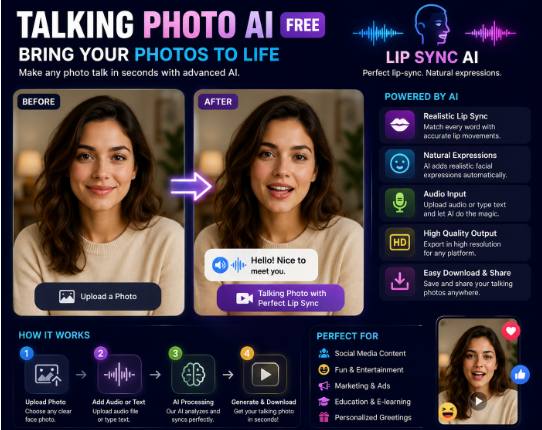
I used talking photo AI to see whether I could make a character appear to speak.
This was probably the most interesting part of the experiment.
I provided a short piece of dialogue, and the AI generated facial and mouth movements to match the speech.
Seeing the same still image first move and then appear to speak made me realize how quickly AI video technology has developed.
The Source Image Made a Huge Difference
One of the biggest lessons I learned was that AI can’t completely compensate for a poor source image.
I got much better results when:
- The subject was clearly visible.
- The face was facing mostly toward the camera.
- The image had good resolution.
- Lighting was reasonably even.
- There weren’t objects covering the face.
When I used a low-quality image, the generated movement looked less natural.
So now I spend a little more time choosing the image before starting the video generation process.
Why I Liked the No-Sign-Up Approach
The biggest advantage for me was convenience.
I wasn’t ready to commit to a complicated workflow. I simply wanted to test an idea and see whether the technology was useful.
Being able to try an AI image to video generator free no sign up option made that process much easier.
I could experiment first rather than spending time creating an account before knowing whether I liked the results.
For quick tests, that makes a big difference.
Where I Can See Myself Using It
After experimenting with several images, I could see more practical uses for this technology.
Content creators could turn illustrations into short clips. Businesses could create simple visual introductions. Someone preparing social media content could add movement to an otherwise static graphic.
Talking-photo tools could also be useful for creating short educational or presentation-style clips.
Of course, I would always make sure that I have permission to use photographs of real people and avoid creating misleading content.
What Didn’t Work Perfectly
I don’t want to make it sound as though every result was flawless.
Some videos had strange movements, while certain facial expressions didn’t look completely natural.
Longer or more complicated instructions also produced less consistent results for me.
I’ve learned to treat AI generation as an iterative process.
If the first result isn’t right, I change the source image or simplify the instructions and try again.
My Simple Workflow Now
After experimenting, I’ve settled on a basic process:
- Create or choose a clear image.
I make sure the subject is visible and the image has good quality. - Generate the animation.
I use an AI image-to-video tool and start with subtle movement. - Review the result.
I check for strange facial or body movements. - Try talking-photo animation when appropriate.
If I want the character to speak, I use talking photo AI with a short script. - Make another version if necessary.
I don’t expect the first generation to be perfect.
This workflow is much easier than traditional video editing for the type of short experiments I’m interested in.
My Final Verdict
My first goal was simply to find out whether I could turn an AI-generated picture into a video without signing up for a complicated service.
The experiment went further than that.
Using an AI image generator free tool gave me a starting point, while an AI image to video generator free no sign up option allowed me to add movement quickly. Adding talking photo AI showed me that the same image could also become a speaking character.
The technology still has limitations, but I was impressed by how accessible the process has become.
For me, the biggest advantage isn’t replacing traditional video production. It’s being able to take an idea from a still image to a short animated concept in a matter of minutes.
That’s enough to make these AI tools worth experimenting with.