BTA means “But Then Again” in texts, chats, and social media. It’s a shortcut for that moment when you second-guess yourself mid-sentence. But drop those same three letters into a work email or travel document, and they mean something completely different.
That gap is exactly why people get confused.
BTA Slang Version: What It Actually Does in a Sentence
“But Then Again” isn’t just a filler phrase. It carries a specific energy — it’s the pause before you reconsider something you just said. Softer than “but.” More honest than pretending you’re certain.
“The show started slow, BTA the last episode was worth it.”
That sentence isn’t arguing with itself. It’s being fair. BTA signals that you’re adding the other side, not taking back what you said. That’s why it fits so naturally into casual conversation — it sounds balanced without sounding defensive.
People rarely use BTA to disagree with someone else. It almost always shows up when someone is rethinking their own take.
Where You’ll Actually See BTA Mean
In texts, it slips in exactly where you’d normally pause and say “but then again” out loud:
- “I was about to leave early, BTA the second half was actually good.”
- “She seemed annoyed, BTA I might’ve been overthinking it.”
On TikTok and Instagram, it shows up in captions or comments where someone is showing both sides without writing a full paragraph about it. Quick, self-aware, a little honest. That’s the vibe.
“Didn’t love the trip at first. BTA I’d probably go back.”
The tone across all these is the same — calm, conversational, slightly reflective. Never dramatic. Never aggressive.
Here’s What Most Get Wrong About BTA
They treat it like a simple swap for the word “but.”
It’s not. There’s a real difference between:
“I don’t like that idea.”
and
“I don’t like that idea, BTA I haven’t tried it your way yet.”
The second one leaves the door open. BTA tells the reader you’re still thinking, still being fair. That’s the whole reason people reach for it instead of just writing “but.” It carries a slightly humble, open-minded undertone that “but” alone doesn’t.
If someone sends you a message with BTA, they’re not dismissing what came before it — they’re balancing it.
BTA Meaning in Examples (Mixed Formats, Real Situations)
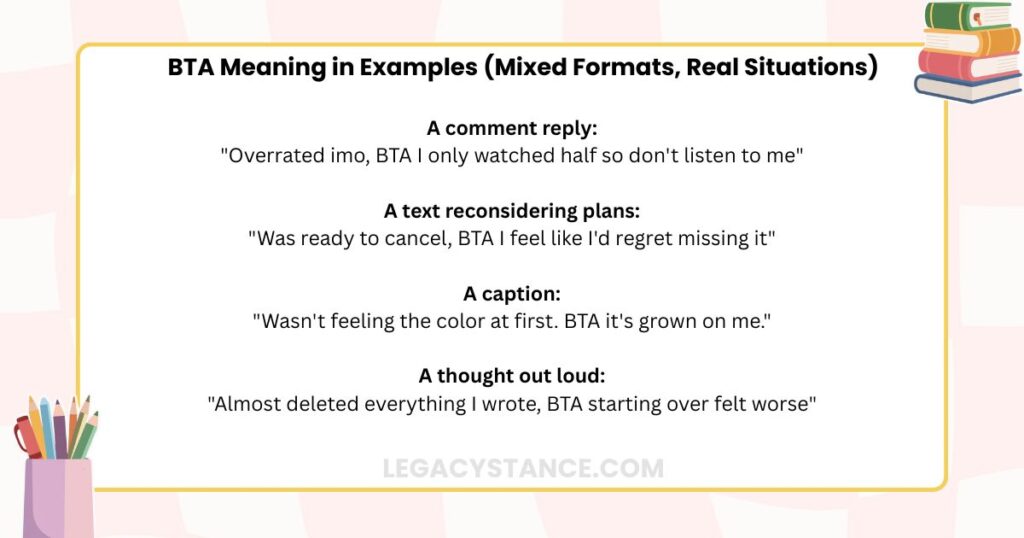
A comment reply:
“Overrated imo, BTA I only watched half so don’t listen to me”
A text reconsidering plans:
“Was ready to cancel, BTA I feel like I’d regret missing it”
A caption:
“Wasn’t feeling the color at first. BTA it’s grown on me.”
A thought out loud:
“Almost deleted everything I wrote, BTA starting over felt worse”
Notice none of these sound forced. BTA earns its place in each one.
BTA Business Meaning — Same Letters, Different World
In corporate or travel-related writing, BTA has nothing to do with second-guessing. It stands for two separate professional terms:
Business Travel Account — a central payment system companies set up so employees don’t pay for work trips out of pocket. Flights, hotels, transfers — all billed through one account.
Business Travel Allowance — a fixed amount of money given to an employee to cover travel costs on a work trip.
A sentence like “all hotel bookings must go through the BTA” is a policy instruction, not someone thinking out loud.
The rule is straightforward: casual context points to “But Then Again,” professional or travel context points to one of the business meanings. The same acronym, genuinely different audiences.
Does BTA Mean Anything in Basketball?
Short answer: not officially. There’s no recognized basketball term behind BTA. If someone used it in a sports group chat, they almost certainly meant “But Then Again.” Some niche local leagues might use their own shorthand, but nothing standard exists in the sport under this acronym.
The One Tone Mistake People Make
Because BTA signals contrast, some readers assume it’s passive-aggressive or dismissive. It’s usually not.
“The food was decent, BTA I probably won’t order from there again” is just an honest review. It’s not shade. Reading BTA as sarcasm when the person is just being balanced will make you misread the whole message.
Default to calm and reflective. That covers the vast majority of real usage.
Read also:
GTB Meaning: What It Means in Texts, TikTok, Medical Use, and More
YN Meaning Slang: What It Means (And Why Context Changes Everything)
FAQs
What’s the difference between BTA and TBH?
TBH (to be honest) is upfront disclosure — you’re revealing your real opinion. BTA is reconsideration — you’re revisiting something you already said. One is honesty about a feeling. The other is balance in thinking.
Is BTA ever rude or confrontational?
Rarely. The whole point of “But Then Again” is that it softens contrast rather than sharpening it. If someone uses it rudely, the problem is the rest of the sentence, not BTA itself.
How do you reply when someone uses BTA?
Focus on the second half of their message — that’s where their actual point landed. If someone texts “I wanted to come, BTA I’m exhausted,” they’re leaning toward staying home. Respond to that lean. You don’t need to acknowledge the acronym at all.
Can BTA appear in formal writing?
Only if it’s the business travel version — and even then, spelled-out terms are more common in formal documents. In personal or creative writing, it stays casual. You wouldn’t use it in a work email unless your workplace is unusually relaxed.
Same three letters. The meaning shifts based entirely on where you find them. In a chat, it’s someone thinking out loud. In a travel policy, it’s a payment system. Get the context right and BTA is never confusing again.