IGU usually means “I got you” in texting and chat. It’s a fast way to say “understood,” “I’ll handle it,” or “I’m here for you.” In frustrated or joking messages, it can also mean “I give up.” Context decides which one.
You got a message. Three letters. No explanation.
IGU.
And now you’re here. That’s fair — because this one actually has two meanings that feel nothing alike, and the letters alone won’t tell you which is which.
Start Here: The Two IGU Meanings
“I Got You” is what IGU means most of the time. It’s short for saying yes to someone, backing them up, or confirming you understood something. No long reply needed. Just IGU.
“I Give Up” is the second meaning — less common, but real. It shows up when someone is venting, joking about failing, or done trying with something. Same three letters, completely different energy.
The only thing separating them is the mood of the conversation.
How to Tell Which One IGU Is
This is where most explanations fall short. They list both meanings and leave you guessing. Here’s what actually helps:
If the conversation before IGU involved a request, a plan, or someone needing support — it’s almost certainly “I got you.”
If the conversation involved frustration, repeated failure, or dramatic humor — it’s probably “I give up.”
That’s it. You don’t need to analyze the person’s personality or texting style. Just look at what came right before it.
IGU Real Examples That Show the Difference
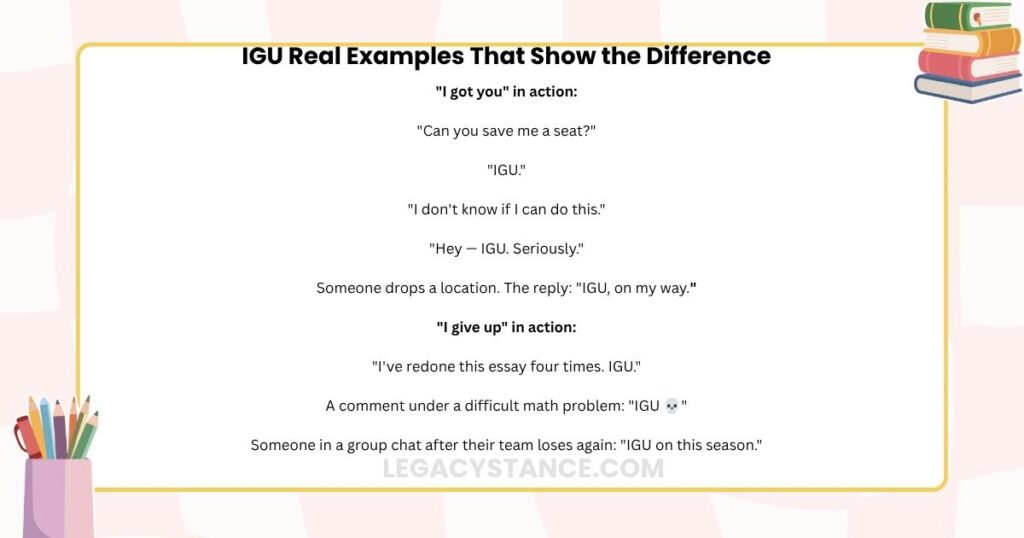
These are written to sound like actual texts, not examples from a textbook.
“I got you” in action:
“Can you save me a seat?”
“IGU.”
“I don’t know if I can do this.”
“Hey — IGU. Seriously.”
Someone drops a location. The reply: “IGU, on my way.”
“I give up” in action:
“I’ve redone this essay four times. IGU.”
A comment under a difficult math problem: “IGU 💀”
Someone in a group chat after their team loses again: “IGU on this season.”
The second set has a specific feel to it — exhausted, sometimes funny, always a little dramatic. That contrast is your best tool for reading IGU correctly.
Does the Sender’s Gender Change the IGU Meaning?
People search things like “IGU meaning text from a guy” or “IGU meaning text from a girl” — which makes sense when you’re trying to read into a message from someone specific.
The short answer: no, gender doesn’t change what IGU means. The slang works the same way regardless of who sends it. What shifts the meaning is tone, not the person.
If someone you’re interested in sends you IGU after you asked them something, they’re almost certainly saying “I got you” — as in yes, they’re in, no worries. Read the conversation, not the sender.
IGU on Snapchat and TikTok
On Snapchat, conversations move fast and captions are short. IGU fits that perfectly as a quick confirmation — “got it,” “I’m in,” “understood.” You’ll rarely see the “I give up” version there unless someone is being theatrical about something in their story.
On TikTok, it splits more clearly. In comments under relatable or supportive videos, IGU means “I got you” — the viewer is agreeing or connecting with the creator. In captions on fail videos or frustration content, it almost always means “I give up.” The emoji next to it usually confirms which direction it’s going.
IGU vs. Similar Terms
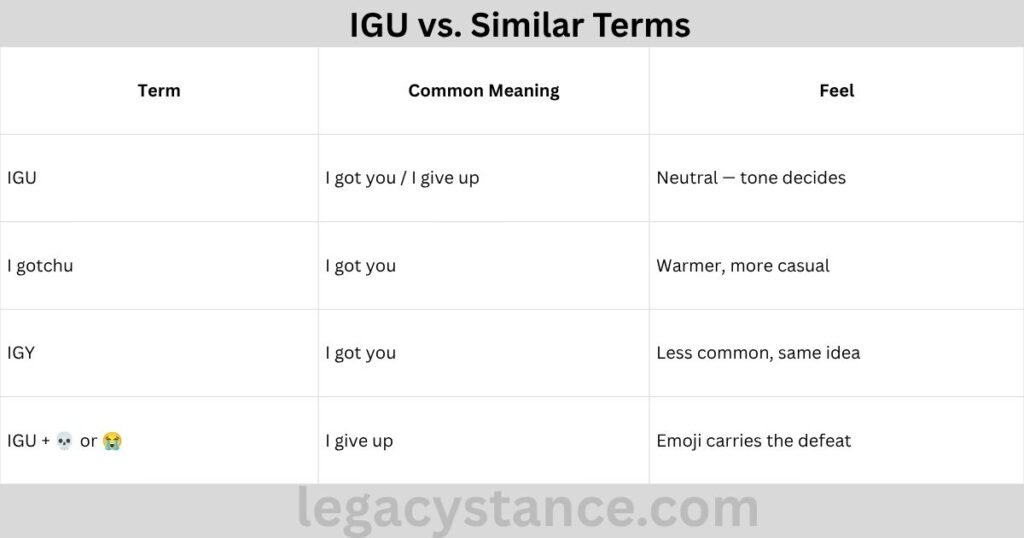
| Term | Common Meaning | Feel |
| IGU | I got you / I give up | Neutral — tone decides |
| I gotchu | I got you | Warmer, more casual |
| IGY | I got you | Less common, same idea |
| IGU + 💀 or 😭 | I give up | Emoji carries the defeat |
I gotchu is probably the friendliest version of the same idea — it sounds like something a close friend says without thinking. IGU is more clipped, a little more matter-of-fact.
The Window Industry IGU (Separate Thing Entirely)
If you searched “IGU meaning windows” — that’s a completely different world. In construction and glass manufacturing, IGU stands for insulating glass unit. It refers to double or triple-pane window glass designed to hold in heat or cool air.
Nothing to do with texting. Just worth clearing up because the searches sometimes overlap.
How to Reply When Someone Sends You IGU
If they meant “I got you”: Keep it simple. Thank them, confirm the plan, or just move the conversation forward. They’ve already said yes — no need to push further.
“Thank you, that helps a lot.”
“Perfect — see you then.”
If they meant “I give up”: Match the energy. Light humor or a bit of encouragement both work.
“Same honestly 😭”
“You’re almost there though, don’t quit”
You don’t have to decode the perfect response. Just respond to the mood they gave you.
What Actually Happens in Real Conversations
From what shows up across social media threads, comment sections, and group chats — IGU as “I got you” is the dominant meaning by a wide margin. The “I give up” version is real, but it almost always comes packaged with other signals: a defeated emoji, a frustrated rant before it, or obvious humor.
If you’re ever genuinely unsure, default to “I got you.” You’ll be right most of the time, and it’s the safer read in almost any situation.
Read also:
PWMP Meaning: What It Means in Text, TikTok, Snapchat & More
WDYM Meaning in Chat — What It Really Means and How to Use It
FAQs
Can IGU be used sarcastically?
Yes — in close friendships where sarcasm is already the default, someone might fire back IGU while clearly not meaning it. It usually lands with a dry or deadpan tone. If you’re not sure if someone’s being sarcastic, the rest of the message will usually make it obvious.
Is IGU okay to send to someone you just met?
In casual online spaces — Discord, comment sections, group chats — it works fine. In a more personal one-on-one text with someone you don’t know well yet, writing out “I got you” is clearer and warmer. Three-letter slang can feel cold or dismissive to people who aren’t deep in that texting style.
What if someone said IGU and then didn’t follow through?
That’s a people problem, not a slang problem. IGU as “I got you” implies commitment, but not everyone delivers on it. The abbreviation meant what it meant — the follow-through is a separate issue.
Does IGU carry the same weight in a group chat as in a private text?
Slightly different. In a group chat, saying IGU feels like a public commitment — everyone sees it. In a one-on-one conversation, it’s quieter and more personal. The meaning stays the same, but the social weight behind it shifts depending on who’s watching.