Finding clear meanings for Science Words That Start With Q can feel tricky because these terms are rare but important. This guide keeps things simple. You’ll see real definitions, everyday examples, and why each word matters in school and real life. Whether you’re studying for exams or just curious, this list helps you understand—not just memorize—key Q terms across physics, biology, chemistry, and more.
20 Most-Used Science Words That Start With Q
These cross multiple subjects and appear most often in textbooks and exams. Definitions live in their subject sections below — use this as your navigation map.
Quantum — Physics
Quark — Physics
Quasar — Astronomy
Quartz — Earth Science
Quartzite — Earth Science
Quinine — Chemistry / Medicine
Quinone — Chemistry / Biology
Quiescent — Biology
Quicklime — Chemistry
Quarantine — Medicine
Quorum sensing — Biology
Quadriceps — Biology / Medicine
Qualitative — Scientific method
Quantitative — Scientific method
Quenching — Chemistry
Quaternary — Earth Science
Quadrant — Math / Science
Quotient — Math / Science
Quantum leap — Physics
Queue — Technology
Physics Science Words That Start With Q
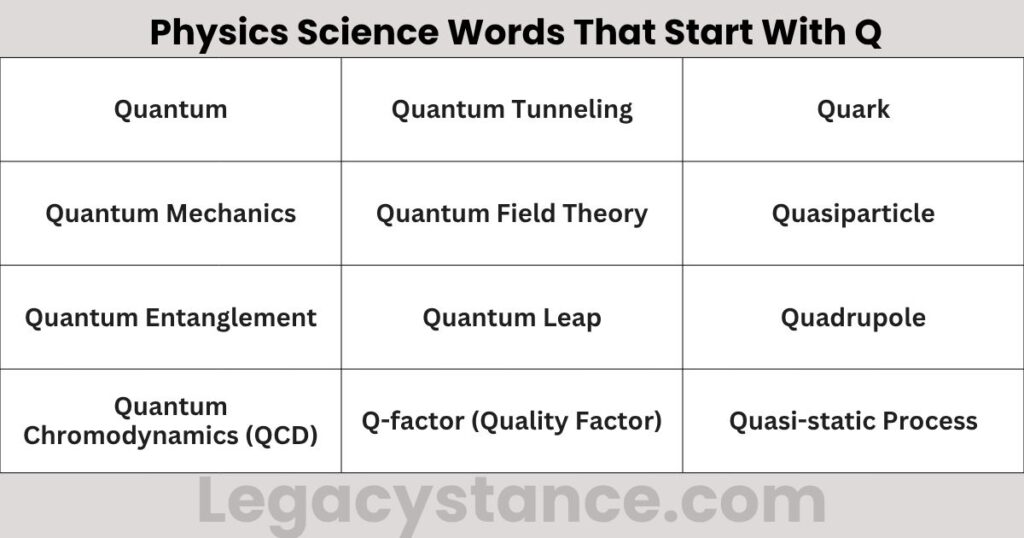
Quantum Latin for “how much.” The minimum amount of energy that can exist or be transferred. You cannot have half a quantum — like you cannot pay with half a penny. This single word underpins an entire branch of physics.
Quantum Mechanics The rulebook for particles at atomic and subatomic scales. Normal physics collapses here — particles exist in multiple states simultaneously, and the act of observing them changes their behavior.
Quantum Entanglement Two particles become linked so that changing one instantly affects the other — no matter the distance between them. Einstein called it “spooky action at a distance.” It remains one of physics’ most verified and most bizarre facts.
Quantum Tunneling A particle passes through a barrier it classically should not be able to cross. This is not science fiction — it happens inside nuclear reactors and modern computer processors.
Quantum Field Theory Unifies quantum mechanics with special relativity. Describes particles as excitations in invisible fields — the way a ripple is an excitation of water.
Quantum Leap In pop culture this means a giant jump. In actual physics it is the smallest possible jump — an electron shifting between energy levels. The real version is microscopic, not dramatic.
Quark Six types exist: up, down, charm, strange, top, bottom. They always bond in groups — a lone quark has never been directly observed. They make up protons and neutrons.
Quasiparticle Not a real particle. When many particles interact inside a material, their collective behavior mimics a single new particle. Quasiparticles simplify otherwise impossible calculations.
Quadrupole A system with two opposing dipoles. Found inside MRI machines and particle accelerators.
Quantum Chromodynamics (QCD) Describes how quarks interact via the strong nuclear force. The three charge types quarks carry are named red, green, blue — nothing to do with actual color.
Q-factor (Quality Factor) Measures energy storage efficiency against energy loss in a system. High Q-factor means less waste. Used in circuit design, resonators, and antenna engineering.
Quasi-static Process A change happening slowly enough that the system stays near-equilibrium at every step. Essential concept in thermodynamics modeling.
Chemistry Science Words That Start With Q
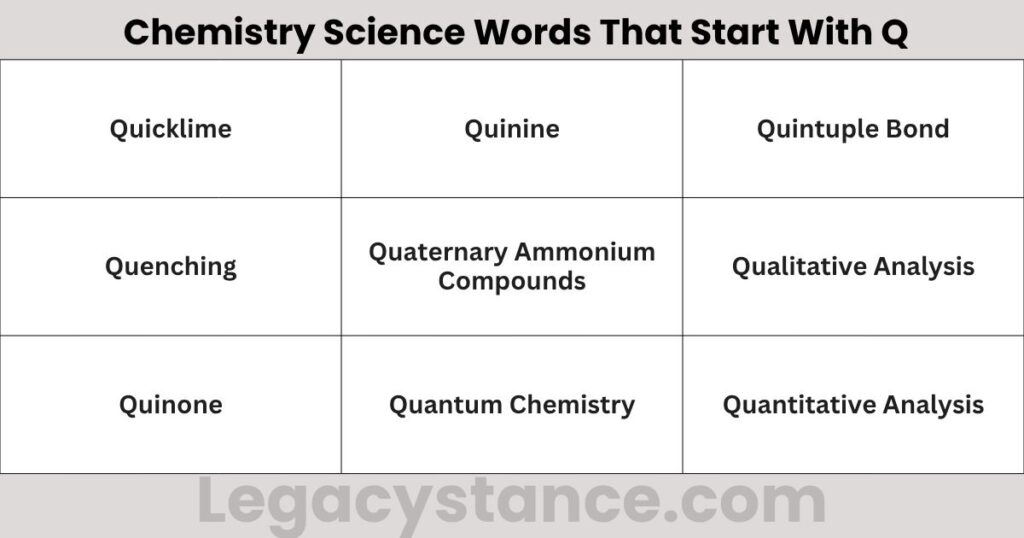
Quicklime Calcium oxide (CaO). Add water and it releases violent heat. Used in cement production, wastewater treatment, and soil stabilization — Romans used it building roads two thousand years ago.
Quenching Plunging heated steel into water or oil for rapid hardening. The speed of cooling determines the final hardness of the metal. Blacksmiths have done this for millennia.
Quinone Organic compound carrying electrons between protein complexes during cellular respiration. Without quinones, cells cannot convert food into ATP — the molecule that powers nearly everything your body does.
Quinine Extracted from cinchona tree bark. The original malaria treatment and the source of tonic water’s bitterness. Modern medicine uses synthetic versions, but the natural compound is still studied.
Quaternary Ammonium Compounds Positively charged nitrogen molecules that kill bacteria by rupturing their membranes. Found in hospital disinfectants, eye drops, and some fabric softeners.
Quantum Chemistry Applies quantum mechanics to chemical bonding — explaining why certain atoms bond, how molecules are shaped, and why some reactions happen and others do not.
Quintuple Bond Five shared electron pairs between two atoms. Observed for the first time between two chromium atoms in 2005. Rare, unstable, and still being studied.
Qualitative Analysis Identifies what substances are present in a sample — no measurement involved. Example: a flame test revealing the presence of sodium.
Quantitative Analysis Measures exactly how much of a substance is present. Used in pharmaceutical quality control, food safety testing, and environmental monitoring.
Biology Science Words That Start With Q
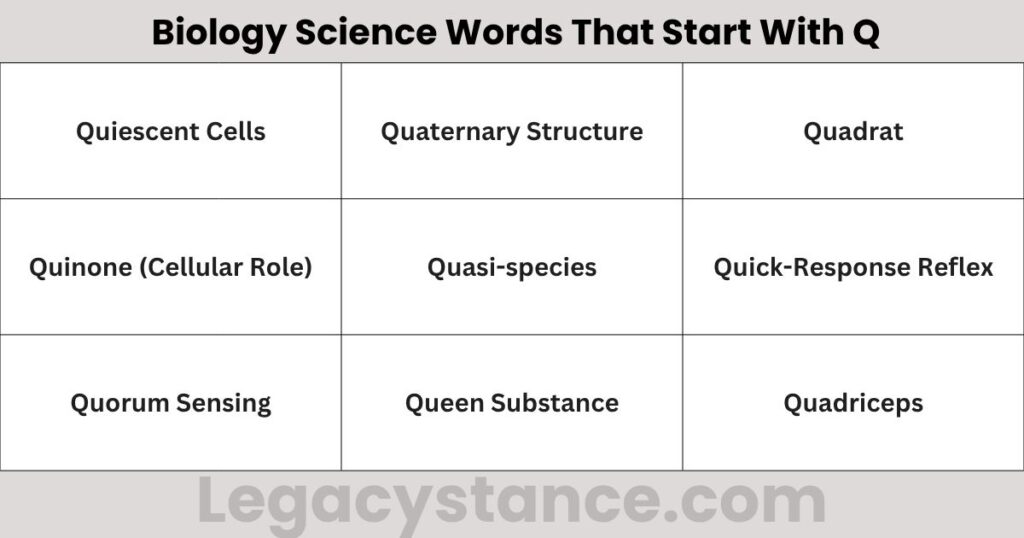
Quiescent Cells Living but not dividing. Stem cells often stay quiescent until the body signals a need — like reserve workers on standby. Some cancer research focuses on what keeps cells quiescent and what disrupts it.
Quinone (Cellular Role) Transfers electrons between protein complexes inside mitochondria. This electron transfer is how your cells produce ATP. Quinones are not optional — no quinones, no energy production.
Quorum Sensing Bacteria release chemical signals constantly. When signal concentration reaches a threshold — enough bacteria nearby — the colony switches behavior. They may form a biofilm, produce toxins, or become resistant to antibiotics. It is bacterial communication through chemistry.
Quaternary Structure The fourth and highest level of protein organization — multiple folded chains assembled into one working unit. Hemoglobin has quaternary structure: four chains working together to carry oxygen through blood.
Quasi-species A virus population is not one identical strain. It exists as a swarm of slightly different genetic variants, all competing. This is why influenza mutates quickly and why some viruses become drug-resistant.
Queen Substance A pheromone produced by a queen bee. It suppresses the development of rival queens and regulates worker bee behavior. Remove the queen, and the colony detects her absence within hours through this chemical signal.
Quadrat A square frame dropped in random locations by ecologists to count organisms within a fixed area. One of the simplest and most reliable field sampling tools in biology.
Quick-Response Reflex A nerve signal routed through the spinal cord, bypassing the brain. When you touch something hot, your hand withdraws before your brain registers pain. The brain catches up a fraction of a second later.
Quadriceps Four muscles on the front of the thigh — rectus femoris, vastus lateralis, vastus medialis, vastus intermedius. They extend the knee and stabilize the kneecap. Active every time you stand, walk, or climb.
Earth Science Words That Start With Q
Quartz Silicon dioxide (SiO₂) in crystalline form. Hardness of 7 on the Mohs scale makes it resistant to weathering. One of Earth’s most abundant minerals — white sand beaches are largely quartz grains. Used in glassmaking, electronics, and precision timekeeping.
Quartzite Sandstone subjected to intense heat and pressure deep underground transforms into quartzite. Harder and denser than its source rock. Used in countertops, flooring, and road aggregate.
Quaternary Period The last 2.6 million years of geological time. Contains the Pleistocene epoch — repeated ice ages — and the Holocene, which is the current epoch. Humans evolved entirely within this period.
Quicksand Fine sand saturated with water loses friction between grains and behaves like a liquid. You do not sink completely — the density is too high for full submersion — but panicked thrashing makes it worse. Slow, deliberate movement is the way out.
Quake Sudden energy release in Earth’s crust from tectonic movement, fault slippage, or volcanic activity. Measured on the Moment Magnitude scale. Shallow quakes cause more surface damage than deep ones.
Quadrature (Tidal) When the Moon sits at 90° to the Sun relative to Earth. Gravitational forces partially cancel each other, producing neap tides — the weakest tidal range of the lunar cycle.
Quartz Sandstone Sedimentary rock composed almost entirely of quartz grains cemented together. Light-colored, common in ancient desert and beach deposits.
Space & Astronomy Science Words That Start With Q
Quasar Short for quasi-stellar object. Supermassive black holes actively consuming matter release energy that outshines entire galaxies. The brightest known objects in the universe. Most are billions of light-years away — observing them is looking back at the early universe.
Quantum Gravity The unsolved problem of unifying quantum mechanics with general relativity. Quantum mechanics governs the very small; relativity governs the very large. At extreme scales — like inside a black hole — both should apply simultaneously, but no complete theory reconciles them yet.
Q-Band Microwave frequencies between 33 and 50 GHz used in radio astronomy. Astronomers use Q-band observations to map cold molecular clouds — the regions where new stars form.
Quiet Sun A phase in the Sun’s 11-year activity cycle when sunspot numbers are low. Fewer solar flares and coronal mass ejections during this phase reduce risk to satellites, power grids, and communication systems.
Quasi-Stellar Radio Source The original full name for what became “quasar.” Early radio telescopes detected intense signals from what appeared to be stars — the “quasi-stellar” label came from that initial confusion.
Quiescent Galaxy A galaxy that has largely stopped forming new stars. Star formation requires cold gas — quiescent galaxies have used theirs up or had it heated by a central black hole.
Medical & Health Science Words That Start With Q
Quarantine Separation applied to people exposed to disease but not yet confirmed sick. Different from isolation, which applies to confirmed cases. Comes from Italian “quarantina” — a 40-day waiting period used in medieval Venice to stop plague spreading from ships.
Quadriplegia Paralysis of all four limbs from spinal cord injury, typically at the cervical (neck) level. Also called tetraplegia. The higher the injury on the spine, the more function is affected.
Quadriceps Tendon The thick tendon connecting the quadriceps muscles to the kneecap. A complete tear requires surgery. Recovery takes six to twelve months. More common in people over 40 and in athletes who jump repeatedly.
QRS Complex A specific waveform on an ECG. It represents the electrical signal triggering ventricular contraction — the heart’s main pumping action. Abnormal shape, width, or timing indicates arrhythmias, heart attacks, or conduction problems.
Q Fever Caused by Coxiella burnetii, a bacterium spread through contact with infected cattle, sheep, and goats. Causes fever, severe headache, and sometimes pneumonia. Named Q for “query” — its origin was unknown when first documented in Australian slaughterhouse workers in 1935.
Quinolone Antibiotics Block bacterial DNA replication by interfering with enzymes the bacteria need to copy their genetic material. Used for urinary tract infections, some respiratory infections, and certain gastrointestinal illnesses.
Quinsy A peritonsillar abscess — a pocket of pus forming beside a tonsil, usually following untreated tonsillitis. Causes severe throat pain, difficulty swallowing, and a muffled voice. Requires drainage and antibiotics.
Quickening The first fetal movements detectable by the pregnant person — typically between weeks 16 and 25 of pregnancy. Historically used as the legal and moral marker of pregnancy before modern imaging existed.
Technology & Applied Science Words That Start With Q
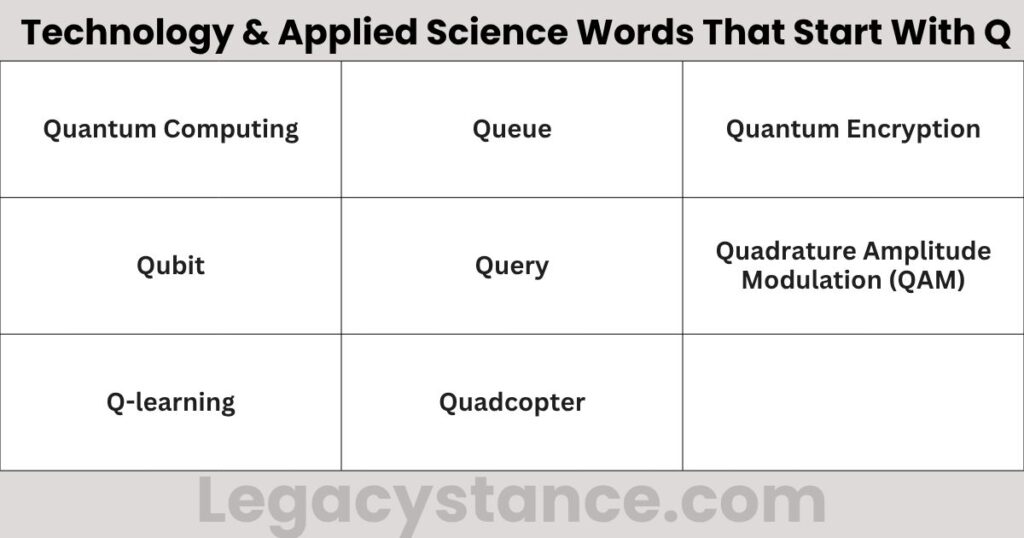
Quantum Computing Regular computers process bits — either 0 or 1. Quantum computers use qubits, which can be 0 and 1 simultaneously through superposition. This allows certain calculations to run exponentially faster. Current applications: cryptography research, molecular simulation, optimization problems.
Qubit Quantum bit. The fundamental information unit in a quantum computer. Extremely fragile — any interaction with the surrounding environment collapses its quantum state, a problem called decoherence.
Q-learning A reinforcement learning method where software learns by receiving rewards for correct actions and penalties for wrong ones. Used in game-playing AI, robotic movement, and traffic optimization systems.
Queue First-in, first-out data structure. The first item added is the first processed. Used in print spoolers, operating system task scheduling, and network packet management.
Query A structured request sent to a database. Every search engine search is a query. In scientific databases, researchers write queries to filter thousands of studies down to those matching specific criteria.
Quadcopter A drone with four rotors arranged in a cross. Each rotor pair spins in opposite directions for stability. Used in ecological field surveys, infrastructure inspection, search and rescue, and precision agriculture.
Quantum Encryption Security system built on quantum mechanics. Any attempt to intercept a quantum-encrypted message disturbs the quantum state — making eavesdropping physically detectable rather than just theoretically difficult.
Quadrature Amplitude Modulation (QAM) A signal encoding technique combining amplitude and phase changes to transmit more data per signal. Used in Wi-Fi, cable television, and 4G/5G mobile networks.
Science Words That Start With Q — By Grade Level
Grades 3–5 Quartz, Quake, Quadrant, Queue, Quicksand, Quarantine, Quotient
Grades 6–8 Quantum, Quark, Quasar, Quartzite, Qualitative, Quantitative, Quorum sensing, Quaternary period, QRS complex, Quenching, Quicklime, Quadriceps
Grades 9–12 Quantum mechanics, Quantum tunneling, Quaternary structure, Quantum chromodynamics, Q-factor, Quasi-species, Quantum field theory, Quinolone antibiotics, Quadriplegia
College and Beyond Quantum decoherence, Quasicrystal, Quasi-static equilibrium, Quasiparticle, Quantum dot, Q-switching, Quaternion, Quantized vortex, Quantum Hall effect
The Full Alphabetical List — 150+ Science Words That Start With Q
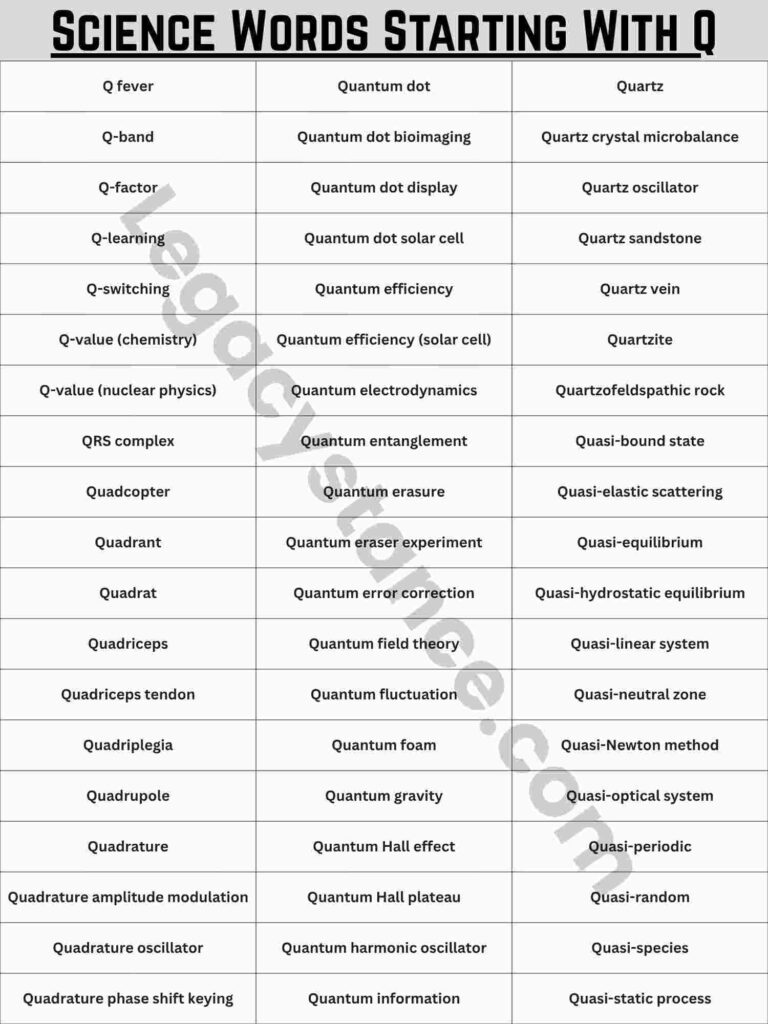
- Q fever
- Q-band
- Q-factor
- Q-learning
- Q-switching
- Q-value (chemistry)
- Q-value (nuclear physics)
- QRS complex
- Quadcopter
- Quadrant
- Quadrat
- Quadriceps
- Quadriceps tendon
- Quadriplegia
- Quadrupole
- Quadrature
- Quadrature amplitude modulation
- Quadrature oscillator
- Quadrature phase shift keying
- Quadruplet (genetics)
- Qualitative analysis
- Qualitative data
- Qualitative observation
- Qualitative research
- Quantitative analysis
- Quantitative data
- Quantitative research
- Quantization
- Quantized vortex
- Quantum
- Quantum annealing
- Quantum biology
- Quantum biology (enzyme tunneling)
- Quantum biology (photosynthesis)
- Quantum cascade laser
- Quantum chaos
- Quantum chemistry
- Quantum chromodynamics
- Quantum chromatic number
- Quantum coherence
- Quantum computing
- Quantum confinement
- Quantum criticality
- Quantum decoherence
- Quantum dot
- Quantum dot bioimaging
- Quantum dot display
- Quantum dot solar cell
- Quantum efficiency
- Quantum efficiency (solar cell)
- Quantum electrodynamics
- Quantum entanglement
- Quantum erasure
- Quantum eraser experiment
- Quantum error correction
- Quantum field theory
- Quantum fluctuation
- Quantum foam
- Quantum gravity
- Quantum Hall effect
- Quantum Hall plateau
- Quantum harmonic oscillator
- Quantum information
- Quantum jump
- Quantum key distribution
- Quantum leap
- Quantum logic gate
- Quantum memory
- Quantum mechanics
- Quantum noise
- Quantum number
- Quantum optics
- Quantum phase transition
- Quantum realm
- Quantum resistance
- Quantum simulation
- Quantum spin
- Quantum state
- Quantum superposition
- Quantum supremacy
- Quantum thermodynamics
- Quantum tunneling
- Quantum well
- Quantum wire
- Quantum yield
- Quark
- Quark-gluon plasma
- Quarantine
- Quartz
- Quartz crystal microbalance
- Quartz oscillator
- Quartz sandstone
- Quartz vein
- Quartzite
- Quartzofeldspathic rock
- Quasi-bound state
- Quasi-elastic scattering
- Quasi-equilibrium
- Quasi-hydrostatic equilibrium
- Quasi-linear system
- Quasi-neutral zone
- Quasi-Newton method
- Quasi-optical system
- Quasi-periodic
- Quasi-random
- Quasi-species
- Quasi-static process
- Quasi-stellar object
- Quasi-stellar radio source
- Quasicrystal
- Quasiparticle
- Quasiparticle excitation
- Quasar
- Quaternary
- Quaternary ammonium
- Quaternary climate
- Quaternary glaciation
- Quaternary period
- Quaternary sediment
- Quaternary structure
- Quaternion
- Quaternion algebra
- Queen substance
- Quenching (fluorescence)
- Quenching (metallurgy)
- Query
- Queue
- Quick-response reflex
- Quickening
- Quicklime
- Quicksand
- Quiescent
- Quiescent current
- Quiescent galaxy
- Quiescent phase
- Quiescent stellar evolution
- Quinine
- Quinolate
- Quinoline
- Quinolone antibiotics
- Quinone
- Quinsy
- Quintuple bond
- Quorum sensing
- Quorum threshold
- Quota (ecology)
- Quotient
- Qubit
- Quadratic growth (biology)
- Quiet Sun
Common Mix-Ups Worth Knowing
Quarantine vs. Isolation Quarantine = exposed, not yet confirmed sick, waiting to see. Isolation = confirmed sick, fully separated. In outbreak management, confusing these two has real public health consequences.
Quartz vs. Quartzite Quartz is a mineral. Quartzite is a rock — quartz grains compressed and recrystallized by geological heat and pressure. One is a crystal; the other is a metamorphic rock built from it.
Qualitative vs. Quantitative Qualitative describes — color, texture, presence of a substance. Quantitative measures — grams, milliliters, concentrations. Both are essential; they answer entirely different types of scientific questions.
Quiescent vs. Dormant Quiescent cells are resting but primed to respond quickly. Dormant organisms are in deep inactivity — seeds waiting for spring, bears through winter. Light rest versus full shutdown.
Quantum Leap — Actual vs. Popular Popular usage: enormous progress. Physics usage: the tiniest possible energy transition. Opposite meanings. Knowing the real definition matters in any physics context.
Quark vs. Quantum A quark is a specific subatomic particle. Quantum is a concept — the minimum measurable unit of something. Quarks operate by quantum rules, but the words are not synonyms.
Where Q Science Words Show Up in Real Life
Medical settings: QRS complexes guide cardiac diagnosis. Quarantine protocols contain outbreaks. Quinolones treat common infections. Quickening marks a milestone in prenatal care.
Chemistry labs: Quicklime adjusts pH in water treatment. Quenching determines metal hardness. Qualitative and quantitative analysis run on every sample processed.
Inside your body right now: Quinones in your mitochondria are producing ATP as you read this. Your quadriceps activated when you last stood up. A quick-response reflex protects you from burns before your brain catches up.
Space research: Quasars are the universe’s most powerful natural beacons — and studying them reconstructs what the cosmos looked like 10 billion years ago.
Technology: Quantum computing will likely crack current encryption methods — which is precisely why quantum encryption research is accelerating in parallel. Q-learning already optimizes traffic signals and delivery routing in live systems.
Why Q Science Words Matter Beyond the Test
Knowing “quorum sensing” explains why infections sometimes worsen suddenly — and why early antibiotic treatment matters. Knowing “qualitative vs. quantitative” sharpens how you evaluate any claim, in science class or a news article.
These terms appear in SAT Subject Tests, AP Biology, AP Chemistry, AP Physics, science olympiad competitions, and university coursework. They are working vocabulary in medicine, engineering, environmental science, and technology — not just academic decoration.
Read more:
130+ Science Words That Start With H | Full List with Meanings
160+ Science Words That Start With L | Full List With Meanings
FAQs about Science Words That Start With Q
1. Why are there so few science words that start with Q?
Q is not common in English, but science borrows many words from Latin and Greek. That’s why fields like quantum physics add many Q terms even if daily language doesn’t.
2. Which Q words should students learn first?
Start with basics like quantum, quark, quartz, qualitative, and quantitative. These show up often in exams and help you understand bigger topics later.
3. What is the easiest way to remember these terms?
Link each word to a real example. For instance, think of quartz as sand or quarantine as staying apart during illness. Simple connections stick better.
4. Are these words useful outside school?
Yes. Terms like quarantine, query, and quantitative are used in health, technology, and daily decisions. They help you understand news and real-world problems.
5. What’s the difference between qualitative and quantitative?
Qualitative describes things (color, shape). Quantitative measures things (numbers, amounts). Both are used together in science experiments.
Final Words
Over 150 science terms starting with Q, organized by subject, difficulty, and grade level. Each word is defined once, in its most relevant section. The full alphabetical list works as a quick reference. Subject sections give context — the reason a word exists, not just what it means.
For test preparation: start with the top-20 table and your subject section. For teaching: the grade-level breakdown shows what fits each stage. For general curiosity: the advanced section contains some of the stranger, more fascinating science in this entire list.