Learning science words that start with I doesn’t have to feel overwhelming. Whether you’re studying for a test, teaching a class, or just trying to understand basic science terms, this guide breaks everything down in a simple way.
You’ll find science vocabulary with I explained in plain English — no confusing jargon, no long textbook definitions. Just clear meanings, real-life examples, and where these words actually show up.
From common terms like inertia and ion to more advanced concepts, this list helps you:
- Understand faster
- Remember longer
- Use the words correctly
If you’ve ever searched for science terms that start with I with meanings, you’re in the right place.
Quick List of Science Words Starting With I
– Igneous – Rock formed from cooled magma or lava
– Immune system – Body’s defense against disease
– Inertia – Resistance to change in motion
– Ion – Atom with an electric charge
– Isotope – Same element, different neutrons
– Invertebrate – Animal without a backbone
– Infrared – Light felt as heat
– Inherited trait – Trait passed from parents
– Incubation – Time for development before symptoms
– Insoluble – Cannot dissolve in liquid
– Insulator – Blocks heat or electricity
– Ignite – To start burning
– Iris – Controls how much light enters the eye
– Intestine – Digests and absorbs nutrients
– Isobar – Line showing equal air pressure
– Ionic bond – Bond formed by electron transfer
– Impulse – Force acting over a short time
– Inertial mass – Resistance to acceleration
– Ignition point – Temperature needed to start burning
– Index fossil – Fossil used to date rocks
The Full List: Science Words That Start With I
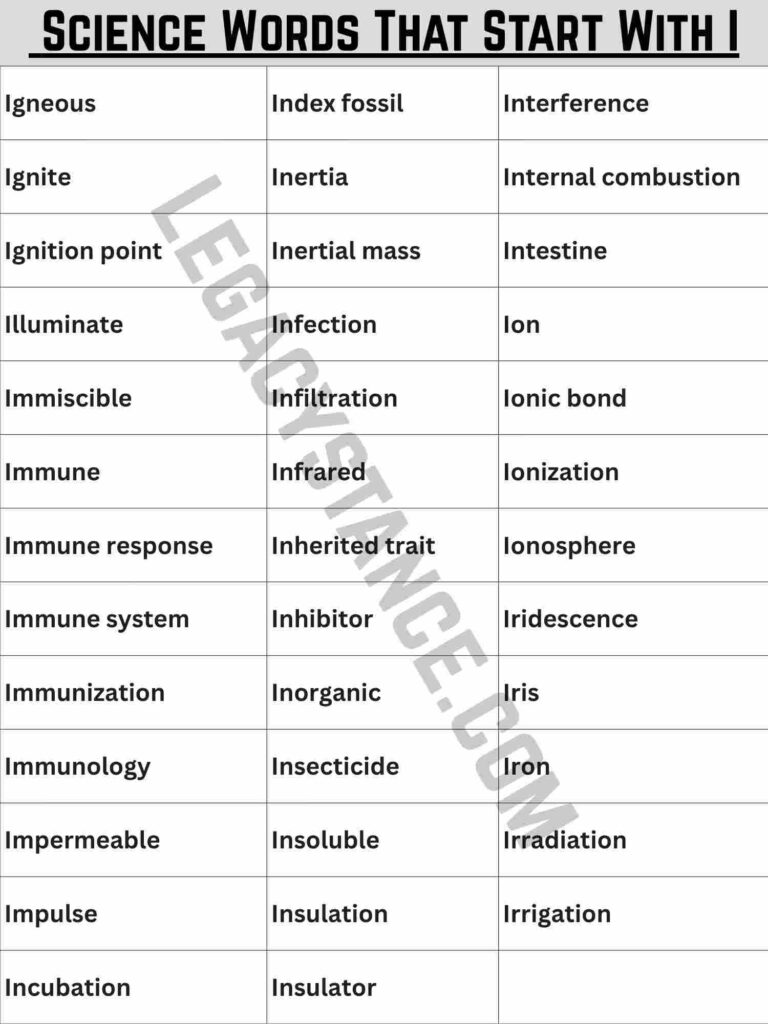
- Igneous
- Ignite
- Ignition point
- Illuminate
- Immiscible
- Immune
- Immune response
- Immune system
- Immunization
- Immunology
- Impermeable
- Impulse
- Incubation
- Index fossil
- Inertia
- Inertial mass
- Infection
- Infiltration
- Infrared
- Inherited trait
- Inhibitor
- Inorganic
- Insecticide
- Insoluble
- Insulation
- Insulator
- Interference
- Internal combustion
- Intestine
- Ion
- Ionic bond
- Ionization
- Ionosphere
- Iridescence
- Iris
- Iron
- Irradiation
- Irrigation
- Isobar
- Isomer
- Isotope
- Invertebrate
- Invasive species
- Involuntary muscle
- Iodine
- Iodine test
- Igneous rock
- Incisor
- Inclined plane
- Incompressible
- Indicator
- Induced current
- Induction
- Inert gas
- Infrared radiation
- Ingestion
- Inhibition
- Inner core
- Inner ear
- Inorganic compound
- Insect
- Interaction
- Interdependence
- Interphase
- Intertidal zone
- Intestinal flora
- Intrusive rock
- Ion exchange
- Ionic compound
- Ionized gas
- Iron oxide
- Irradiance
- Isostasy
- Isothermal
- Isotonic solution
- Isotropic
- Itinerant electron
🔬 Physics Science Words That Start With I
Inertia — Sit a book on a table. It stays there until something moves it. That resistance is inertia. It’s why you jolt forward when a car brakes hard.
Infrared radiation — Invisible waves you feel as heat. Every warm object emits them. TV remotes, thermal cameras, and the sun all use infrared.
Impulse — Force applied briefly to change an object’s motion. A bat hitting a ball. A foot kicking a door. Short contact, big effect.
Induced current — Move a magnet near a wire — electricity flows. No fuel. No burning. Just motion. This is how power stations generate electricity.
Inclined plane — A ramp. One of six simple machines. Spreading work over a longer distance reduces the effort needed to lift something.
Interference — Two waves meet and either combine or cancel. Noise-canceling headphones use this. So do the rainbow colors on a soap bubble.
Induction — Charging an object without touching it. A charged balloon shifts electrons in a nearby metal rod — no contact required.
Inertial mass — A measure of how hard it is to speed something up. Heavier objects need more force to accelerate. That’s inertial mass at work.
🧪 Chemistry Science Words That Start With I
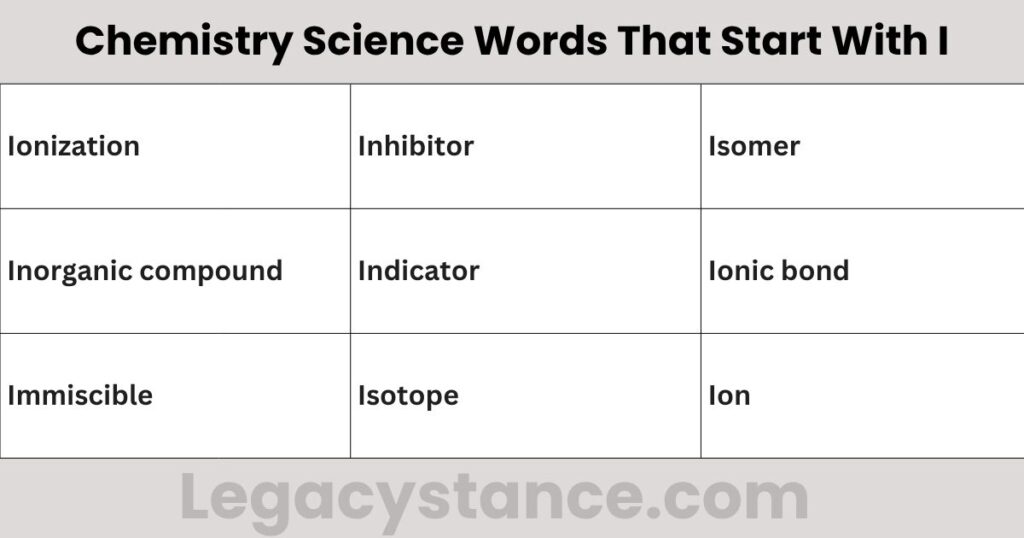
Ion — An atom that gained or lost an electron. Lose one → positive. Gain one → negative. Your blood, sweat, and ocean water are loaded with them.
Ionic bond — Sodium hands an electron to chlorine. They stick together. That’s table salt — the most familiar ionic bond in existence.
Isomer — Same atoms, different arrangement. Glucose and fructose share the same formula but behave completely differently inside your body.
Isotope — Same element, different atomic weight. Carbon-12 is stable. Carbon-14 is radioactive and used to date ancient fossils.
Indicator — Changes color based on pH. Litmus paper turns red in acid, blue in base. Simple, cheap, and used in every school lab.
Inhibitor — Slows or stops a chemical reaction. Food preservatives are inhibitors. So are many drugs that block disease-causing reactions.
Immiscible — Liquids that won’t mix. Oil and water. Shake them all you want — they separate every time.
Inorganic compound — No carbon-hydrogen bond. Water, salt, iron oxide — all inorganic. The opposite of organic chemistry’s carbon-based molecules.
Ionization — Enough energy strips electrons from atoms, creating ions. Heat, radiation, and electricity all do it. Plasma is fully ionized gas.
🧬 Biology Science Words That Start With I
Invertebrate — No backbone. Insects, worms, jellyfish, squid — all qualify. They actually make up the vast majority of animal species on Earth.
Inherited trait — Eye color, blood type, certain diseases — passed from parent to child through genes. The foundation of all genetics.
Immune system — Your body’s security team. It spots threats, flags them, and destroys them. A fever usually means it’s working, not failing.
Incubation period — Time between infection and symptoms. Flu: 1–4 days. Knowing this helps health officials track and contain outbreaks.
Ingestion — Taking food into the body through the mouth. First step of digestion. Nothing else in the digestive system works without it.
Interphase — The stage a cell spends most of its life in. Often called “resting” — but the cell is copying DNA and preparing to divide. Far from rest.
Involuntary muscle — Your heart beats without you thinking about it. Same with your digestive tract. That’s involuntary muscle — smooth and cardiac types.
Invasive species — A species dropped into an ecosystem where it doesn’t belong. Kudzu vine in the American South, cane toads in Australia — both arrived and caused serious damage.
Intestinal flora — Billions of bacteria living in your gut. They’re not harmful — they digest food, make vitamins, and block dangerous microbes.
Interdependence — Bees need flowers for food. Flowers need bees for pollination. Take one away and both suffer. That relationship is interdependence.
🌍 Earth Science Science Words That Start With I
Igneous rock — Formed when magma cools. Granite (underground, slow cooling) and basalt (lava surface, fast cooling) are the two most common types. About 90% of Earth’s crust is igneous.
Intrusive rock — Igneous rock that cooled slowly deep underground. Slow cooling = large crystals. Granite is the textbook example.
Isobar — Weather map lines connecting areas of equal air pressure. Tight isobars = strong winds. Wide spacing = calm air.
Index fossil — From a species that lived briefly but spread everywhere. Used to date rock layers. Trilobites and ammonites are the most common examples.
Intertidal zone — Between high and low tide. Wet twice a day, dry twice a day. Animals here — crabs, mussels, sea stars — handle constant change.
Infiltration — Water soaking into soil. Pavement blocks it, which is one reason cities flood more easily than forests.
Isostasy — Earth’s crust floats on the mantle like an iceberg on water. Scandinavia is still slowly rising today because ancient glaciers melted and removed their weight thousands of years ago.
Inner core — Solid iron and nickel at Earth’s center. Temperature near 5,000°C — close to the sun’s surface — but extreme pressure keeps it solid.
🚀 Space & Astronomy Science Words That Start With I
Ionosphere — A charged atmospheric layer 60–1,000 km up. It reflects AM radio waves, letting them travel far beyond the horizon.
Irradiance — Solar energy striking a surface per square meter. It drives weather, climate, and photosynthesis all at once.
Infrared telescope — Sees heat instead of visible light. The James Webb Space Telescope works mostly in infrared — letting it see through dust clouds that block ordinary light.
Isothermal layer — A region in the atmosphere where temperature stays constant with altitude. Important for modeling how heat moves through space environments.
Ionized plasma — Gas heated so intensely that electrons break free from atoms. Stars are made of it. So is lightning. The fourth state of matter.
💊 Medical & Health Science Words That Start With I
Immunity — The body’s learned ability to fight a specific pathogen. Built naturally after infection or artificially through vaccination.
Immunization — Introducing a weakened pathogen to trigger immune memory — without causing real disease. The body prepares its defense before the real threat arrives.
Infection — A harmful microorganism enters and multiplies. Your immune system blocks most exposures before you ever feel anything.
Inflammation — Redness, swelling, heat, pain. Short-term: protective. Long-term (chronic): linked to heart disease, diabetes, and arthritis.
Incision — A surgical cut through tissue. Planned carefully to minimize damage and recovery time.
Incisor — The four front teeth on top, four on the bottom. Built to bite and cut food, not grind it.
Inhibition (neural) — One neuron suppresses another. This keeps signals controlled. Without inhibition, nerves would fire uncontrollably.
Impulse (nerve) — An electrical signal traveling along a nerve. Touch something hot — an impulse races from fingertip to brain in milliseconds.
💻 Technology & Applied Science Words That Start With I
Insulator — Resists electricity or heat. Rubber and plastic coat electrical wires to prevent shocks. Glass insulators appear on power line poles.
Internal combustion — Fuel burns inside cylinders, pushing pistons, turning the crankshaft. Most cars, motorcycles, and generators run on this process.
Irrigation — Controlled water delivery to crops. Roughly 70% of global freshwater goes to agriculture. Drip systems waste far less than flood methods.
Insecticide — Kills insects to protect crops. Overuse builds resistant pest populations and harms useful insects like bees — a major tension in modern agriculture.
Ion exchange — Swapping unwanted ions for neutral ones. Used in water softeners, purification systems, and laboratory filtration.
🟢 Easy Science Words That Start With I (Grades 3–5)
Short definitions, no complexity — great for young learners or anyone starting fresh.
| Word | What It Means |
| Ice | Water in solid form, below 0°C |
| Insect | Six-legged animal with three body segments |
| Iron | Strong magnetic metal, element number 26 |
| Iris | Colored ring of the eye that controls pupil size |
| Itch | Skin sensation caused by nerve irritation |
🔴 Advanced Science Words That Start With I
Isotropic — Same physical properties in every direction. Many materials behave differently depending on orientation (anisotropic). An isotropic material is uniform throughout.
Itinerant electron — An electron that moves freely between atoms in a metal rather than staying bound to one. This free movement is exactly what makes metals conduct electricity.
Iridescence — Color that shifts as the viewing angle changes. Caused by light waves interfering across thin layered surfaces. Butterfly wings, beetle shells, and soap bubbles all show it.
Isostasy — Gravitational balance between Earth’s crust and the mantle beneath it. When large masses are added or removed — glaciers, erosion — the crust adjusts vertically over thousands of years.
Isotonic solution — A solution with the same ion concentration as the fluid inside cells. Cells placed in isotonic solution neither shrink nor swell. Saline IV fluid is isotonic.
Science Words That Start With I — By Grade Level
Grade 6 focus words: Inertia · Ion · Igneous · Invertebrate · Inherited
Grade 7 focus words: Immune system · Isotope · Interdependence · Induced current · Interphase
Grade 8–9 focus words: Ionization · Isomer · Isostasy · Iridescence · Itinerant electron
Common Mix-Ups Worth Knowing
Inertia vs. Momentum Inertia is a property — resistance to change. Momentum is a measurement — mass × velocity. A parked truck has massive inertia but zero momentum.
Ion vs. Isotope Ions involve electrons (charge changes). Isotopes involve neutrons (mass changes). The element stays neutral in an isotope.
Invertebrate vs. Vertebrate “In-” means without. No spine = invertebrate. Memory trick: the spine is invisible because it doesn’t exist.
Igneous vs. Metamorphic Both involve heat. Igneous rock forms from cooling magma. Metamorphic rock forms when existing rock is changed by heat and pressure — but never fully melts.
Immunity vs. Immunization Immunity is the result. Immunization is the process that builds it.
Where These Words Actually Show Up
| Setting | Words You’ll Hear |
| Doctor’s office | Immunity, infection, incubation, inflammation, impulse |
| Weather report | Isobar, infrared, ionosphere, isothermal |
| Your kitchen | Immiscible, insoluble, ignition, iron |
| News & environment | Invasive species, irrigation, immunization, irradiance |
| Cars & engines | Inertia, internal combustion, insulator, ignition point |
| Outdoors & nature | Invertebrate, intertidal zone, index fossil, igneous rock |
Memory Tricks for I Science Words
These small tricks make the words easier to remember:
– Inertia → “In = stay in place” (objects resist moving or stopping)
– Ion → Charged atom (lost or gained electrons)
– Isotope → Same element, different weight
– Infrared → “Below red” light → heat you can feel
– Invertebrate → “In = no” → no backbone
– Igneous → Think “ignite” → formed from heat and lava
– Immune system → Your body’s security system
– Insulator → “Insulate = block” heat or electricity
– Incubation → Time before something develops or appears
– Index fossil → Helps “index” or date rock layers
Related Posts:
83 Science Words That Start With J | Meanings & Examples
85+ Science Words That Start With Z | Full List with Meanings
FAQ
Q: Why do so many science words start with “in-“?
The prefix “in-” comes from Latin and means either “not” or “into.” Insoluble = not solvable. Invertebrate = without vertebra. Ingestion = going into the body. Spot the prefix and you can decode dozens of words you’ve never seen before.
Q: Which words appear most on science tests?
Inertia, ion, isotope, immune system, igneous, invertebrate, and inherited trait show up consistently from grades 5 through 10. Short on study time — start with those seven.
Q: What’s the real difference between inorganic and organic?
Organic compounds contain carbon-hydrogen bonds. Inorganic ones don’t. Water is inorganic. Glucose is organic. Carbon dioxide contains carbon but has no C-H bond, so it’s classed as inorganic. This trips up a lot of students in introductory chemistry.
Q: Is infrared the same thing as heat?
Not exactly. Infrared is electromagnetic radiation. When objects absorb it, their molecules vibrate faster — and that vibration is what we feel as heat. Infrared causes the heat sensation. It isn’t heat itself. That’s why you feel the sun’s warmth on a cold day even though the air around you stays chilly.
What You Now Understand
Over 75 science words starting with I — sorted by subject, difficulty, and real-world setting. Definitions short enough to remember. Explanations clear enough to actually understand. The confusion section should prevent the most common test mistakes.
Science vocabulary clicks when a word connects to something real — a rock you’ve seen, a process in your own body, a line on a weather map. That’s the point where a definition stops being something to memorize and starts being something you actually know.

Hi, I’m the creator of Legacystance.com, dedicated to making English learning simple and enjoyable. I write clear, practical guides on adjectives, verbs, idioms, pronunciation, spelling, and more. Every article is carefully researched to give accurate, easy-to-understand information. My goal is to help readers improve their English skills confidently, one step at a time, with content that is trustworthy, useful, and beginner-friendly.