You get a reply that just says “stsu” and nothing else. No explanation, no emoji to soften it. For a second you’re stuck wondering if you said something wrong.
“Stsu” is text shorthand for “shut the s* up.”** It’s a slightly disguised version of a phrase people already shout out loud, typed in a way that looks a little less harsh on screen. That’s the core meaning, full stop.
What changes everything is who sent it and why.
Where the STSU Word Comes From
“Stsu” works the same way “stfu” does — same energy, same intention, just one letter swapped to spell out a different sounding word. Both exist because typing the actual curse feels too direct for a quick reply, or because some apps flag certain words and people work around that.
It’s not slang with a deep backstory. It’s a shortcut. People wanted a fast way to type “shut up” with extra weight behind it, and this became one of the common forms.
Reading the STSU Meaning Tone Correctly
The word itself never changes. What changes is everything around it.
A message like “stsu you actually pulled that off?? 😭” isn’t an insult. It’s shock dressed up as annoyance — a normal way people react to news that surprises them. A message like “stsu. just stop talking.” with no emoji and a period at the end is a different thing entirely. That’s someone asking for the conversation to end.
A few patterns hold up consistently:
- Laughing emojis, “lol,” or exclamation points usually mean the sender is reacting, not attacking
- A flat sentence with no emoji and proper punctuation usually means real irritation
- All caps reads louder either way — louder excitement or louder anger, depending on what’s around it
- The last few messages in the thread matter more than this one word does
If you’ve been joking around and “stsu” shows up mid-laugh, it’s almost always playful. If it shows up after tension’s been building, take it at face value.
Sender Patterns: STSU by Girl vs. Guy
This gets searched a lot, so here’s the honest answer: gender doesn’t change what the word means. It changes how it tends to get used, based on common texting habits.
In messages from girls, “stsu” shows up more often as a reaction to surprising news — paired with crying-laughing emojis, used almost like a gasp. In messages from guys, especially in gaming groups or sports chats, it shows up more as competitive ribbing between friends, often blunt-sounding without any real heat behind it.
Neither pattern is fixed. Plenty of guys use it as pure reaction-speak. Plenty of girls use it to genuinely end a conversation. Treat these as tendencies, not rules.
How STSU meaning Looks on Different Apps
Instagram: Usually shows up in comments or DMs as a reaction to a photo or a flex. “stsu you didn’t post that” reads as a compliment more than an insult.
Snapchat: Quick, throwaway, gone in seconds. “stsu I can’t believe you did that 💀” fits the fast, casual rhythm Snapchat conversations usually run on.
Roblox and gaming chats: Trash talk is just part of the culture here. “stsu you got carried” between regular teammates is closer to a high-five than an insult, though it can turn real if someone’s actually losing patience mid-game.
The platform doesn’t change the definition. It changes how often the word leans playful versus serious, since some spaces run hotter than others by default.
A Rare Second STSU Meaning
Once in a while, “stsu” stands for “so that’s you” — usually inside a conversation where someone’s figuring out who’s behind a typo, an anonymous comment, or a mix-up. You’ll know it’s this version because the rest of the sentence won’t sound like an insult at all.
Some gaming groups or online communities also use the letters as a tag or inside name that has nothing to do with either definition above. If a message doesn’t fit “shut up” or “so that’s you,” asking directly beats guessing.
Quick Reference: STSU Meaning
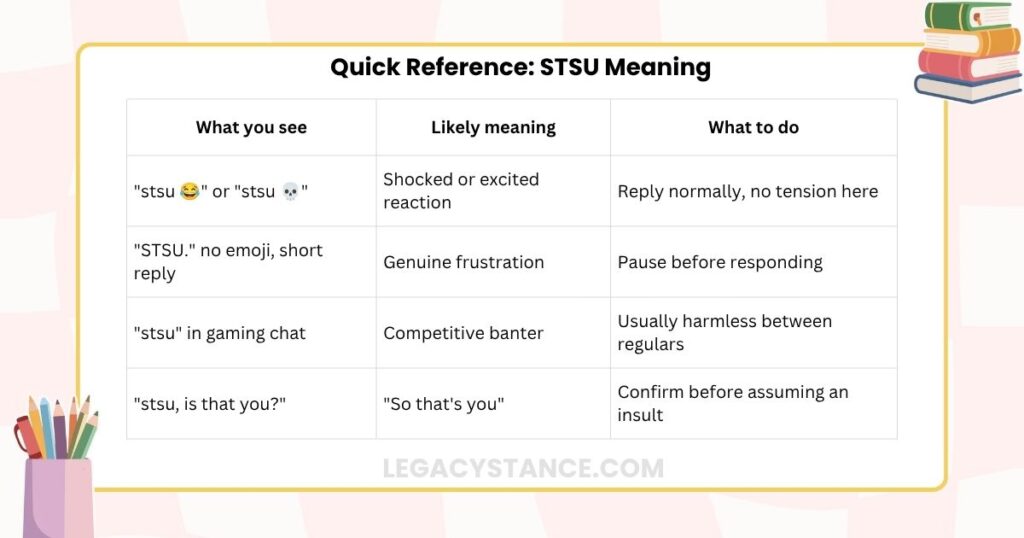
| What you see | Likely meaning | What to do |
| “stsu 😂” or “stsu 💀” | Shocked or excited reaction | Reply normally, no tension here |
| “STSU.” no emoji, short reply | Genuine frustration | Pause before responding |
| “stsu” in gaming chat | Competitive banter | Usually harmless between regulars |
| “stsu, is that you?” | “So that’s you” | Confirm before assuming an insult |
How to Respond STSU
If the tone is clearly playful, matching it works fine — something like “I know, I know” keeps things light without overanalyzing a joke.
If you genuinely can’t tell, ask. “Wait, are you actually upset?” cuts through guessing faster than trying to decode punctuation.
If it’s hostile and coming from someone you don’t know, the simplest answer is disengaging. Block, mute, or just don’t reply. Arguing with someone who opened with an insult rarely leads anywhere useful.
Read also:
SMFH Meaning: What Those 4 Letters Are Really Saying
CBFW Meaning: What It Means in Chat, Texts, and Social Media
FAQs
Is “stsu” worse than “stfu,” or basically the same thing?
They carry the same weight. The spelling difference doesn’t soften the meaning much — it just changes how the word looks on the page, which is often the only reason people pick one over the other.
Can “stsu” be used as a compliment?
Yes, in the sense that people use it to react to something impressive, almost like saying “stop, that’s too much” out of disbelief rather than annoyance. It’s common in comment sections under flex posts or good news.
Should I be worried if a stranger sends me “stsu”?
If it comes with no context and feels aimed at you personally, treat it as hostile and disengage rather than trying to figure out their intent. Strangers rarely use it playfully without some shared context first.
Does typing “STSU” in all caps always mean someone’s angry?
Not always — all caps just adds volume to whatever emotion is already there. Paired with emojis or a joke, it reads as loud excitement. Paired with a flat sentence, it reads as loud frustration.