Most homeowners default to a full privacy fence without weighing it against the alternative, and end up either overpaying for screening they didn’t need or fighting wind load on a panel that was never the right choice for an exposed yard. The decision comes down to a handful of concrete factors, not just how much privacy sounds appealing on paper.
What’s the Actual Difference?
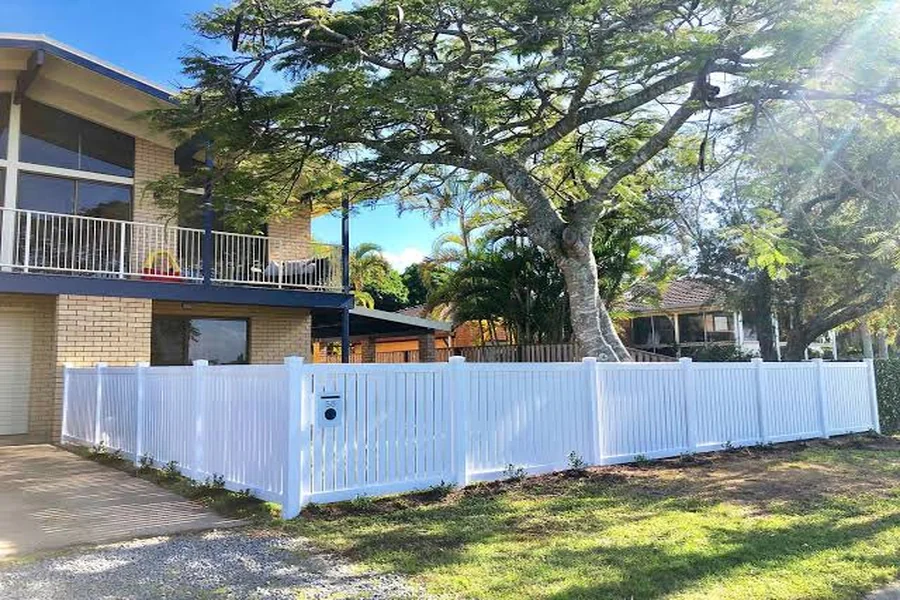
A privacy fence uses solid slats with zero gap between them, blocking sightlines completely. A semi-privacy fence uses the same basic slat system with a controlled gap between slats that breaks sightlines without sealing the yard off, while still letting air and light through. Exact gap sizes vary by manufacturer, so check the specific product’s spec sheet rather than assuming a standard figure.
That gap changes several of the factors that matter most: wind exposure, how much screening you actually get, and in some cases whether local rules treat the fence as open or solid construction.
When Full Privacy Is Worth It
Solid privacy panels make sense wherever sightline control matters more than airflow: pool decks, hot tub areas, yards that back directly onto a neighbor’s second-floor windows, or street-facing lots with heavy foot traffic.
The trade-off is wind. A solid panel presents a continuous surface to any gust that hits it, the same reason a solid fence section generally imposes more wind demand than a slatted one of the same size. Because of that, solid panels may require heavier posts, closer spacing, or deeper embedment than a more open design, depending on the tested system, not automatically or in every case. Ask whatever fence supplier you’re using for their actual tested wind rating for the specific configuration you’re ordering, rather than assuming one product’s numbers apply to another. Some manufacturers, PrimeAlux’s solid privacy line among them, publish that lab-tested rating directly rather than an estimate, which is worth asking for regardless of who you buy from.
For pool enclosures specifically, privacy is not the same thing as code compliance. Verify that the complete fence and gate system, height, gap sizes, gate hardware, and all, meets your local pool-barrier requirements before assuming a solid fence satisfies them on its own.
When Semi-Privacy Makes More Sense
Semi-privacy earns its place wherever full sightline blocking isn’t actually the goal: front yards, side yards, courtyards, multi-unit separations between balconies, or any elevated or rooftop deck application where wind load is a structural concern rather than a comfort issue.
That last case is worth calling out specifically. On elevated decks and rooftop applications, wind loads and attachment conditions deserve closer attention than they typically get at grade level. A semi-privacy configuration can reduce the wind pressure acting on the fence, which helps, but it doesn’t substitute for verifying that post spacing, anchors, and the supporting structure are adequate for the specific installation. If your project is elevated and not at grade, that verification matters more than which panel looks better in a catalog photo.
Semi-privacy also tends to be the answer where local rules push toward it. Some HOA rules and municipal ordinances restrict fence height, opacity, or sightlines, particularly in front yards, corner lots, and other visibility-sensitive locations, rather than requiring open construction outright. If your project is in a covenant-controlled community, check the governing documents for that kind of restriction before you commit to a fully solid design.
Privacy Fence vs. Semi-Privacy Fence
| Factor | Privacy | Semi-Privacy |
|---|---|---|
| Slat gap | None (solid) | Spaced, with a gap between slats |
| Sightline control | Full block | Partial; interrupts direct sightlines |
| Airflow | Minimal | Yes |
| Best fit | Pool decks (verify local pool-barrier code separately), close neighbors, street-facing lots | Wind-exposed sites, elevated decks, HOA-restricted zones |
A Practical Way to Decide
A few questions settle most of these decisions faster than browsing style photos:
- Is the yard genuinely exposed to wind, or is it sheltered by the house, other structures, or mature trees?
- Is this an elevated or rooftop installation, where added lateral load actually matters structurally, not just visually?
- Does anything actually overlook the space that a solid fence needs to block, or is the goal more about boundary definition?
- Does an HOA or local bylaw restrict solid fencing on any part of the property line?
Semi-privacy aluminum fence panels, for example, exist specifically for the middle case: enough screening to define the boundary, without the wind load or the sightline-blocking of a fully solid run. That’s a reasonable default whenever the answer to the questions above is genuinely mixed, rather than automatically defaulting to the solid option.
Frequently Asked Questions
Does a semi-privacy fence provide any real privacy?
It interrupts direct sightlines and provides partial screening, but visibility through the gaps remains possible depending on viewing angle, distance, and lighting. It’s a meaningful reduction in exposure, not a full visual barrier the way a solid privacy panel is.
Is a semi-privacy fence cheaper than a full privacy fence?
Not necessarily. Pricing depends on the manufacturer, profile design, finish, and hardware, not just how much material is in the panel. Semi-privacy costs less in some product lines, but the gap itself doesn’t guarantee a lower installed price, get quotes for both from the same supplier before assuming.
Can I mix privacy and semi-privacy panels on the same fence line?
Yes, and it’s a common approach: solid privacy along a shared property line or pool enclosure, semi-privacy along a windier or less exposed run. Check that post spacing and hardware are compatible between the two panel types before mixing them on one continuous line.
The Short Version
The gap between the slats changes several of the factors that matter most: wind exposure, how much screening you actually get, and in some cases whether local rules treat the fence as open or solid construction. Answer the exposure and sightline questions first, verify code requirements separately if a pool is involved, and the choice between privacy and semi-privacy usually settles itself.