
Looking for Vegetables That Start With B? You might know broccoli, beets, and Brussels sprouts, but there are many more worth discovering. From everyday kitchen staples to unique regional vegetables, this guide brings them together in one easy-to-browse list. Whether you’re expanding your food knowledge, planning lessons, improving your diet, or simply curious, you’ll find plenty of interesting B vegetables to explore.
Quick Reference Vegetables That Start With B
| Vegetable | Flavor | Best Use |
| Broccoli | Mild, earthy | Roasting, steaming |
| Broccolini | Sweet, delicate | Grilling, roasting |
| Broccoli Rabe | Bitter, peppery | Sautéed with garlic |
| Broccoflower | Mild | Roasting, steaming |
| Brussels Sprouts | Nutty, bitter | Roasting |
| Bok Choy | Mild, fresh | Stir-fry, soup |
| Baby Bok Choy | Milder than full-size | Stir-fry, steaming |
| Black Kale (Cavolo Nero) | Earthy, deep | Soups, braising |
| Beetroot | Sweet, earthy | Roasting, raw |
| Baby Beets | Sweeter, tender | Roasted, salads |
| Burdock Root | Earthy, woody | Braising, sautéing |
| Black Radish | Sharp, pungent | Raw, thinly sliced |
| Bulb Fennel | Anise-like | Roasting, raw |
| Broad Beans | Creamy, nutty | Boiling, mashing |
| Butter Beans | Mild, buttery | Stews, soups |
| Black-Eyed Peas | Earthy, savory | Stews, salads |
| Black Beans | Earthy, rich | Soups, rice dishes |
| Borlotti Beans | Rich, creamy | Soups, pasta |
| Black Turtle Beans | Dense, earthy | Latin dishes |
| Bush Beans | Mild, fresh | Steaming, stir-fry |
| Beluga Lentils | Earthy, firm | Cold salads |
| Bitter Melon | Intensely bitter | Stir-fry, stuffed |
| Bottle Gourd | Mild, neutral | Curries, soups |
| Butternut Squash | Sweet, buttery | Roasting, soups |
| Buttercup Squash | Sweet, dense | Roasting |
| Banana Squash | Sweet, mild | Roasting, soups |
| Black Zucchini | Mild, watery | Grilling, stir-fry |
| Baby Pumpkin | Sweet | Stuffing, roasting |
| Butter Lettuce | Soft, mild | Salads, wraps |
| Bibb Lettuce | Soft, mild | Lettuce cups |
| Belgian Endive | Mildly bitter | Raw, braised |
| Batavian Endive | Mildly bitter | Soups, braised |
| Beet Greens | Earthy, mild | Sautéed |
| Borage | Cucumber-like | Raw, garnish |
| Broadleaf Batavia | Mild | Salads |
| Bull’s Blood Beet Greens | Earthy, slightly sweet | Salads, sautéed |
| Baby Spinach | Mild, tender | Salads, wilted |
| Bitter Leaf | Bitter, assertive | West African soups |
| Black Mustard Greens | Peppery, sharp | South Asian cooking |
| Bamboo Shoots | Mild, slightly grassy | Stir-fry, soup |
| Bean Sprouts | Clean, mild | Stir-fry, raw |
| Baby Corn | Mild, slightly sweet | Stir-fry, salads |
| Broccoli Stems | Same as broccoli | Stir-fry, raw |
| Bulb Onion | Pungent, sweet when cooked | Everyday cooking |
| Brown Onion | Strong, pungent | Cooking base |
| Bunching Onion | Mild | Garnish, stir-fry |
| Baby Leek | Mild, sweet | Soups, braised |
| Batata (Sweet Potato) | Sweet, creamy | Roasting, mashing |
| Breadfruit | Neutral, starchy | Roasting, frying |
| Banana Blossom | Mild, fibrous | Plant-based cooking |
| Black Garlic | Sweet, mellow, complex | Spreads, sauces |
| Bayam (Amaranth Greens) | Mild, earthy | Stir-fry, soups |
| Bignay Leaves | Slightly sour | Southeast Asian dishes |
| Black Nightshade Leaves | Mild, slightly bitter | African and Asian stews |
| Bunching Spinach | Mild | Stir-fry, raw |
| Butterhead Lettuce | Mild, tender | Salads |
| Broccoli Sprouts | Peppery, sharp | Raw, salads |
| Bitter Gourd (White Variety) | Very bitter | Stir-fry |
| Bull Horn Pepper | Sweet, mild | Roasting, stuffing |
| Bell Pepper | Sweet, crisp | Raw, roasted, stuffed |
| Banana Pepper | Mild, tangy | Pickled, raw, stuffed |
| Bhindi (Okra) | Slightly grassy | Frying, curries |
| Black Sesame Leaves | Mild, nutty | Korean cooking |
| Brined Capers (Bud) | Salty, tangy | Garnish, sauces |
| Baby Arugula | Peppery | Salads |
| Baby Chard | Mild, earthy | Salads, wilted |
| Bunching Chard | Earthy | Sautéed, soups |
| Bitter Cress | Peppery, sharp | Raw salads |
| Black Salsify | Earthy, oyster-like | Roasting, boiling |
| Bulb Kohlrabi | Mild, slightly sweet | Raw, roasted |
| Baby Turnip | Mild, peppery | Roasting, soups |
| Baby Carrot (Field Variety) | Sweet | Roasting, raw |
| Bristly Amaranth | Mild | Cooked greens |
Complete List — Every Vegetable Covered
Cruciferous Vegetables That Start With B
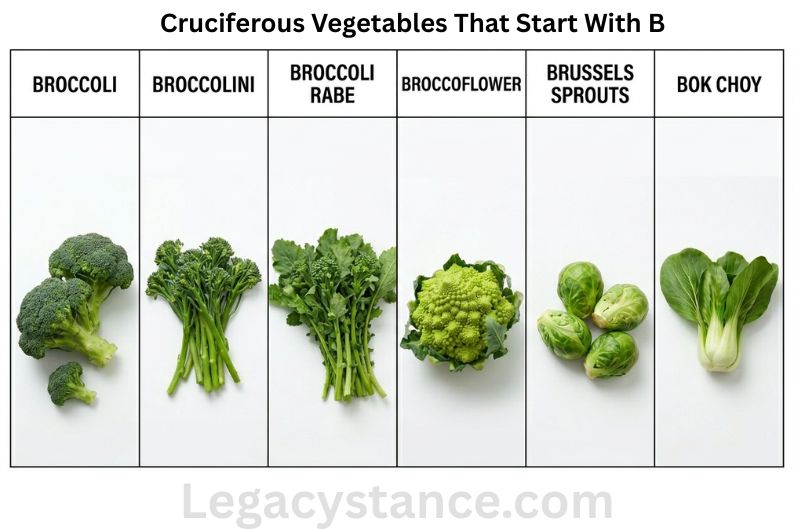
Broccoli Large dark green heads with dense florets on thick stalks. Mild and earthy raw, nutty when roasted.
- Best cooked: roasted, steamed, stir-fried
- Storage: unwashed in fridge, use within 5 days
- Don’t discard the stems — peel and slice them, they taste identical to florets
Broccolini A 1993 hybrid of broccoli and Chinese kale. Thin stems, small florets, sweeter and more delicate than broccoli. Cooks in 3 minutes. Not baby broccoli — a completely different plant.
Broccoli Rabe (Rapini) More closely related to turnips than broccoli. Thin stems, tiny florets, leafy greens all along the stalk. Bitter and peppery. Blanch it first — one minute in boiling water removes the harsh edge.
- Classic Italian use: with sausage, pasta, garlic and olive oil
Broccoflower Green-colored cauliflower, sometimes with a Romanesco fractal pattern. Milder than both broccoli and cauliflower. Treats identically to cauliflower in cooking.
Brussels Sprouts Tiny cabbages that grow 40–50 per stalk. Nutty when roasted, sulfurous when boiled. Always halve them before cooking — cut-side down in a hot pan.
- Storage: on the stalk, up to 2 weeks in fridge. Loose, about 1 week.
Bok Choy White stems, dark green leafy tops. Stems are crunchy; leaves are tender and wilt quickly. Mild cabbage flavor that absorbs sauces well.
- Add stems first in stir-fry — they take longer than the leaves
Baby Bok Choy Smaller version, more tender throughout. Both stems and leaves cook in roughly the same time.
Black Kale (Cavolo Nero / Lacinato Kale) Dark, pebbly, narrow leaves. Deeper and earthier than curly kale. Holds up well in soups and braises without falling apart. Also called dinosaur kale or Tuscan kale.
Root Vegetables That Start With B
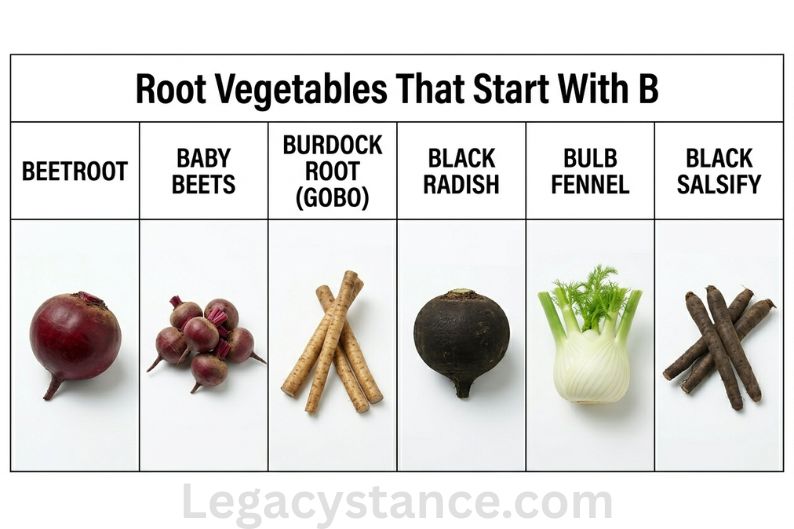
Beetroot Deep burgundy, round, sweet and earthy. Stains everything it touches. Roast whole, then the skin rubs off with a paper towel. The greens are edible too.
- Storage: remove greens before refrigerating — they pull moisture from the root. Keeps 2–3 weeks.
Baby Beets Younger, smaller beets. Sweeter and more tender, skin thinner. Often roasted whole and tossed into salads.
Burdock Root (Gobo) Long, thin, brown-skinned root. White inside. Common in Japanese and Korean cooking. Earthy, slightly woody, firm even after cooking. Cut pieces oxidize fast — drop into vinegar water immediately after cutting.
Black Radish Large, very dark exterior, stark white interior. Much sharper and more pungent than red radish — closer to horseradish in intensity. Thinly sliced and eaten raw in Eastern European cooking.
Bulb Fennel White to pale green layered bulb with feathery green fronds on top. Distinct anise/licorice flavor. That flavor mellows dramatically when roasted or braised. Remove the fronds before refrigerating.
Black Salsify Long, dark-skinned root with white flesh. Often called the “oyster plant” because the cooked flavor has a faint oyster-like quality. Needs peeling and dropping into acidulated water immediately to prevent browning.
Baby Turnip Harvested young, milder and less pungent than mature turnips. Tender enough to eat raw. Roasted, they become slightly sweet.
Legumes and Beans Vegetables That Start With B
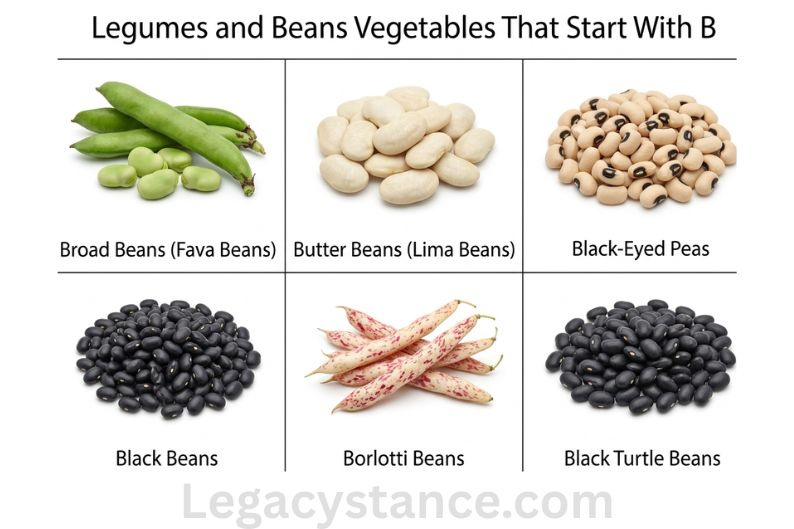
Broad Beans (Fava Beans) Large, flat, bright green beans in thick rubbery pods. Creamy and nutty. Double-pod them after blanching — squeeze each bean out of its inner grey skin for the best flavor and texture.
Butter Beans (Lima Beans) Large, flat, pale beans. Soft, buttery, starchy. The difference between creamy and grainy is just a few minutes of cooking — don’t overdo it.
Black-Eyed Peas Cream-colored with a black spot. Earthy and savory, hold their shape after cooking. Used in Southern American, West African, and Indian cooking.
Black Beans Small, dark, earthy, and slightly rich. Widely used in Latin American, Caribbean, and South American cuisines. Work in soups, rice dishes, and stews.
Borlotti Beans Cream pods with beautiful pink-red speckles when fresh. The markings disappear when cooked — they turn uniform brownish-pink. Rich, creamy flavor. Classic in Italian minestrone and pasta e fagioli.
Black Turtle Beans A variety of black bean used heavily in Central and South American cooking. Dense, earthy, slightly chewy texture even when fully cooked.
Bush Beans Green beans from bush plants rather than climbing vines. Mild, fresh flavor. Snap them — a fresh one breaks cleanly with a crisp sound.
Beluga Lentils Small, round, shiny black. Named after beluga caviar. Hold their shape perfectly after cooking — the only lentil that works reliably in cold salads without turning to mush.
Gourds and Squash Vegetables That Start With B
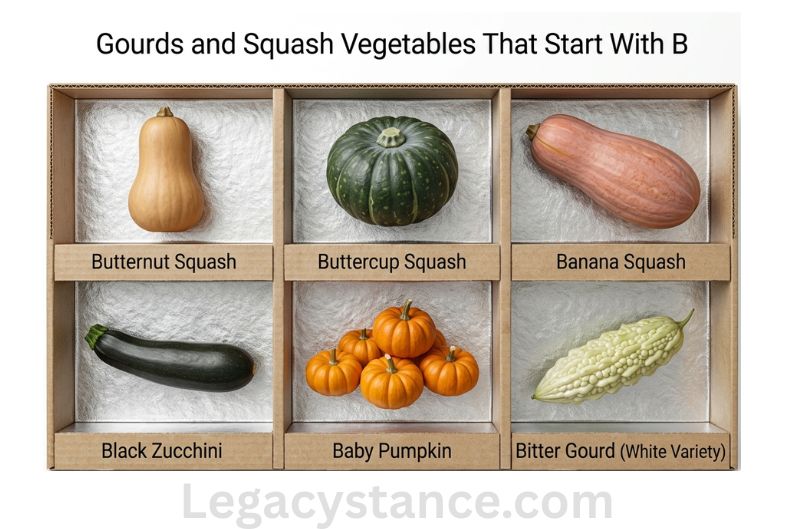
Bitter Melon Warty, green, genuinely intensely bitter. The bitterness comes from momordicin compounds throughout the flesh. Two types: longer Asian variety and shorter, more wrinkled Caribbean variety. Soak sliced pieces in salted water 20–30 minutes before cooking to reduce bitterness.
- Used in: Chinese stir-fries with egg, Indian sabzi, Filipino pinakbet
Bottle Gourd (Lauki / Doodhi) Pale green, smooth, bottle-shaped. Very mild, almost neutral flavor. Carries spices and broths without competing with them.
- Warning: if it tastes intensely bitter, discard it entirely — some produce cucurbitacin, a toxic compound.
Butternut Squash Tan-skinned, pear-shaped, deep orange flesh. Rich and sweet. Hard to peel raw — roast halved instead and scoop the flesh out.
Buttercup Squash Dark green, squat, drum-shaped with a grey-green button at the bottom. Sweeter and drier than butternut. Roasts to a firmer, denser texture.
Banana Squash Very large, elongated, muted pink-orange skin. Orange flesh, similar to butternut but denser. Usually sold in sections due to its size.
Black Zucchini A dark-skinned variety of summer squash. Flavor essentially the same as green zucchini — mild and slightly watery. The near-black skin adds visual contrast.
Baby Pumpkin Small pumpkins, often used for stuffing whole. Sweet, slightly dense flesh.
Bitter Gourd (White Variety) A paler variant of bitter melon with the same intense bitterness. Used in parts of Southeast Asia and South Asia interchangeably with the green variety.
Leafy Greens Vegetables That Start With B
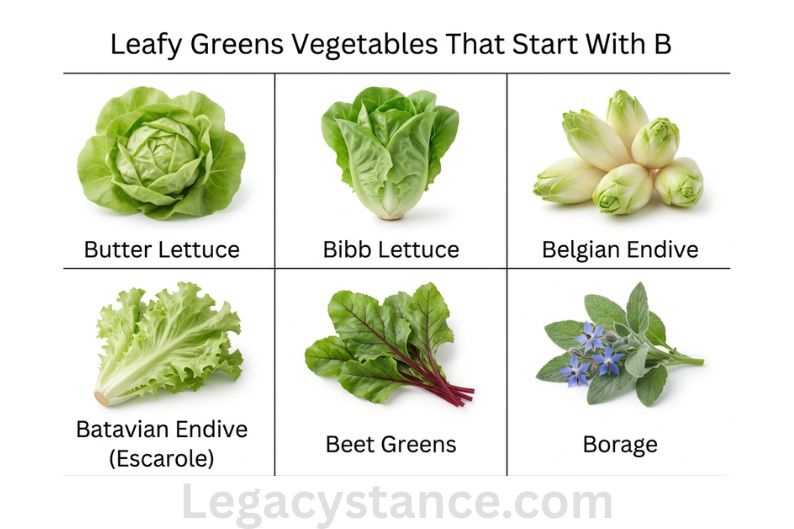
Butter Lettuce Soft, loosely packed heads with silky round leaves. Very mild, slightly sweet. No bitterness at all. Wash only just before using — wet leaves deteriorate fast.
Bibb Lettuce Very similar to butter lettuce but with smaller, more cupped leaves. The cup shape makes it ideal for lettuce wraps. Developed in Kentucky in the 1800s.
Belgian Endive Small, torpedo-shaped, tightly packed pale leaves with slight green tips. Grown in total darkness to keep it mild. Any light exposure increases bitterness. Mildly bitter raw, sweeter when braised.
Batavian Endive (Escarole) Broader, wavy, pale green leaves. Less bitter than curly endive, more tender. Used in Italian soups and braised with white beans.
Beet Greens The leafy tops of beetroot plants. Reddish-veined, slightly crinkled. Taste similar to Swiss chard. Most people discard them — a mistake. Young leaves work raw in salads; larger leaves sauté well.
Borage Fuzzy grey-green leaves with striking blue star-shaped flowers. Both leaves and flowers are edible. The flavor is unmistakably cucumber — clean and cool. Used in salads, cold drinks, and cocktails.
Broadleaf Batavia A loose-leaf lettuce with broad, slightly frilly leaves. Mild, crunchy, reliable in salads.
Bull’s Blood Beet Greens Deep red-purple leaves from the Bull’s Blood beet variety. Earthy and slightly sweet. Used as a salad leaf or cooked green. The color holds better than most red leaves when raw.
Baby Spinach Young spinach leaves, softer and milder than mature spinach. No tough stems. Works raw or wilted.
Bitter Leaf (Vernonia amygdalina) A West and Central African green with pronounced bitterness that requires washing and often blanching before use. Used in Nigerian egusi soup and Cameroonian ndolé. The bitterness is valued, not removed entirely.
Black Mustard Greens Leaves of the black mustard plant. Sharp, peppery, more intense than yellow mustard greens. Common in Punjabi saag. Needs long, slow cooking to mellow.
Bayam (Amaranth Greens) Leafy green popular across Southeast Asia. Mild and earthy. Used in stir-fries and soups. Wilts quickly in heat.
Bunching Spinach Spinach sold in bunches rather than bags. Larger leaves, slightly more assertive flavor than baby spinach.
Butterhead Lettuce Parent category of butter and bibb lettuce. Soft, loosely heading, mild. Very similar to butter lettuce — used identically.
Bitter Cress Small, wild-growing green with a sharp peppery flavor. Related to watercress. Used raw in salads where a spicy note is wanted.
Baby Arugula Young arugula leaves — peppery and slightly nutty. Smaller and less intensely peppery than mature arugula.
Baby Chard Young Swiss chard leaves with thin, tender stems. Milder than mature chard. Works well raw or quickly wilted.
Bunching Chard Swiss chard sold in bunches with full-sized leaves and thick, colorful stems. Earthy flavor. Works in soups, sautéed, or stuffed.
Bristly Amaranth A variety of amaranth grown for its leaves rather than seeds. Mild and earthy. Cooked as a pot herb in parts of Africa and Asia.
Black Sesame Leaves Used in Korean cooking as a herb-vegetable (kkaennip or perilla-related). Distinct nutty, sesame-adjacent flavor. Used in wraps, pickled, or fresh with grilled meat.
Shoots and Sprouts Vegetables That Start With B
Bamboo Shoots Young sprouts of bamboo before they mature into cane. Cream-colored, firm, slightly fibrous. Mild and slightly grassy — absorb whatever they’re cooked in.
- Fresh shoots must be boiled before eating — they contain natural toxins when raw
- Store cooked shoots in water in the fridge; change water daily
Bean Sprouts Sprouted mung beans. White, crisp, about 95% water. Clean and very mild. Add at the very end of cooking — 30 seconds in heat is enough.
Baby Corn Immature corn ears harvested before kernels develop. The entire cob is edible. Mild and slightly sweet. Widely used in Thai and Chinese stir-fries.
Broccoli Stems Usually discarded but completely edible. Peel the tough outer layer and treat them identically to florets. Denser and crunchier but same flavor.
Broccoli Sprouts Sprouted broccoli seeds, 3–5 days old. Small, delicate, and peppery. Eaten raw in salads or on sandwiches.
Alliums and Bulbs Vegetables That Start With B
Bulb Onion The standard yellow/white/red cooking onion. Pungent raw, sweet and savory when cooked. Foundation of cooking in almost every cuisine.
Brown Onion Papery brown skin, strong pungent flavor. The most common onion variety in most markets. Used as a cooking base everywhere.
Bunching Onion (Green Onion / Scallion) Long, slender, mild. Both green tops and white base are edible. Used raw as garnish or cooked briefly in stir-fries.
Baby Leek Young leeks, thinner and more tender than full-size. Milder and sweeter. Braised or in soups.
Bulb Kohlrabi A swollen stem vegetable — not a root, despite looking like one. Pale green or purple exterior. White inside. Mild and slightly sweet, similar to the heart of broccoli stems. Eaten raw, roasted, or julienned into slaws.
Peppers Vegetables That Start With B
Bell Pepper Green, red, yellow, or orange. Crisp, sweet, no heat. One of the most widely eaten vegetables globally. Eaten raw, roasted, stuffed, or cooked into sauces.
Banana Pepper Long, pale yellow, mild with a slight tang. Eaten pickled, raw in salads, or stuffed and roasted.
Bull Horn Pepper Long, red or yellow, sweet and mild. Common in Mediterranean and Middle Eastern cooking. Excellent roasted — the skin blisters and peels, and the flesh becomes silky.
Starchy Vegetables That Start With B
Batata (Sweet Potato) Orange or white-fleshed depending on variety. Sweet and creamy. One of the most nutritious starchy vegetables. Roasted, mashed, or made into soups.
Breadfruit Large, starchy, green-skinned fruit used as a vegetable when unripe. Neutral flavor when cooked — similar to potato or bread in texture. Roasted, fried, or boiled across Pacific Island, Caribbean, and South Asian cuisines.
Specialty and Regional Vegetables That Start With B
Banana Blossom The large, purple-maroon flower of the banana plant. Inner pale petals and core are edible. Raw, it’s slightly bitter and astringent. Cooked, it becomes fibrous and stringy — popular as a plant-based substitute for pulled meat.
Black Garlic Regular garlic fermented slowly at controlled heat for weeks. Cloves turn completely black and soft. No sharpness — instead it tastes sweet, complex, with hints of molasses and balsamic. Completely different product from raw garlic.
Bhindi (Okra) Green ridged pods. Slightly grassy flavor. The interior is mucilaginous — that’s the texture that puts people off. High heat reduces this dramatically. Fry it, roast it, or add it to slow stews where the sliminess thickens the sauce.
Bignay Leaves Leaves from the Bignay tree, used in Southeast Asia, particularly the Philippines. Slightly sour. Added to soups and meat dishes for acidity.
Black Nightshade Leaves Leaves from the black nightshade plant, used in parts of Africa and Asia as a cooked green. The mature berries of this plant are potentially toxic, but the leaves are cooked and eaten traditionally. Not widely known outside its regions.
Brined Capers (Bud) The unopened flower bud of the caper plant, pickled or salt-cured. Technically a vegetable bud. Salty, tangy, with a distinct flavor used in Mediterranean cooking — particularly with fish, pasta, and salads.
Vegetables That Start With B by Region
Asian Cuisines
- Bok choy, baby bok choy
- Bamboo shoots
- Bitter melon, bottle gourd
- Bean sprouts, baby corn
- Burdock root (Japan, Korea)
- Banana blossom (Southeast Asia)
- Bayam/amaranth greens (Southeast Asia)
- Black sesame leaves (Korea)
- Black mustard greens (South Asia)
- Bhindi/okra (South Asia)
- Bignay leaves (Philippines)
European Cuisines
- Belgian endive (Belgium, France)
- Batavian endive/escarole (Italy)
- Broccolini (Italian-origin)
- Broccoli rabe/rapini (Italy)
- Borlotti beans (Italy)
- Bulb fennel (Mediterranean)
- Black kale/cavolo nero (Tuscany)
- Black salsify (France, Belgium)
- Bull horn pepper (Mediterranean)
South Asian and Middle Eastern
- Bottle gourd (Pakistan, India, Middle East)
- Broad beans/fava (North Africa, Middle East)
- Bhindi/okra (India, Pakistan)
- Batata/sweet potato (widespread)
- Black mustard greens (Punjab)
African Cuisines
- Bitter leaf (West Africa)
- Black-eyed peas (West Africa)
- Bayam/amaranth (Africa)
- Bristly amaranth (Africa, Asia)
- Black nightshade leaves (Africa)
American and British
- Broccoli, Brussels sprouts
- Butternut squash, buttercup squash
- Butter lettuce, bibb lettuce
- Black beans (Central American origin)
- Black-eyed peas (Southern US)
- Bell pepper, banana pepper
Best Cooking Methods
Roast:
- Broccoli, Brussels sprouts, beetroot, butternut squash, broccolini, bulb fennel, broccoflower, black garlic, buttercup squash, bull horn pepper, baby turnip, bulb kohlrabi, black salsify
Stir-fry:
- Bok choy, bamboo shoots, bean sprouts, bitter melon, baby corn, broccolini, beet greens, bayam, black mustard greens, broccoli, bhindi/okra
Braise or slow-cook:
- Burdock root, bitter melon, borlotti beans, black-eyed peas, broad beans, Belgian endive, batavian endive, bottle gourd, banana blossom, black kale
Eat raw:
- Butter lettuce, bibb lettuce, borage, black radish (thinly sliced), beluga lentils (cold in salads), broccoli sprouts, baby arugula, bitter cress, bull’s blood beet greens, broadleaf batavia
Nutrition Overview
| Vegetable | Key Nutrients |
| Broccoli | Vitamin C, Vitamin K, folate, fiber |
| Brussels Sprouts | Vitamin K, Vitamin C, folate, fiber |
| Beet Greens | Vitamin A, Vitamin K, calcium — often higher than the root |
| Beetroot | Folate, manganese, potassium |
| Broad Beans | Protein, folate, iron, fiber |
| Black-Eyed Peas | Protein, folate, iron, fiber |
| Bok Choy | Vitamin A, Vitamin C, calcium, Vitamin K |
| Butternut Squash | Vitamin A, Vitamin C, fiber, potassium |
| Burdock Root | Fiber, potassium, manganese |
| Bitter Melon | Vitamin C, folate |
| Beluga Lentils | Protein, iron, folate, fiber |
| Black Beans | Protein, iron, folate, fiber |
For general awareness only — not medical advice.
Interesting Facts about Vegetables That Start With B
- Brussels sprouts grow on a stalk — one stalk, sometimes four feet tall, with 40 to 50 sprouts attached from base to top
- Borage flowers taste like cucumber — the same plant compounds, not coincidence
- Broccolini was created in Japan in 1993. It’s a hybrid, not a smaller version of broccoli
- Bottle gourds are among the oldest cultivated plants in history — used as water containers and vessels before pottery was widespread
- Belgian endive is grown in complete darkness. Any light during growth increases bitterness and turns the leaves green
- Burdock root burrs inspired Velcro — a Swiss engineer noticed the hooked seeds on his dog and examined them under a microscope
- Black garlic became popular in Western kitchens in the 2010s, but fermentation of garlic is a much older technique
- The speckled markings on borlotti beans disappear completely when cooked
- Beet greens have more calcium and Vitamin K than the actual beetroot most people eat
Family Feud — Most Likely Answers
If the survey asked “name a vegetable starting with B,” these would most likely be the top answers:
- Broccoli — almost certainly the number one answer
- Beets / Beetroot
- Brussels Sprouts
- Bok Choy
- Beans (general)
Related Fruits and Vegetables That Start With B
| Name | Botanical Type | Used As |
| Banana | Fruit | Fruit |
| Banana Blossom | Flower | Savory vegetable |
| Blackberry | Fruit | Fruit |
| Blueberry | Fruit | Fruit |
| Bitter Melon | Fruit (botanically) | Vegetable in cooking |
| Bottle Gourd | Fruit (botanically) | Vegetable in cooking |
| Butternut Squash | Fruit (botanically) | Vegetable in cooking |
| Breadfruit | Fruit | Cooked as starchy vegetable |
Botanically, any plant part that contains seeds is a fruit. But in kitchens and markets, we classify by how something tastes and how it’s cooked — so bitter melon and butternut squash are vegetables for all practical purposes.
Read more:
150+ Foods That Start With I — Fruits, Dishes, Drinks, and More
300+ Foods That Start With H — List of Everyday and Unique Foods
Frequently Asked Questions
What is the difference between broccoli, broccolini, and broccoli rabe?
Three different plants. Broccoli is the standard large-headed vegetable. Broccolini is a 1993 hybrid of broccoli and Chinese kale — thinner, sweeter, more delicate. Broccoli rabe is actually related to turnips, not broccoli — it’s leafier, more bitter, and peppery. They look vaguely alike but taste completely different.
Is it safe to eat bottle gourd if it tastes bitter?
No. Discard the whole thing. Some bottle gourds produce cucurbitacin — a compound that causes serious digestive illness. If any bite tastes intensely bitter, throw out the entire gourd immediately. Normal bottle gourd has almost no flavor.
What’s the easiest B vegetable for people who say they don’t like vegetables?
Butternut squash, roasted. Cube it, toss with oil and salt, roast at high heat until caramelized. It comes out sweet and crispy at the edges. Most people who “don’t like vegetables” eat a full bowl without complaint.
What happens if you eat bitter melon raw?
It’s edible raw but extremely bitter and difficult to enjoy. The seeds of a fully ripe (red) bitter melon can be toxic — always remove them. For green bitter melon, slice, remove seeds and white pith, soak in salted water before cooking. Nobody eats it raw for pleasure.