
Learning the names of tools makes everyday jobs easier, whether you work in construction, mechanics, woodworking, or simple home repair. This guide to Tools That Start With M brings together common hand tools, power tools, measuring tools, and industrial equipment in one easy place.
Each tool has a real purpose, from cutting and shaping to measuring and fixing. The list is written in simple language so students, beginners, DIY users, and trade workers can quickly understand what each tool does and when it is used.
Quick List: Common Tools That Start With M
- Mallet
- Measuring tape
- Monkey wrench
- Miter saw
- Multimeter
- Metal file
- Miter box
- Marking gauge
- Moisture meter
- Masonry trowel
- Marking knife
- Mortising chisel
- Magnetic screwdriver
- Mud knife
- Micro screwdriver set
Hand Tools That Start With M
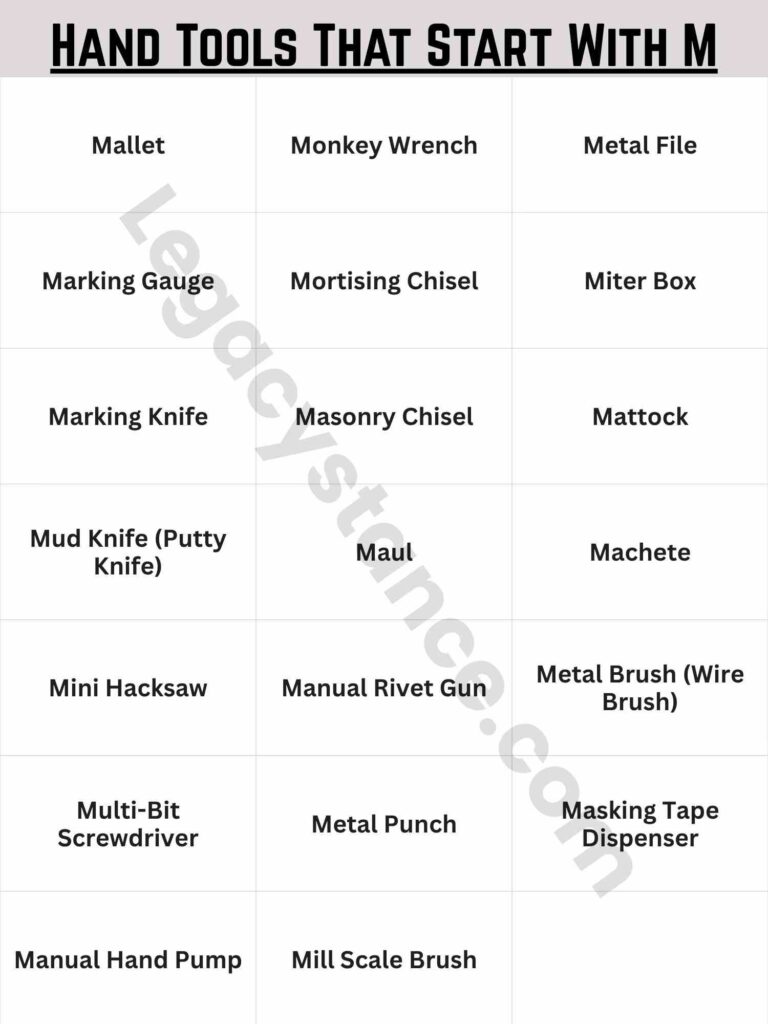
Mallet
Type: Striking hand tool Soft-headed tool — rubber, wood, or plastic — for striking without damaging surfaces. Used by carpenters for chiseling, furniture assemblers for seating joints, and auto body workers for panel shaping.
Monkey Wrench
Type: Adjustable hand tool Two flat parallel jaws — one fixed, one movable — grip large nuts, bolts, and flat fittings. Heavier than a standard adjustable wrench, suited for large stubborn fasteners. Common in plumbing.
Metal File
Type: Abrasive hand tool Removes sharp edges and smooths rough cuts on metal or wood. Available in flat, round, half-round, and triangular profiles. Coarse (bastard-cut) removes material fast; smooth-cut refines surfaces.
Marking Gauge
Type: Layout hand tool Scribes a precise line parallel to a wood edge before cutting or chiseling. A pin or blade drags along the surface leaving a clean reference mark. Essential for accurate joinery.
Mortising Chisel
Type: Cutting hand tool Thicker and sturdier than a standard chisel, built specifically for chopping rectangular mortise slots in wood for tenon joints. Used by furniture makers and door-frame carpenters.
Miter Box
Type: Cutting guide Three-sided guide with 45° and 90° slots. A handsaw runs through the slot for accurate angle cuts on trim and molding. No power tool needed.
Marking Knife
Type: Layout hand tool Thin, precise blade that severs wood fibers at the cut line instead of marking with pencil. Reduces tear-out when sawing or chiseling. Preferred by fine woodworkers for joinery work.
Masonry Chisel
Type: Cutting hand tool Wide hardened-steel blade used with a club hammer to split brick, cut concrete block, and remove old mortar. Always wear safety glasses — masonry chips fly fast.
Mattock
Type: Digging hand tool Wide adze blade on a long handle, sometimes with a pick opposite end. Breaks compacted soil and cuts through roots where a shovel can’t penetrate. Used in landscaping and farming.
Mud Knife (Putty Knife)
Type: Spreading hand tool Flat flexible blade for applying joint compound, scraping old paint, and filling wall cracks. Drywall workers use wide mud knives; painters use narrow ones for scraping.
Maul
Type: Striking hand tool Heavy long-handled tool for splitting firewood and driving fence posts or stakes. Heavier than an axe, built for splitting force rather than chopping.
Machete
Type: Cutting hand tool Broad, long blade for clearing brush and cutting vegetation. Used by landscapers, farmers, and outdoor workers where pruning tools aren’t heavy enough.
Mini Hacksaw
Type: Cutting hand tool Compact hacksaw for cutting metal in tight, confined spaces where a full-size hacksaw won’t fit. Used by plumbers and electricians for close-quarter pipe and conduit cuts.
Manual Rivet Gun
Type: Fastening hand tool Installs blind rivets into sheet metal or thin panels by pulling a mandrel through the rivet body. Used by HVAC installers and fabricators where welding isn’t practical.
Metal Brush (Wire Brush)
Type: Surface prep hand tool Steel or brass bristles remove rust, scale, old paint, and weld spatter from metal surfaces before painting, welding, or coating.
Multi-Bit Screwdriver
Type: Fastening hand tool Single handle accepting interchangeable bits — Phillips, flathead, Torx, hex. Reduces the need to carry multiple screwdrivers. Standard in home toolkits and trade toolboxes.
Metal Punch
Type: Marking hand tool Hardened steel rod struck with a hammer to indent or pierce metal. Center punches mark drilling spots; drive punches remove pins and rivets.
Masking Tape Dispenser
Type: Workshop hand tool Holds a roll of masking tape and cuts it cleanly with one hand during painting, surface protection, or bundling tasks.
Manual Hand Pump
Type: Fluid hand tool Moves liquids by hand pressure without electricity. Used to transfer oil, water, or fuel from containers in field environments and workshops.
Mill Scale Brush
Type: Surface prep hand tool Stiff wire brush designed to remove mill scale — the oxide layer on hot-rolled steel — before welding or painting to ensure clean adhesion.
Mechanic Tools That Start With M
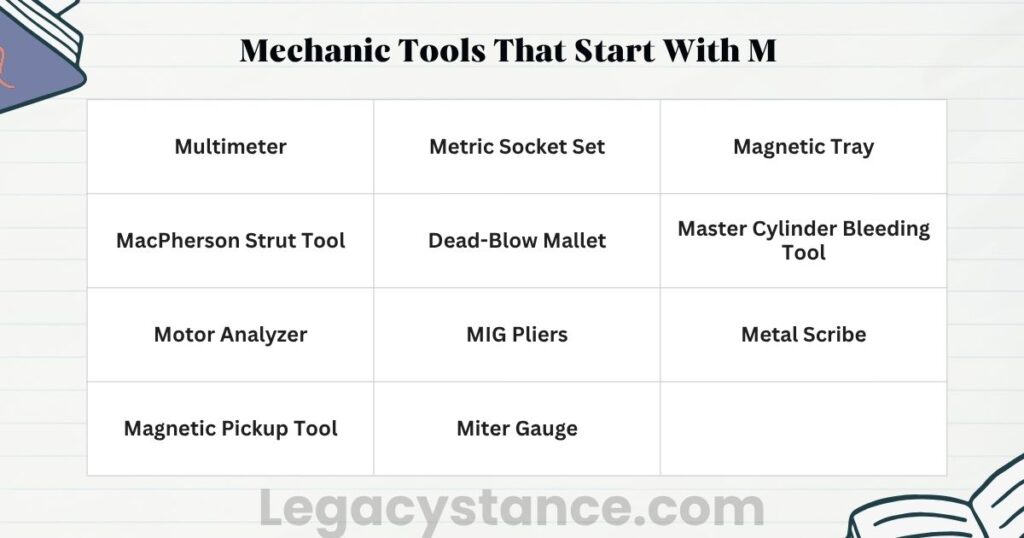
Multimeter
Type: Diagnostic electrical instrument Measures voltage, current, and resistance. Mechanics test battery charge and diagnose sensor faults. Electricians confirm circuits are dead before working on them.
Metric Socket Set
Type: Fastening tool set Sockets from 6mm to 24mm in shallow and deep profiles for use with a ratchet handle. Most modern vehicles use metric fasteners exclusively. Wrong size strips bolt heads fast.
Magnetic Tray
Type: Workshop accessory Magnetized shallow tray holds nuts, bolts, and small parts while working. Prevents fasteners from rolling off workbenches or disappearing under vehicles.
MacPherson Strut Tool
Type: Specialty suspension tool Compresses coil springs safely during strut replacement. Attempting spring compression without the correct tool risks serious injury from uncontrolled spring release.
Dead-Blow Mallet
Type: Striking mechanic tool Sand or lead shot-filled head eliminates rebound after striking. Used to remove stuck hubs, seat axle shafts, and free seized components without bounce-back damage.
Master Cylinder Bleeding Tool
Type: Specialty brake tool Creates vacuum to draw fresh brake fluid through hydraulic lines. Removes air from the system — the primary cause of soft, spongy brake pedal feel.
Motor Analyzer
Type: Diagnostic instrument Tests electric motors for winding faults and insulation breakdown without full disassembly. Used in automotive shops and industrial maintenance.
MIG Pliers
Type: Welding accessory Multi-function pliers for MIG welding stations — trims wire, cleans the nozzle, removes spatter. Standard tool at every MIG welder setup.
Metal Scribe
Type: Marking mechanic tool Hardened sharp point scratches precise reference lines onto metal surfaces before cutting or drilling. More accurate than pencil on metal.
Magnetic Pickup Tool
Type: Workshop accessory Extendable magnetized rod retrieves dropped metal fasteners from inside engine bays, deep cavities, or under equipment where fingers can’t reach.
Miter Gauge
Type: Woodworking/Workshop tool Slides in the table saw’s miter slot and guides boards through angled crosscuts. Set from 0° to 45° for consistent repeat cuts.
Construction Tools That Start With M
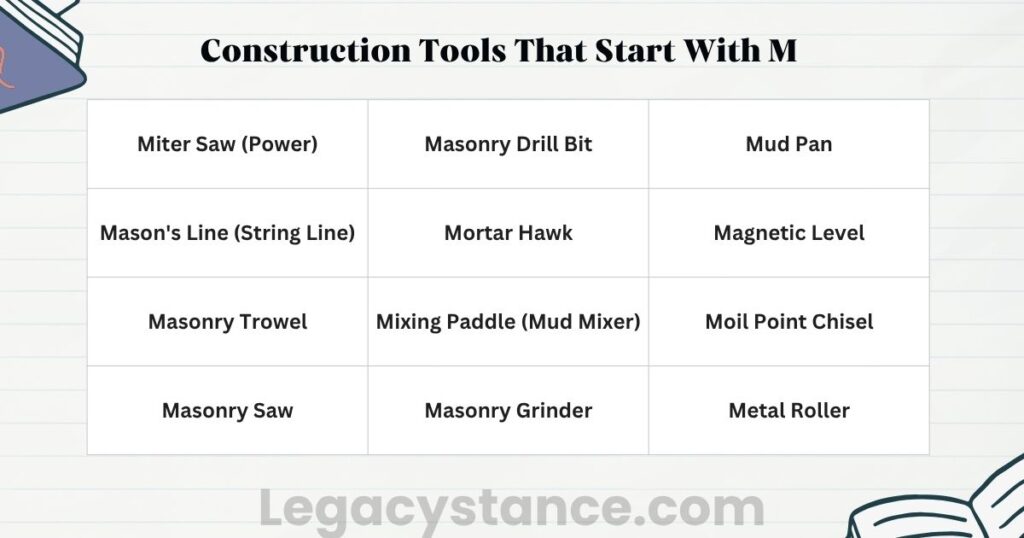
Miter Saw (Power)
Type: Power cutting tool Makes fast, precise crosscuts and angle cuts through lumber, trim, and molding. Sliding compound models cut boards up to 12 inches wide. Used by framers and finish carpenters.
Masonry Drill Bit
Type: Drill accessory Carbide-tipped bit bores through concrete, brick, stone, and mortar with a hammer drill. Used for anchoring hardware and fixtures to masonry surfaces.
Mud Pan
Type: Drywall tool Rectangular trough holds joint compound while working. A drywall knife draws compound from the pan for wall application.
Mason’s Line (String Line)
Type: Layout tool Tightly stretched string between two points gives bricklayers a horizontal reference for keeping courses level and walls plumb row by row.
Mortar Hawk
Type: Masonry hand tool Flat square platform with a short handle underneath carries mortar or plaster close to the work area. Plasterers hold it in one hand, apply material with the other.
Magnetic Level
Type: Measuring tool Spirit level with embedded magnets that attach hands-free to steel surfaces. Electricians use it to align conduit and electrical boxes without a helper.
Masonry Trowel
Type: Masonry hand tool Triangular flat blade scoops, places, and spreads mortar for laying brick and block. Pointing trowels fill joints; brick trowels lay full mortar beds.
Mixing Paddle (Mud Mixer)
Type: Power tool attachment Attaches to a heavy-duty drill and mixes joint compound, mortar, grout, and plaster to smooth consistency in under a minute.
Moil Point Chisel
Type: Demolition tool Pointed steel bit used with a demolition hammer to break concrete and hard masonry. Concentrates force into a small area for breaking dense material.
Masonry Saw
Type: Power cutting tool Wet or dry blade cuts through brick, block, tile, and concrete pavers. Used for fitting masonry units around corners, openings, and irregular edges.
Masonry Grinder
Type: Power tool Angle grinder fitted with a diamond or abrasive disc for cutting, grinding, and smoothing concrete, brick, and stone surfaces.
Metal Roller
Type: Painting tool Paint roller for applying paint, primer, or sealant to large flat surfaces on construction and industrial projects.
Measuring & Precision Tools That Start With M
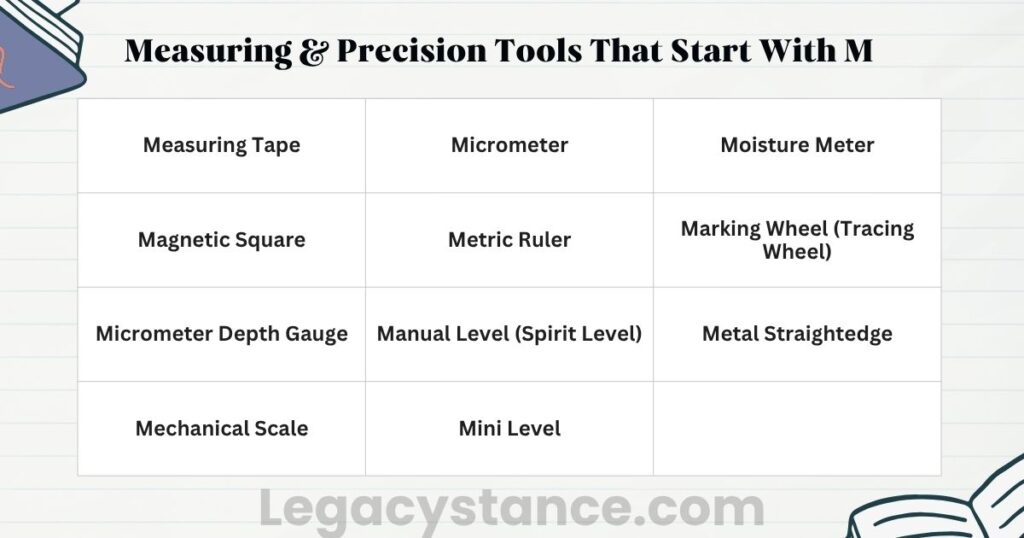
Measuring Tape
Type: Measuring tool Retractable steel blade in 3m to 10m lengths. The hooked end clips over edges for single-person use. The most universally used measuring tool in every trade.
Micrometer
Type: Precision measuring instrument Measures thickness and diameter to 0.01mm or finer. Outside micrometers measure shafts; internal micrometers measure bore diameters. Standard in machine shops.
Moisture Meter
Type: Diagnostic measuring tool Reads water content percentage inside wood, drywall, or concrete. Flooring contractors check subfloor moisture before laying hardwood. Home inspectors detect hidden water damage.
Magnetic Square
Type: Layout/welding tool Holds two metal pieces at precisely 90° using magnetic force. Welders position parts for tack welding without extra clamps or hands.
Metric Ruler
Type: Measuring tool Measures in millimeters and centimeters. Used in classrooms, engineering offices, and workshops. Metal versions are preferred in fine woodworking for marking joints.
Marking Wheel (Tracing Wheel)
Type: Layout tool Rolls along fabric leaving evenly spaced marks to transfer pattern lines. Used by tailors and upholstery workers, usually with transfer paper.
Micrometer Depth Gauge
Type: Precision measuring instrument Measures depth of holes, slots, and recesses in machined parts to 0.01mm accuracy. Used by quality inspectors to verify parts meet specifications.
Manual Level (Spirit Level)
Type: Measuring tool Liquid-filled vial with a bubble indicates level and plumb. Lengths range from 9 inches to 6 feet. Used by tile setters, cabinet installers, and framers.
Metal Straightedge
Type: Layout tool Rigid flat bar for drawing straight lines and guiding cuts. More accurate than plastic for marking on metal, wood, and drywall.
Mechanical Scale
Type: Measuring tool Weighs materials using a spring or balance mechanism — no electricity needed. Used in workshops and field environments.
Mini Level
Type: Measuring tool A compact spirit level for checking small surfaces, cabinet shelves, and tight spaces where a full-length level won’t fit.
Power Tools Beginning With M
Multi-Tool (Oscillating Tool)
Type: Power tool Vibrates blade back and forth at high speed for cutting, sanding, scraping, and grinding. Fits tight spaces other tools can’t reach. Essential for renovation work — cutting drywall near pipes, undercutting door casings, removing grout.
Magnetic Drill Press
Type: Industrial power tool Electromagnet locks the drill onto flat steel surfaces — beams, columns, plates — while boring through structural steel. Used in steel fabrication, bridge construction, and shipbuilding.
Metal Bandsaw
Type: Power cutting tool Continuous blade loop cuts metal bar, tube, and structural sections. Horizontal models chop stock to length automatically; vertical models cut curves and contours.
Miter Saw Stand
Type: Workshop support equipment Raises a miter saw to working height with outfeed rollers for long boards. Turns two-person cutting into a one-person task.
Micro Drill Press
Type: Precision power tool Small benchtop drill press for accurate small-diameter holes in electronics, jewelry, and model making. More controlled than a handheld drill for fine work.
Measuring & Layout (Additional)
Milling Cutter
Type: Machining tool Rotating multi-edge cutting tool used in milling machines to remove material from metal or plastic. Different profiles produce flat surfaces, slots, grooves, or contours.
Professional & Specialty Tools That Start With M
Mandrel
Type: Forming/machining tool Metal rod or bar used as a core around which material is shaped. Metalworkers bend tubing over mandrels; jewelers shape rings on them; machinists use them to hold lathe workpieces.
Marking Punch (Center Punch)
Type: Metal marking tool Creates a small indentation before drilling to stop the drill bit wandering across the metal surface. A quick step that prevents off-center holes.
Metal Shears (Aviation Snips)
Type: Cutting hand tool Cuts sheet metal — roofing, HVAC ducting, and flashing. Red handles cut straight; green cut left curves; yellow cut right curves.
Mill File
Type: Abrasive hand tool Single-cut flat file producing a smooth finish on metal. Used by toolmakers to deburr edges, sharpen tools, and refine machined surfaces.
MIG Welder
Type: Welding equipment Feeds continuous wire electrode with shielding gas protecting the weld pool. Faster and cleaner than stick welding. Standard in fabrication shops and auto body work.
Metal Lathe
Type: Machine tool Rotates a workpiece against a cutting tool to produce precise cylinders, cones, and profiles. Machinists manufacture shafts, bushings, and custom parts on metal lathes.
Magnetic Particle Inspection Equipment
Type: Non-destructive testing instrument Magnetizes metal parts and applies iron particles to reveal cracks invisible to the naked eye. Used in aircraft maintenance and structural inspections.
Micromanipulator
Type: Precision laboratory instrument Positions small tools with sub-millimeter accuracy. Used by neuroscientists for electrode placement and electronics engineers for probing microscopic circuits.
Magnetic Chuck
Type: Workholding device Electromagnetic or permanent magnet base holds steel workpieces on a surface grinder without clamps. Essential for flat surface grinding.
Microhardness Tester
Type: Materials testing instrument Measures hardness of small surface areas — thin coatings or weld zones — using a diamond indenter under a known load.
Metering Pump
Type: Industrial fluid control equipment Delivers precise, controlled volumes of fluid into a process stream. Used in water treatment for dosing chemicals and in chemical plants for controlled additive injection.
Magnetic Separator
Type: Industrial processing equipment Removes ferrous metal particles from production lines using a powerful magnet above a conveyor. Used in food processing, recycling, and mining to prevent contamination.
Metal Injection Molding Press
Type: Industrial manufacturing equipment Injects metal powder mixed with binder into molds to produce small, complex metal parts. Parts are sintered to densify the metal. Used in medical device and firearms manufacturing.
Mold Press
Type: Industrial manufacturing equipment Shapes rubber and plastic under heat and hydraulic pressure. Produces auto parts, seals, gaskets, and footwear components.
Mechanical Claw
Type: Material handling tool Gripping device for picking up, moving, and placing heavy or irregularly shaped parts in industrial environments without direct hand contact.
Metal Rounding Plane
Type: Woodworking tool Hand plane with a curved sole for rounding edges and shaping convex profiles on wood. Used in cabinet making and furniture finishing.
Metal Detector (Industrial)
Type: Quality control equipment Built into conveyors and production lines to detect metal contamination in food, pharmaceutical, and packaged goods. Triggers automatic rejection when metal is detected.
Digital & Software Tools That Start With M
| Tool | Type | Primary Use |
| Microsoft Excel | Spreadsheet software | Cost estimates, data analysis, project scheduling |
| MicroStation | CAD software | Civil engineering, infrastructure drawing |
| MATLAB | Computational software | Engineering simulation, data analysis |
| Monday.com | Project management | Task tracking, timelines, team coordination |
| MAGNET Axiom | Digital forensics | Data recovery, cybersecurity investigation |
Safety Tools & Equipment Starting With M
Mechanical Respirator (Half-Face Respirator)
Type: Personal protective equipment Filters dust, vapors, and particulates. Filter cartridge type must match the hazard — particulate filters don’t protect against chemical vapors.
Metatarsal Guards
Type: Personal protective equipment Protect the top foot bones from falling objects — a zone a standard steel-toe boot leaves exposed. Used by foundry workers, steel erectors, and dock workers.
Mechanical Lockout Device
Type: Safety/LOTO equipment Physically locks electrical, pneumatic, or hydraulic energy sources in the off position before equipment is serviced. OSHA-required in all industrial maintenance.
Inspection Mirror
Type: Inspection tool Small mirror on an extendable handle for seeing into hidden spaces — behind pipes, inside engine bays, under chassis. Saves significant disassembly time.
Magnetic Wristband
Type: Workshop accessory Holds screws and small metal parts on your wrist during installation work. Prevents fasteners dropping into wall cavities, engine bays, or tight spaces.
Mop / Floor Squeegee
Type: Maintenance tool Cleans and moves liquid across floor surfaces. Squeegees direct spills toward drains. Standard in workshops, kitchens, and industrial floors.
Complete Reference: 115+ Tools That Start With M
| Tool Name | Category |
| Mallet | Hand Tool |
| Monkey Wrench | Hand Tool |
| Metal File | Hand Tool |
| Marking Gauge | Layout Tool |
| Mortising Chisel | Hand Tool |
| Miter Box | Cutting Guide |
| Marking Knife | Layout Tool |
| Masonry Chisel | Hand Tool |
| Mattock | Digging Tool |
| Mud Knife | Hand Tool |
| Maul | Striking Tool |
| Machete | Cutting Tool |
| Mini Hacksaw | Hand Saw |
| Manual Rivet Gun | Fastening Tool |
| Metal Brush | Surface Prep |
| Multi-Bit Screwdriver | Hand Tool |
| Metal Punch | Hand Tool |
| Masking Tape Dispenser | Workshop Accessory |
| Manual Hand Pump | Fluid Tool |
| Mill Scale Brush | Surface Prep |
| Multimeter | Diagnostic Tool |
| Metric Socket Set | Mechanic Tool |
| Magnetic Tray | Workshop Accessory |
| MacPherson Strut Tool | Mechanic Tool |
| Dead-Blow Mallet | Striking Tool |
| Master Cylinder Bleeding Tool | Brake Tool |
| Motor Analyzer | Diagnostic Tool |
| MIG Pliers | Welding Accessory |
| Metal Scribe | Marking Tool |
| Magnetic Pickup Tool | Workshop Accessory |
| Miter Gauge | Workshop Tool |
| Miter Saw | Power Tool |
| Masonry Drill Bit | Drill Accessory |
| Mud Pan | Drywall Tool |
| Mason’s Line | Layout Tool |
| Mortar Hawk | Masonry Tool |
| Magnetic Level | Measuring Tool |
| Masonry Trowel | Masonry Tool |
| Mixing Paddle | Power Tool Attachment |
| Moil Point Chisel | Demolition Tool |
| Masonry Saw | Power Tool |
| Masonry Grinder | Power Tool |
| Metal Roller | Painting Tool |
| Measuring Tape | Measuring Tool |
| Micrometer | Precision Tool |
| Moisture Meter | Diagnostic Tool |
| Magnetic Square | Layout Tool |
| Metric Ruler | Measuring Tool |
| Marking Wheel | Layout Tool |
| Micrometer Depth Gauge | Precision Tool |
| Manual Level | Measuring Tool |
| Metal Straightedge | Layout Tool |
| Mechanical Scale | Measuring Tool |
| Mini Level | Measuring Tool |
| Milling Cutter | Machining Tool |
| Multi-Tool (Oscillating) | Power Tool |
| Magnetic Drill Press | Power Tool |
| Metal Bandsaw | Power Tool |
| Miter Saw Stand | Workshop Equipment |
| Micro Drill Press | Precision Power Tool |
| Mandrel | Forming Tool |
| Marking Punch | Metal Marking Tool |
| Metal Shears | Hand Tool |
| Mill File | Hand Tool |
| MIG Welder | Welding Equipment |
| Metal Lathe | Machine Tool |
| Magnetic Particle Inspection Equipment | NDT Equipment |
| Micromanipulator | Laboratory Tool |
| Magnetic Chuck | Workholding Device |
| Microhardness Tester | Testing Equipment |
| Metering Pump | Industrial Equipment |
| Magnetic Separator | Industrial Equipment |
| Metal Injection Molding Press | Manufacturing Equipment |
| Mold Press | Manufacturing Equipment |
| Mechanical Claw | Material Handling |
| Metal Rounding Plane | Woodworking Tool |
| Metal Detector (Industrial) | Quality Control |
| Microsoft Excel | Software Tool |
| MicroStation | CAD Software |
| MATLAB | Computational Tool |
| Monday.com | Project Management |
| MAGNET Axiom | Forensics Software |
| Mechanical Respirator | Safety Equipment |
| Metatarsal Guards | Safety Equipment |
| Mechanical Lockout Device | Safety Equipment |
| Inspection Mirror | Diagnostic Tool |
| Magnetic Wristband | Workshop Accessory |
| Mop / Floor Squeegee | Maintenance Tool |
| Metal Detector (Handheld) | Security/Detection |
| Magnetic Drill Bit | Drill Accessory |
| Mortise Lock Installation Kit | Door Hardware Tool |
| Marine Caulk Gun | Sealing Tool |
| Metal Nibbler | Sheet Metal Tool |
| Marking Chalk Line | Layout Tool |
| Multi-Process Welder | Welding Equipment |
| Metal Deburring Tool | Finishing Tool |
| Manual Pipe Bender | Plumbing Tool |
| Masonry Anchor Tool | Fastening Tool |
| Modular Scaffolding System | Construction Equipment |
| Motor Hoist (Engine Hoist) | Lifting Equipment |
| Metal Forming Hammer | Shaping Tool |
| Measuring Wheel | Layout/Survey Tool |
| Mastic Gun | Sealing Tool |
| Manual Floor Scraper | Flooring Tool |
Choosing the Right Tool
Hand tools — quality over price. A well-made mallet or chisel outlasts three cheap ones. Buy once, buy right for tools you reach for daily.
Power tools — match the tool to your actual workload. A homeowner doing occasional trim cuts doesn’t need a 12-inch sliding compound saw. A dedicated workshop user benefits from the capacity.
Measuring tools — let accuracy requirements set your budget. Standard framing uses a tape measure. Precision machining needs a micrometer. Know your tolerance before spending on instruments.
Safety equipment — no compromises. Better filter ratings on a respirator are always worth the extra cost.
Beginner Mistakes to Avoid
Reaching for a hammer when the job needs a mallet damages surfaces and cracks chisel handles. Using a metric socket that’s “close enough” strips bolt heads and creates a bigger problem than the original repair. Skipping the center punch before drilling lets the bit wander and produces off-center holes. Not checking subfloor moisture before installing hardwood floors results in buckling and cupping months later.
Read more –
130+ Tools That Start With K: Hand Tools, Power Tools, and Software
115+ Tools That Start With I: Hand, Mechanic & Professional Tools
FAQs
What are the most common tools that start with M?
Some of the most commonly used tools include a mallet, measuring tape, miter saw, monkey wrench, multimeter, and moisture meter. These tools are found in home workshops, garages, construction sites, and repair jobs.
Which M tools are best for beginners?
Beginners usually start with basic and affordable tools like a measuring tape, multi-bit screwdriver, mud knife, mini hacksaw, and mallet. These tools are easy to use and useful for everyday repair and DIY projects.
Why is a multimeter important?
A multimeter helps test voltage, resistance, and electrical current. It is important for checking batteries, wiring, outlets, and electrical problems safely before repairs are made.
What is the difference between a mallet and a hammer?
A hammer uses a hard metal head for driving nails and heavy striking. A mallet has a softer head made from rubber, wood, or plastic, which helps prevent damage to surfaces and materials.
Do I need both metric and SAE socket sets?
If you work on different vehicles or machinery, having both sets is helpful. Many modern vehicles use metric fasteners, while older equipment may still use SAE sizes.
Final Thoughts
From a mallet on a woodworking bench to a magnetic particle inspection unit in an aircraft hangar, tools that start with M span every trade, every skill level, and every environment. Knowing what each one does — and when to reach for it — is the real foundation of practical knowledge. Whether you’re building vocabulary, stocking a toolkit, or learning a trade, this list gives you a solid, working reference to come back to.