YFM stands for “You Feel Me?” It’s asking if someone relates to what you just said or understands where you’re coming from emotionally.
Someone Just Sent You “YFM” and You’re Lost
You’re scrolling through messages and there it is again—YFM sitting at the end of someone’s text like you’re supposed to know what it means. Maybe you’ve seen it under TikTok videos or in Instagram comments, and you keep pretending you get it.
The confusing part? It doesn’t spell anything obvious. No “feel” starts with F in text shortcuts, and the letters don’t match up the way you’d expect. So you’re left guessing or, let’s be honest, googling it at 2 AM.
Breaking Down What YFM Really Does
Think of YFM as a vibe check disguised as a question. When someone uses it, they’re not testing your reading comprehension. They’re asking if you’ve been there—if you know that exact feeling they’re describing.
Say your friend texts: “Spent $50 on food delivery this week, YFM?” They’re not asking if you understand the concept of ordering food. They want to know if you’ve also blown money on late-night cravings and felt that same mix of satisfaction and regret.
It creates this little moment where both people go “yeah, I’ve lived that” without needing to write a whole therapy session about it. That’s why it sticks around—it does a lot of emotional work with barely any effort.
Where You’ll Actually See This Pop Up
YFM lives in the spontaneous corners of the internet. Friend group texts where everyone’s complaining about the same annoying coworker. Instagram story replies where someone shares a hot take about dating and you respond with “YFM 100%.” Comment sections under relatable content where thousands of people are basically saying “same.”
It works best when conversations move fast and people already share some common ground. Like if your friends are all stressing about exams, someone throws out “Can’t remember the last time I slept properly, YFM?” and everyone just knows.
Less common in one-on-one deep conversations where you’re actually explaining feelings. More common in rapid-fire group energy where everyone’s riffing off the same topic.
Chat Platforms vs. Social Media
Texting keeps YFM personal—it’s usually between people who already have history. TikTok and Instagram turn it into a broadcast thing, like the creator is asking thousands of strangers “we all feel this, right?” and building community through shared annoyance or joy.
Discord servers and gaming chats use it during live action. “That boss fight is literally impossible, YFM?” when everyone just died for the fifth time.
Reading the Room: When Tone Shifts Everything
Here’s where people mess up. YFM sounds different depending on your relationship with the person and what’s happening in the conversation.
Between close friends talking about nothing important: Totally harmless. “I could eat tacos every single day, YFM?” is just friendly chatter.
With someone you barely know: Might feel too familiar, like you’re assuming you’re closer than you actually are.
During a disagreement: Can come across aggressive. “I already explained this twice, YFM?” isn’t really asking—it’s accusing the other person of not paying attention.
Watch out for fake YFM too. Someone says “Sure, I love being ignored, YFM?” dripping with sarcasm—they’re not looking for agreement, they’re calling you out.
The problem with text is you can’t hear someone’s voice, so that friendly “YFM?” you meant as a joke might land as pushy or passive-aggressive. Timing matters, relationship matters, and what happened three messages ago definitely matters.
Skip YFM in These Situations
Anything work-related is a hard no. Your professor, your boss, your client—none of them need to see YFM in an email or formal message. It reads as unprofessional and honestly a bit immature in serious contexts.
Don’t use it when you’re trying to make an actual important point. “I need help with something, YFM?” weakens what you’re saying because it sounds uncertain instead of direct.
Also bad with people who don’t speak texting fluently—older relatives, international friends still learning English, anyone who’d read it and think you made a typo. Save yourself the awkward explanation.
And if you’re already annoying someone, adding YFM is like poking them harder. “You’re overreacting, YFM?” will not calm anyone down. Trust me.
Read Also: What Does NFS Mean in Text? (From Girls, Guys, Snapchat & More)
What to Say Instead
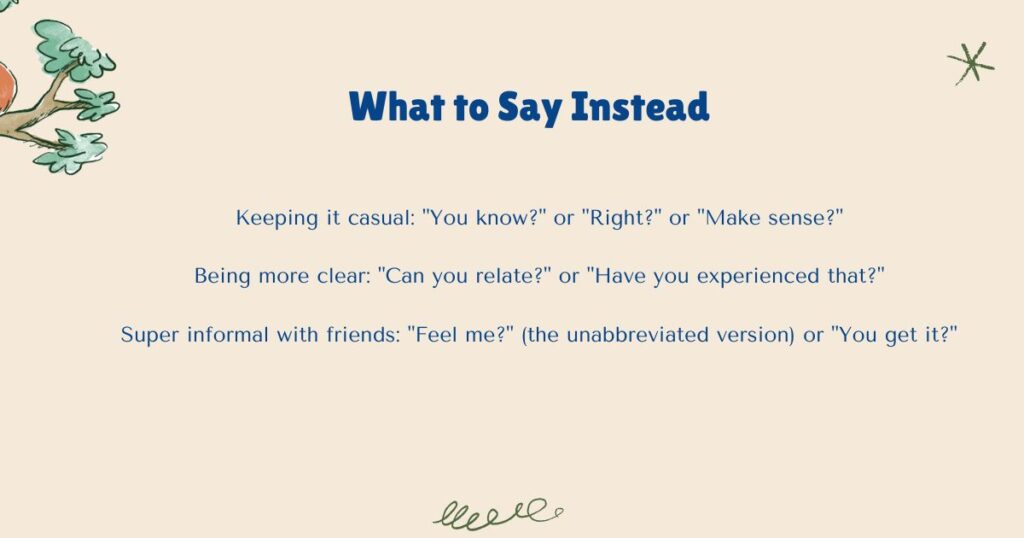
Sometimes you want the same energy without the slang:
Keeping it casual: “You know?” or “Right?” or “Make sense?”
Being more clear: “Can you relate?” or “Have you experienced that?”
Super informal with friends: “Feel me?” (the unabbreviated version) or “You get it?”
Match your word choice to who you’re talking to. Your best friend gets the slang. Your academic advisor gets full sentences.
How This Actually Shows Up in Messages
Complaining about something universal: “Why does everyone walk so slow in hallways, YFM?”
Hyping something you like: “This song has been stuck in my head for three days straight, YFM?”
Late night thoughts: “Sometimes you just need to delete social media and touch grass, YFM? 😭”
Testing if someone’s on your wavelength: “Pineapple on pizza is actually elite, YFM?”
Mid-story context: “So I showed up and nobody told me the plans changed, YFM? I looked so dumb.”
Bonding over shared pain: “Group projects where you do all the work >>> YFM?”
Each one is creating a little bridge—”I’m saying something, now tell me we’re experiencing life similarly.”
The Girl-to-Guy Thing People Ask About
When girls text YFM, it’s often softening something vulnerable. Sharing feelings about relationships or life stress and checking if you’re emotionally in sync. “Talking to new people is exhausting, YFM?” is less about the statement and more about creating connection.
Guys use it more for surface-level solidarity—sports takes, work complaints, shared annoyances. “This game is absolutely rigged, YFM?” after their team loses. Less emotional depth, more team mentality.
Neither way is right or wrong, just different communication styles. Girls might see it as invitation to deeper chat. Guys might see it as casual agreement and move on.
What People Get Wrong
Overuse kills it. If you end every single message with YFM, it stops meaning anything and starts sounding desperate for validation.
It’s not the same as “fr” (for real). FR is confirming something is true. YFM is asking if someone relates. Different jobs.
Assuming everyone relates is risky. “I hate when parents are supportive, YFM?” Uh, no, some people don’t relate to that at all, and now it’s weird.
Using it when you need concrete information. “Meet at the coffee shop at 3, YFM?” doesn’t work because you need confirmation, not vibes.
Read Also: TMB Meaning in Text: Why Everyone’s Using It (And When You Shouldn’t)
Quick Answers to What People Actually Wonder
Does this work everywhere?
No. It’s an internet/texting thing born from casual digital chat. Real-life spoken conversations don’t really use the abbreviation—people just say “you feel me?” out loud.
Will older people know what I mean?
Probably not. It’s generational slang that doesn’t translate across age groups well.
Can I use it sarcastically?
Yeah, and people do. But be careful because the person on the other end might not catch the sarcasm through text.
What if I use it and someone doesn’t respond?
Either they don’t know what it means, they don’t relate to what you said, or they just didn’t feel like responding. It’s not that deep.
Is it offensive?
Not inherently, but context always matters. Tone and timing can make anything sound rude.
The Real Point of All This
YFM is one of those tiny linguistic tools that does way more than it looks like it should. Three letters that ask “are we experiencing the same reality right now?” in digital spaces where connection feels harder to find.
Use it with people who share your communication style, skip it when professionalism matters, and pay attention to whether it’s actually landing the way you meant it to. The whole point is creating those quick moments of “yeah, same”—but only if both people are actually feeling it.

Hi, I’m the creator of Legacystance.com, dedicated to making English learning simple and enjoyable. I write clear, practical guides on adjectives, verbs, idioms, pronunciation, spelling, and more. Every article is carefully researched to give accurate, easy-to-understand information. My goal is to help readers improve their English skills confidently, one step at a time, with content that is trustworthy, useful, and beginner-friendly.