Wu-Tang means something untouchable. Whether people are talking about the rap group, using it as street slang for elite quality, or throwing it into a meme — the core idea is always the same: powerful, real, and built to last.
The Honest Reason You’re Here
You probably caught it somewhere unexpected. A comment, a caption, maybe a friend’s text that said something like “bro we ate Wu-Tang tonight” after a good game. And you smiled and moved on, but quietly had no idea what that actually meant.
It doesn’t feel like a phrase you can just ask about. It sounds like everyone already knows. That’s exactly what makes it confusing — it travels fast and explains itself slowly.
The Origin, But Not the Boring Version
Here’s what most articles skim over: the name isn’t random and it’s not purely American.
RZA, the group’s architect, was obsessed with old kung fu films — specifically one called Shaolin and Wu Tang from 1983. That movie draws from the Wudang Mountains in China, a place tied to Taoist philosophy and internal martial arts like Tai Chi. In Taoism, “Wu” roughly means nothingness — not emptiness in a sad way, but openness. The space that allows movement. “Tang” links to China’s Tang dynasty, an era defined by cultural strength.
RZA took those ideas and fused them with nine guys from Staten Island who had nothing but talent and time. The result was Enter the Wu-Tang (36 Chambers) in 1993 — an album that changed rap permanently. The “36 Chambers” part comes from another kung fu film where a student earns mastery by surviving 36 rooms of training. That’s not decoration. That’s the whole philosophy of the group — you earn your place.
Nine members. Independent production. No major label control at launch. That defiance became part of the brand’s DNA, which is why the slang meaning carries the same rebellious confidence.
What the Slang Actually Feels Like
Calling something “Wu-Tang” is not the same as calling it good. It’s a specific kind of praise — for things that are raw, unpolished in the best way, and clearly built with real intention behind them.
A clean studio beat with no soul isn’t Wu-Tang. A rough demo that gives you chills? That might be.
It also carries a crew dimension that most slang doesn’t. When people say “Wu-Tang forever” or “we moved Wu-Tang tonight,” they’re talking about loyalty that doesn’t need explaining. The original group had nine members with very different personalities, but they moved as one unit. That’s the image. Your people. Your squad. Unmovable.
The Drake Effect and Why It Went Mainstream
In 2014, Drake used the line “It’s a Wu-Tang meeting” to describe calling in authority and handling things at the highest level. That line took on a second life online — people started using “Wu-Tang meeting” for absurdly petty situations. Someone stole your parking spot? Wu-Tang meeting. The restaurant got your order wrong? Wu-Tang meeting.
It became a joke about fake seriousness. The funnier the mismatch between the drama and the situation, the better it lands.
That’s a very different usage from the original — and both are valid depending on who you’re talking to.
The Smoking Reference People Search For
Yes, in some social circles, “Wu-Tang” describes a very large, carefully constructed blunt. The logic is straightforward — it’s a size and quality stamp, paying tribute to something grand and crafted with care. You’ll hear it more in laid-back settings, usually among people who are already familiar with the group’s music as background noise for exactly that kind of session.
It’s niche, but it’s real. If you’re not in that circle, this usage probably won’t come up naturally.
Read also: HBS Meaning — What It Actually Stands For (And Why It Depends)
When the Tone Shifts Everything
Same word, completely different energy depending on delivery:
“That set was Wu-Tang” — pure respect. No debate.
“You think you’re Wu-Tang?” — that’s a challenge. Someone’s questioning your confidence.
“We having a Wu-Tang meeting about this” said deadpan — that’s the Drake meme energy, and it’s funny when the situation is obviously minor.
“Wu-Tang forever” at the end of a long group chat thread — warmth, loyalty, shorthand for “I’m glad we have each other.”
The phrase is confident by nature. It doesn’t apologize for itself. So if you drop it in a moment that calls for humility or sensitivity, it lands wrong — not offensive, just tone-deaf.
Where It Doesn’t Belong
A few places to just leave it out:
Work emails or formal settings — even if you mean it as genuine praise, it reads unprofessional to people who don’t share the cultural context.
Serious emotional conversations — someone going through something difficult doesn’t need their pain framed through slang. Save it for celebration, not comfort.
When you’re clearly performing it — if it’s not natural to how you talk, forcing it will be obvious. People can feel the gap between someone who lives the language and someone who Googled it.
Uses of Wu-Tang in Real Examples
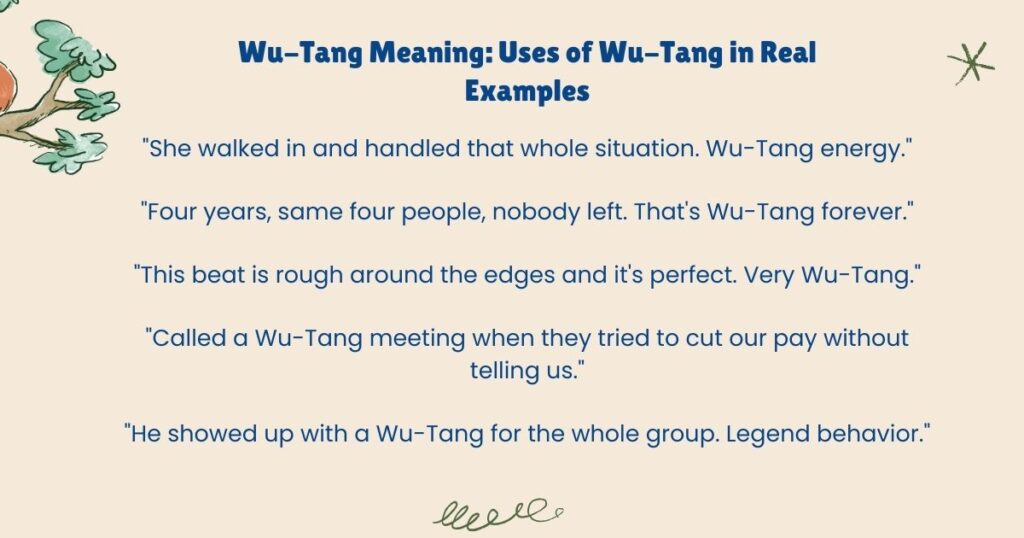
“She walked in and handled that whole situation. Wu-Tang energy.”
“Four years, same four people, nobody left. That’s Wu-Tang forever.”
“This beat is rough around the edges and it’s perfect. Very Wu-Tang.”
“Called a Wu-Tang meeting when they tried to cut our pay without telling us.”
“He showed up with a Wu-Tang for the whole group. Legend behavior.”
“Nobody believed in what we were building. We did it anyway. Wu-Tang style.”
How Different People Hear It Differently
People who grew up on the music hear it as a direct reference — an homage to something they consider sacred in hip-hop.
Younger people who found the phrase through memes or TikTok might not connect it to the group at all. To them it’s just a tone: confident, untouchable, a little old-school cool.
Hip-hop purists sometimes get annoyed at how loose the usage has become. That tension is real, but it’s also proof the phrase has cultural staying power.
The Misreadings That Actually Happen
People sometimes assume it’s aggressive slang — something combative. It’s not, usually. The original group had Wu Xing philosophy running through their lyrics, which is about balance, not just aggression.
Others treat it like a compliment you throw around casually, and then it loses its weight. If everything is Wu-Tang, nothing is. The phrase works best when it’s earned, not handed out.
Read Also: TMB Meaning in Text: Why Everyone’s Using It (And When You Shouldn’t)
FAQs Worth Actually Answering
Does Wu-Tang come from Chinese culture?
Yes — the Wudang Mountains, Taoist philosophy, and kung fu films all shaped the name directly. The American hip-hop group built on top of that foundation rather than creating it from scratch.
Is “Wu-Tang forever” a romantic thing to say?
It can be, but only in a context where both people already share that language. On its own, it reads more like deep friendship loyalty than romance.
Why do people say it for weed specifically?
It’s a quality and size compliment borrowed from the group’s larger-than-life reputation. Not a mainstream usage, just a specific subculture applying the same “legendary” energy to what they’re passing around.
Is it outdated slang?
No. It has layers now — original hip-hop meaning, the Drake meme version, the loyalty shorthand. Different generations use different versions of it, which actually keeps it alive.
What’s the difference between Wu-Tang the group and Wu-Tang the phrase?
The group is the origin. The phrase is what people took from them and ran with. You don’t have to know a single song to understand what the slang means — though knowing the music adds a whole other dimension to it.
Final Thought
What’s interesting about Wu-Tang is that it spread because the ideas behind it are genuinely worth spreading. Loyalty, doing things your own way, building something real with the people around you — those aren’t complicated concepts, but they’re rare enough that when something represents them well, the language sticks.
That’s what happened here. The phrase just keeps finding new rooms to live in.

Hi, I’m the creator of Legacystance.com, dedicated to making English learning simple and enjoyable. I write clear, practical guides on adjectives, verbs, idioms, pronunciation, spelling, and more. Every article is carefully researched to give accurate, easy-to-understand information. My goal is to help readers improve their English skills confidently, one step at a time, with content that is trustworthy, useful, and beginner-friendly.