Sharking means moving in on someone or something with calculated timing — like a shark that circles before it strikes. Bold, patient, and a little opportunistic. That’s the whole idea.
You Probably Saw It and Felt Lost
Maybe someone dropped it in a TikTok comment and the whole reply section was laughing except you. Or your friend sent “he’s literally sharking rn 🦈” and you just sent back a laughing emoji hoping nobody noticed you had no idea what was happening.
The confusing part is that sharking shows up in completely different conversations — dating talk, pool games, stock trading, gaming — and sounds totally different in each one. Same word, totally different situations. That’s what makes it tricky.
The Feeling Behind the Word
Think about what a shark actually does. It doesn’t panic. It doesn’t rush. It watches from a distance, reads the situation, and moves at exactly the right moment.
That’s the energy people are describing when they use this word. It’s not random boldness. It’s timed boldness. Someone who’s been quietly paying attention and then suddenly appears right when a door opens — that’s a shark move.
In dating, that door usually opens when someone’s relationship hits a rough patch. The person who was “just being friendly” all along suddenly gets a lot more attentive. Everyone watching sees it immediately. The person being sharked sometimes doesn’t realize it until way later.
What makes it different from regular confidence is the waiting. A confident person walks up and says something. A shark waits for the perfect conditions first.
Where You’ll Actually Hear It
In dating and social life — this is where the word lives most comfortably right now. “He’s been sharking her since their fight last week” is a sentence that needs zero explanation to most people under 30. The timing element is the whole point.
On TikTok — it became a whole aesthetic. Videos of people “strategically positioned” near their crush, waiting for relationship drama to play out. The 🦈 emoji basically became its own shorthand. “Sharking all summer” turned into a vibe people either related to or called out.
In pool and billiards — this one’s been around way longer than the dating version. Sharking your opponent at the pool table means messing with their focus. Fake coughing during their shot. Moving in their line of sight. Commenting right as they’re about to hit. It’s psychological, it’s petty, and in casual bar games it happens constantly.
In trading — traders use it to describe swooping into a falling market and grabbing assets while everyone else is panicking. Same circling, same calculated strike. Different stakes.
In gaming — stomping on newer or weaker players is sharking. You’re not playing to have fun, you’re hunting easy wins.
Tone Is Everything With This Word
Here’s what people miss: sharking isn’t always an insult.
Said between close friends about one of them? It’s usually a joke with some admiration mixed in. “Bro you were fully sharking that situation” lands like a roast, not an accusation.
Said seriously, without the emoji, about someone you don’t really like? It’s a warning. It implies that person is predatory and calculating. That version stings.
The 🦈 emoji does more tonal work than people realize. With it, the word feels playful. Without it, the same sentence reads much colder.
One real situation where this matters — don’t casually text someone “your partner has been sharking around” unless you’re ready for that to become a whole thing. It doesn’t read as gossip. It reads as an accusation.
Times to Just Not Use It
In professional settings, calling someone’s aggressive networking “sharking” will confuse older colleagues and make you sound dismissive of someone’s work ethic. It doesn’t translate well outside of casual conversation.
If someone’s genuinely going through something hard — a breakup, a rough patch — and a friend is being extra supportive, calling it sharking publicly can make the friend look predatory even if they have good intentions. Context matters a lot.
Also, dropping it in someone’s public comments when they might not even know what it means puts them in an awkward spot. What feels like a playful observation to you might embarrass them in front of people they care about.
When It Gets Complicated in Dating
The dating version is where sharking gets its most interesting debate.
Some people see it as just reading social timing well. You like someone, you notice they seem unhappy in their relationship, and you make yourself more present. Bold? Yes. Manipulative? People disagree.
Others argue that specifically targeting someone in a vulnerable moment — mid-fight with their partner, freshly heartbroken — is taking advantage of low defenses rather than building something real. The thing that starts with sharking often carries that same calculated energy into the relationship itself.
There’s also a version called “sharking down” — dating someone you’re not really attracted to because you think they’ll be more loyal or treat you better. It rarely works out the way people expect and usually ends up being unfair to both people involved.
Read Also: What Does FNL Actually Mean? (And Why It’s Confusing Everyone)
How People Actually Say It — Real Examples
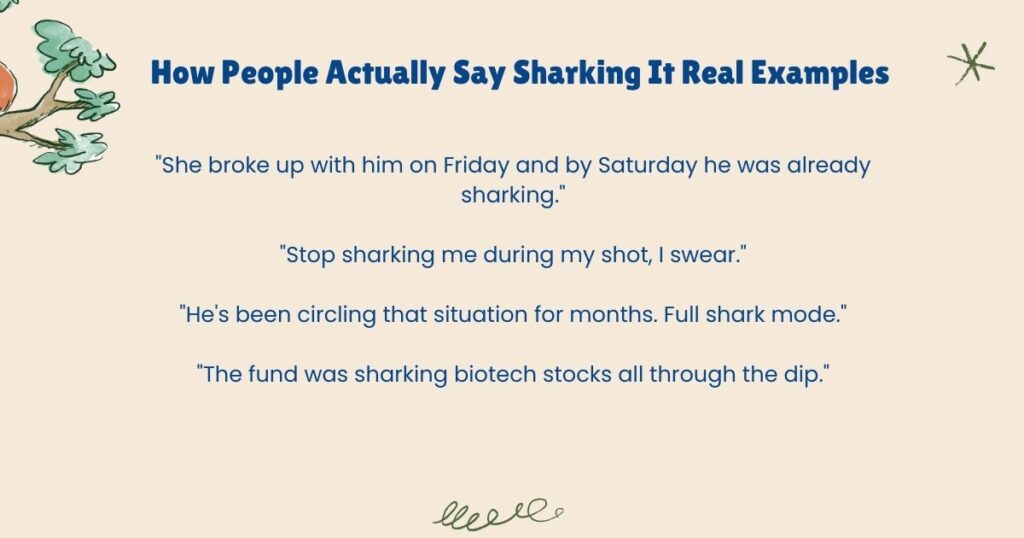
“She broke up with him on Friday and by Saturday he was already sharking.”
“Stop sharking me during my shot, I swear.”
“He’s been circling that situation for months. Full shark mode.”
“The fund was sharking biotech stocks all through the dip.”
“I didn’t even realize I was doing it. My friend had to tell me I was basically sharking her whole situation.”
“New player joins the lobby and these guys just start sharking immediately. No chill.”
“She posted one story looking sad and three different people were sharking her DMs within the hour.”
How It Compares to Similar Words
Orbiting is passive — your ex watching every story but never saying anything. Sharking is active. There’s movement involved.
Lovebombing is overwhelming someone with attention and affection all at once. Sharking is more patient. It waits for the right moment instead of flooding in immediately.
Hustling is general — chasing any kind of opportunity. Sharking is specific. It has that circling, timing-based quality that hustling doesn’t always carry.
The shark comparison is what makes this word stick. It’s so visual. Everyone immediately pictures that slow circle in the water.
Common Ways People Read It Wrong
People assume it always means something predatory and harmful. It doesn’t. The pool version is just gamesmanship. The trading version is often respected. Even in dating, there’s a spectrum between “noticed good timing” and “actively waited for someone to be emotionally vulnerable.”
Written without tone indicators, it’s genuinely hard to tell if someone’s impressed or disgusted. “She’s sharking” could go either way depending on who’s saying it and why.
It also gets overused once people learn it. Not every confident social move is sharking. Sometimes someone just walks up and talks to a person they like. That’s not a calculated hunt — that’s just a normal human interaction that doesn’t need a shark label.
Read Also: MYF Meaning in Text: What It Stands for & How People Actually Use It
FAQs
Does sharking mean the same thing in texting as it does on TikTok?
Mostly yes. TikTok gave it the visual element and the emoji culture around it, but the meaning — calculated, timed boldness — stays the same across platforms.
Is it always about dating?
Not at all. Pool, trading, and gaming all have their own versions of it. Dating just happens to be where it blew up most recently.
Can someone shark without knowing they’re doing it?
Genuinely, yes. You can be consistently present whenever someone seems to be struggling in their relationship and not realize that everyone around you sees a pattern you don’t.
Is calling someone a shark to their face offensive?
Depends entirely on your relationship and whether it’s clearly a joke. Between good friends, usually funny. With someone you’re not that close to, it can land like a real accusation.
Why did it get popular so fast?
Because it describes something people already recognized but didn’t have a single clean word for. Once the word existed, people started seeing the behavior everywhere — including in themselves.
To Close
What’s interesting about this word is that it holds up a mirror. Most people have either done it or spotted it, but it’s the kind of behavior nobody openly admits to. The word being funny and slightly flattering makes it easier to talk about honestly.
Whether that’s a good thing probably depends on which end of the shark’s circle you’re standing on.

Hi, I’m the creator of Legacystance.com, dedicated to making English learning simple and enjoyable. I write clear, practical guides on adjectives, verbs, idioms, pronunciation, spelling, and more. Every article is carefully researched to give accurate, easy-to-understand information. My goal is to help readers improve their English skills confidently, one step at a time, with content that is trustworthy, useful, and beginner-friendly.