SH usually means “same here” in everyday texting. In mental health conversations, it stands for self-harm. Sometimes it just means shush — like telling someone to pipe down. Which one fits depends entirely on what’s being said around it.
The Part Nobody Explains
Here’s the thing that makes SH genuinely confusing — it doesn’t look serious. Two letters. Lowercase, usually. So people scroll past it or guess wrong, and sometimes that guess really matters.
You might have seen it in a comment section and thought “wait, is that agreement or something darker?” That split-second uncertainty is exactly why this word deserves a proper breakdown, not just a quick definition.
“Same Here” — The Everyday Version
This is the one most people mean most of the time. Someone complains, vents, shares something relatable — and instead of writing out a full response, the other person just says “sh.” Done. Point made.
It’s not lazy exactly. It’s efficient in the way texting is supposed to be. There’s a warmth to it when it’s used right — like a silent fist bump through the screen.
What makes it interesting is that “same here” as a full phrase sounds almost formal. But “sh” feels casual, instant, unfiltered. That’s why younger people especially gravitate toward it. It matches how fast their conversations move.
When it usually shows up
Between friends complaining about the same thing. Group chats where someone speaks first and others pile on. Reaction to a relatable post. Someone sharing bad news and a friend quietly saying “sh, I’ve been there.”
It’s rarely used alone as an opener. It almost always responds to something someone else said first.
The Mental Health Meaning — Don’t Skip This Part
On TikTok, in private DMs, and in certain online communities, SH means self-harm. People use the abbreviation because spelling it out feels too exposed, or because they’re worried about content filters pulling down what they post.
This meaning isn’t new, but it grew louder after 2020 when mental health conversations started happening more openly online. Recovery accounts, awareness posts, people checking in on each other — SH became a quiet shorthand inside those circles.
If you see someone use SH in a sentence that feels off — something about urges, feelings, not being okay — that’s the meaning to consider. Not because you should panic, but because noticing matters. A lot of people drop these small signals hoping someone will slow down enough to ask.
Self-help also gets abbreviated as SH sometimes, usually in more positive wellness content. “Started my SH routine” in that context means journaling, therapy, breathwork — that kind of thing. The surrounding words usually make it obvious which direction it’s going.
The “Shush” Version
This one’s more about sound than meaning. “Sh” mimics the actual sound of telling someone to be quiet — and in texts, it carries that same hush-your-voice energy.
Gaming chats use it. Late-night conversations use it. Any situation where someone’s sneaking around or needs the group to settle down.
Unlike the other meanings, this one is almost always playful. “Sh, she doesn’t know yet” or “sh, I’m trying to think” — there’s lightness to it. It rarely comes across as genuinely rude unless the person is already annoyed with you.
Other Places SH Shows Up
In school life: Students use SH for study hall — that free period where you’re technically supposed to work but mostly just exist. “SH after lunch?” is a totally normal thing to see in a school group chat.
In gaming: Shattered Halls — a dungeon from World of Warcraft. If someone says “SH run tonight?” in a gaming space, they mean the game, nothing else.
In names: If you see “Sh” at the start of a name — Shahid, Shabana, Shehzad — that’s just phonetics. It represents the /sh/ sound in names with South Asian, Arabic, or Persian roots. Nothing coded, nothing hidden.
In tech: Unix users type “sh” to launch a shell script. Very niche, very specific, not relevant unless you’re in that world.
Read Also: What Does HY Mean in Text? Hey vs Hell Yeah Explained
Where Tone Makes or Breaks It
Same word, two very different conversations:
“I’m exhausted, haven’t slept in two days.” “Sh, same tbh.” → Warm, relatable, totally fine.
“Been having SH thoughts lately and I don’t know what to do.” → This is not agreement. This needs care.
The risk is that people on autopilot read the letters and assume the first meaning without checking the emotional temperature of the conversation. That’s when someone who needed to be heard gets a casual “same” instead of an actual response.
No dramatic warning needed — just slow down when something feels heavier than usual.
Don’t Use It Here
Work messages. Formal texts to someone you don’t know well. Any situation where you can feel that the person on the other end isn’t fluent in internet shorthand.
Also — if the conversation has gotten genuinely serious, switching to abbreviations can read as dismissive. Even if you mean “same here” sincerely, “sh” in a heavy moment can feel like you’re minimizing what was just said.
And if you’re creating public content around mental health topics, using SH without any context around it can genuinely confuse people who don’t know the mental health meaning. Clarity costs nothing there.
What to Say Instead
If you mean same here → “Same honestly,” “fr,” “mood,” “literally me”
If you mean be quiet → “Shh,” “hush,” “quiet!!”, “don’t say anything”
If you’re talking about mental health → spelling it out is almost always kinder — and clearer — than the abbreviation, especially with someone you’re not sure knows the shorthand
Real Messages, Real Contexts
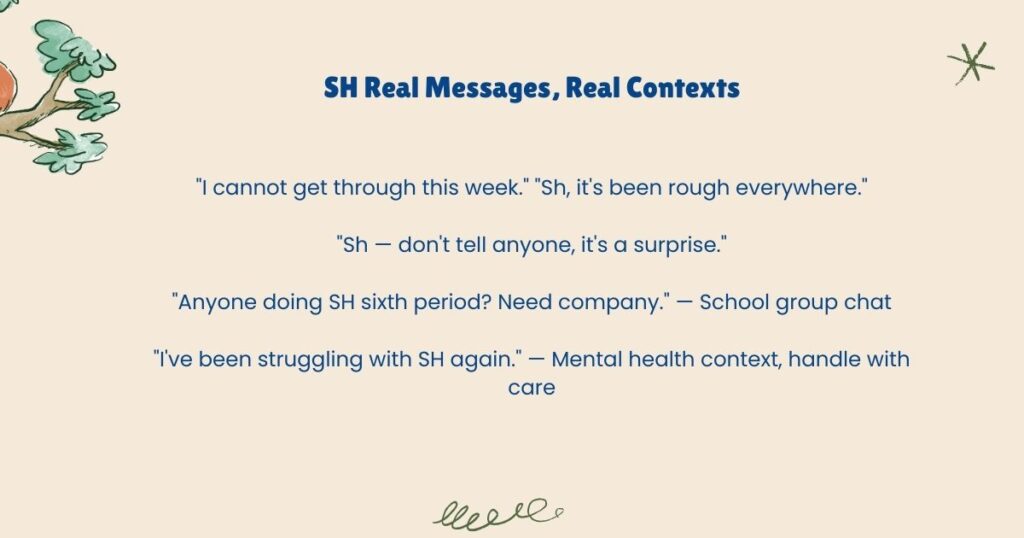
“I cannot get through this week.” “Sh, it’s been rough everywhere.”
“Sh — don’t tell anyone, it’s a surprise.”
“Anyone doing SH sixth period? Need company.” — School group chat
“I’ve been struggling with SH again.” — Mental health context, handle with care
“Boss fight loading, everyone sh.” — Gaming
“Miss you so much right now.” “Sh. Same.” — Soft, understated affection
How Age and Platform Shift the Meaning
People who grew up in early 2000s chat rooms know SH as “same here” without blinking. For them, it’s muscle memory.
Younger users who found community online through mental health content might automatically associate it with the heavier meaning, especially if TikTok is where they spend time.
Neither group is wrong. They just built their understanding in different spaces. That generational difference is part of why SH creates so much confusion when people from different online backgrounds land in the same conversation.
Read Also: Hm Meaning in Text – What “Hm” Really Means in Texting & How to Use It
FAQs
Can SH come across as rude?
The shush version can, if someone doesn’t realize you’re joking. Outside of a playful tone, telling someone to “sh” cold can sting a little.
Is SH the same on every platform?
Not quite. TikTok tilts heavy toward the mental health meaning. Regular texting stays mostly in “same here” territory. Context shapes everything.
What if I genuinely can’t tell which meaning someone means?
Ask. “Wait — same here or something else?” is a completely reasonable follow-up, and in serious conversations, it might be the most important thing you say.
Does SH mean anything romantic?
Not on its own. But “sh, same” as a response to “I miss you” carries quiet warmth — it’s the abbreviation version of mirroring someone’s feelings without overcomplicating it.
Is it okay to use SH casually around people you don’t know well?
Depends. In anonymous comment sections, sure. In a one-on-one with someone new, it might confuse more than it connects.
Two letters. Four possible meanings. One word that moves between laughing together over Monday misery and carrying something genuinely heavy.
Most of the time it’s light. But sometimes it isn’t — and that’s the part worth remembering.

Hi, I’m the creator of Legacystance.com, dedicated to making English learning simple and enjoyable. I write clear, practical guides on adjectives, verbs, idioms, pronunciation, spelling, and more. Every article is carefully researched to give accurate, easy-to-understand information. My goal is to help readers improve their English skills confidently, one step at a time, with content that is trustworthy, useful, and beginner-friendly.