POS usually means “Piece of Shit”—basically calling something completely useless or broken. But throw a slash in front (/pos) and it flips to “positive,” telling people you’re being genuine. Sometimes it’s code for “Parent Over Shoulder” when someone needs to bail from a chat quickly.
You’ve Seen It, But Which Version?
Let me guess—someone dropped “POS” in a comment and you had no clue if they were mad, happy, or speaking in code. Could’ve been under a product review, in your group chat, or replying to your Instagram story. The annoying thing? All three versions get used constantly, and nobody stops to explain which one they mean. You’re just supposed to know somehow.
The Harsh Truth Version
Most of the time, when people type POS without any extra symbols, they’re pissed off. Something broke, someone flaked, a service sucked—and they need exactly three letters to express their disappointment. It’s aggressive on purpose. There’s no gentle way to call something a piece of shit, and that’s the point.
Think about when your phone glitches during an important call, or when you buy something that breaks immediately, or when someone promises to show up and ghosts you. That’s POS energy. It’s not about being mean for fun—it’s pure frustration boiling over into the shortest possible vent.
What Makes Someone Reach for This Term?
People grab it when regular complaints feel too soft. “This isn’t working” sounds patient. “What a disappointment” sounds mature. But POS? That’s got bite. It’s what you type when you’re done being nice about something that’s wasted your time or money.
Gamers use it constantly. Laggy servers, terrible teammates, broken mechanics—all POS. Car people use it for vehicles falling apart. Tech communities use it for products that promise everything and deliver nothing. Anyone dealing with repeat failures eventually lands here.
The Supportive Tag Nobody Expected
Now for the plot twist: /pos means the complete opposite. Someone in online communities (especially folks who struggle reading tone through text) invented this as a safety net. The slash plus “pos” stands for “positive”—basically screaming “I’M BEING NICE HERE” before anyone misreads your energy.
Picture this: You share something you created, and someone comments “This is so weird /pos.” Without that tag, you’d probably spiral wondering if they hate it. With the tag? You know they’re genuinely into it, just acknowledging it’s unconventional.
These tone indicators spread like crazy on Twitter and Discord, anywhere misunderstandings start internet fights. It’s clunky, sure, but it works. People would rather type four characters than spend an hour explaining “no wait, I meant that as a compliment.”
Read Also: Dih Meaning: The Slang Everyone’s Using But No One Explains
The Secret Teen Language (That Parents Decoded Already)
“Parent Over Shoulder” was genius when it started. Teens needed a quick abort signal for group chats that got too honest, too messy, or too revealing. Type “POS” and everyone knew to switch topics fast or pause until the coast cleared.
Except parents caught on years ago. Most teens now just close the app when someone walks by. But in certain friend groups, the code lives on—partly out of habit, partly because it still works on clueless adults, partly because it’s tradition at this point.
Reading the Room Before You Type It
Using POS to vent about your busted headphones with your best friend? Totally fine. Dropping it in a work channel about company equipment? You’re asking for an awkward conversation with your manager.
The friend context matters too. Close friends who know your communication style will laugh when you call your car a POS. New acquaintances might think you’re just negative or immature. There’s a comfort level required before this kind of language lands right.
The /pos Misfire
Here’s where things get weird: people assume adding /pos makes everything automatically nice. It doesn’t work that way. You can’t say something mean, slap /pos on the end, and expect it to magically become a compliment. The tag clarifies intention—it doesn’t transform insults into praise.
Also, tone tags only work in spaces where people know what they mean. Use /pos in a text to your grandma and she’ll think you pocket-typed random characters. Know your audience before getting fancy with slashes.
When This Term Becomes a Problem
Calling products or situations POS privately? Go wild. Making it your public brand? People start seeing you as someone who just complains about everything. There’s a threshold where it stops sounding like justified frustration and starts sounding like you hate the world.
Don’t aim it at people in public posts. Venting about an ex to your close friends using POS language is normal breakup processing. Putting someone on blast publicly with that label is asking for drama, screenshots, and regret. The term carries weight when it’s about humans, not objects.
Professional Spaces Are a Hard No
Customer service interactions, work communications, anything involving money changing hands—leave POS out of it. Even if a product genuinely deserves the label, there are cleaner ways to express your dissatisfaction that don’t risk getting you dismissed as just angry and crude.
Business reviews work better when they explain problems clearly instead of just calling something POS. You want refunds and solutions, not to just feel momentarily better by swearing into the void.
Read Also: FW Meaning: Decoding “I FW You” Without the Confusion
What to Say Instead When the Vibe’s Wrong
Quick casual replacements: Trash, junk, broken, a disaster, completely done with this
If you need to sound reasonable: Disappointing, not meeting expectations, malfunctioning, poorly designed
Playful roasting with friends: Cursed, a crime against humanity, why does this exist, absolutely unhinged
Supportive clarity instead of /pos: Just add “genuinely,” “for real,” “no sarcasm,” or use /gen (genuine) or /srs (serious)
Real Conversations Using POS
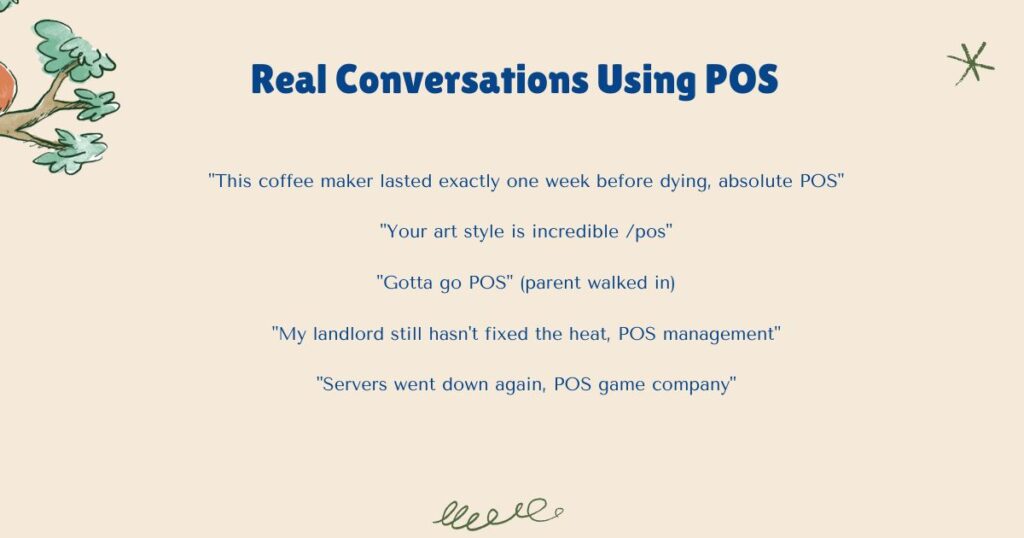
“This coffee maker lasted exactly one week before dying, absolute POS”
“Your art style is incredible /pos”
“Gotta go POS” (parent walked in)
“My landlord still hasn’t fixed the heat, POS management”
“Servers went down again, POS game company”
“Wait you actually pulled that off?? /pos” (making sure amazement reads as positive)
“Third time this month the WiFi crashed, POS router”
“I’m obsessed with your weird sense of humor /pos /gen” (positive and genuine—zero room for confusion)
Where Each Version Lives Online
TikTok’s comment sections run on quick reactions. People label things POS in captions and move on—the platform’s too fast for long explanations. You’ll see it mostly as the insult, rarely as the tone tag.
Twitter’s a battlefield for misunderstandings, so /pos shows up constantly. Someone makes a point that could sound sarcastic? They’ll tag it /pos just to avoid accidental internet beef. The insult version appears too, usually in quote tweets roasting bad takes or terrible products.
Reddit’s complaint culture means POS thrives there. Tech support threads, relationship forums, product reviews—anywhere people gather to share frustrations, you’ll find POS in the comments. Tone tags pop up occasionally but less consistently than Twitter.
Private group chats see all three versions depending on the group’s age and inside jokes. The parent code matters more in teen-specific chats, while friend groups of any age use the insult version freely.
Gaming communities can’t quit this term. Voice chat, Discord servers, Steam reviews—if something’s broken or unfair, someone’s calling it POS within seconds.
Where People Get Totally Lost
The context-free problem: Someone types just “POS” with zero other clues. Could be angry, could be a tone tag without the slash (typo?), could be the parent code. You’re genuinely guessing at that point. When confused, ask directly instead of assuming wrong.
The bilingual confusion: Spanish speakers see “pos” and think “pues” (like saying “well” or “so”). English slang POS has nothing to do with that. If you code-switch between languages regularly, this causes real mix-ups in conversation.
Overuse burnout: Label everything a POS and people stop taking you seriously. It becomes white noise. Save it for things that genuinely deserve the energy, or you’ll sound like you hate literally everything.
The tone tag rules: Some people think tone tags are optional or decorative. They’re not—they’re communication tools. Using /pos sarcastically defeats the entire purpose and makes you the problem the tags were invented to solve.
Straight Answers to What Everyone Wonders
Can you say POS in front of kids?
You probably shouldn’t since it’s literally abbreviated swearing. Kids repeat everything, and parents won’t love hearing their 6-year-old call things a piece of shit.
Does everyone on the internet know what /pos means?
Nope. It’s generational and community-specific. Gen Z gets it instantly. Boomers have no idea. Millennials are split depending on which corners of the internet they hang out in.
What if someone uses POS and I respond totally wrong?
Just be honest—”Wait, which POS did you mean?” Most people appreciate someone checking instead of guessing wrong and making things awkward.
Is there a difference between “pos” and “POS”?
Not really in meaning, but lowercase sometimes signals the tone tag version while capitals lean toward the insult. Not a hard rule though.
Why not just type the full words?
Speed and impact. Three letters hit faster than full sentences. Plus, abbreviated swearing feels slightly less harsh to some people, even though everyone knows what it means.
The Bottom Line
You’re going to keep seeing POS everywhere because it’s flexible, punchy, and does multiple jobs at once. The trick isn’t memorizing definitions—it’s paying attention to context clues. Look for slashes, read the mood of the conversation, notice who’s talking and where.
When you’re the one typing it, make your meaning obvious so you’re not accidentally starting confusion. And if you’re genuinely unsure what someone meant? Just ask. Everyone’s still figuring this stuff out together anyway.

Hi, I’m the creator of Legacystance.com, dedicated to making English learning simple and enjoyable. I write clear, practical guides on adjectives, verbs, idioms, pronunciation, spelling, and more. Every article is carefully researched to give accurate, easy-to-understand information. My goal is to help readers improve their English skills confidently, one step at a time, with content that is trustworthy, useful, and beginner-friendly.