ISTG means “I Swear to God.” It’s shorthand people use when they want to sound serious, express frustration, or react to something surprising — all without typing a full sentence.
Why This One Trips People Up
You’re reading a text thread or scrolling comments and someone drops “ISTG” mid-sentence like everyone just knows. No explanation. No context clue. Just four capital letters sitting there expecting you to keep up.
The confusion is totally fair. Acronyms in online conversations move fast, and ISTG is one of those terms that people use so casually that nobody thinks to explain it. If you grew up outside certain online spaces, or you’re just newer to how people talk in chats and comment sections, seeing it for the first time genuinely throws you off.
The Feeling Behind the Letters
Knowing the full form is one thing. Actually getting why people reach for it is another.
ISTG does something that “I swear to God” typed out fully doesn’t quite do in a fast conversation. It’s punchy. It lands immediately. When someone sends it, there’s an urgency to it — like they need you to believe them right now, or they need you to know they are absolutely not kidding.
It works across a wide emotional range too, which is why it stuck around. People use it when they’re genuinely serious, when they’re venting, when they’re hyped about something, and sometimes when they’re being completely sarcastic. The letters don’t change. The feeling behind them does everything.
What’s interesting is that it doesn’t require punctuation or emojis to carry weight. “ISTG” alone in a message hits differently than almost anything else you could send in four characters.
The Way It Actually Appears in Conversations
ISTG almost always opens a statement. It rarely sits in the middle of a sentence or gets tacked on at the end. That placement matters — it signals right away that whatever follows deserves attention.
You’ll see it in venting texts between friends, in comment sections under relatable content, and in DMs where someone’s trying to clear something up or prove a point. It shows up when emotions are running higher than usual, good or bad.
What you won’t see is ISTG in calm, low-stakes moments. Nobody texts “ISTG I just had some water” because the moment doesn’t need that kind of emphasis. It pairs naturally with drama, excitement, disbelief, or frustration.
Read Also: HYB Meaning: What “HYB” Means in Texts and DMs
How Tone Completely Changes Its Meaning
This is the part most explanations skip over, and it’s honestly the most useful thing to understand.
The frustrated version sounds like someone at their limit. “ISTG this app crashes every single time” is not a complaint — it’s a declaration of war against a broken app.
The sincere version is someone actively trying to prove themselves. “ISTG I didn’t say that about you” is damage control. They want you to believe them, badly.
The excited version has completely different energy. “ISTG that episode destroyed me” coming from someone who just finished a show they love is pure enthusiasm. No frustration anywhere in it.
The sarcastic version is where people misread things most often. “ISTG you’re so reliable 🙄” is not a compliment. The sarcasm is usually obvious in context, but if you strip away the surrounding conversation, it can look genuine. This is exactly why misreads happen.
Relationship distance plays into this too. Between close friends, ISTG feels casual and warm even when dramatic. Between people who don’t know each other well, it can read as intense or aggressive depending on what it’s attached to.
Situations Where You Should Leave It Out
Professional messages. Full stop. Even if your workplace runs on a relaxed, informal vibe, ISTG doesn’t belong in emails, project updates, or anything your manager might read. It undercuts how seriously you want to be taken.
When someone’s going through something emotional and heavy, ISTG isn’t the right move either. “ISTG everything will work out” tries to be reassuring but lands a little too casual. Real words land better in real moments.
With people who aren’t in the same internet culture spaces — older family members, people you’ve just met — there’s a decent chance it reads as strange or even aggressive depending on their background. “I swear to God” said directly to someone already has a loaded sound. The acronym doesn’t automatically defuse that.
And overuse kills it. The more someone leans on ISTG for everything, the less it means when they actually need it to land.
Alternatives That Work Depending on the Vibe
When you want something casual but slightly softer: “no joke,” “for real,” or just “FR” all sit in the same neighborhood without the same intensity.
When the moment calls for something more direct and plain: “I promise,” “I’m serious,” or “genuinely” work without carrying any of the online slang baggage.
When you want to keep the emphasis but dial it down slightly: “STG” (same phrase, just without the “I”) gives a similar punch but reads as slightly less intense in most contexts.
Real Examples Worth Looking At
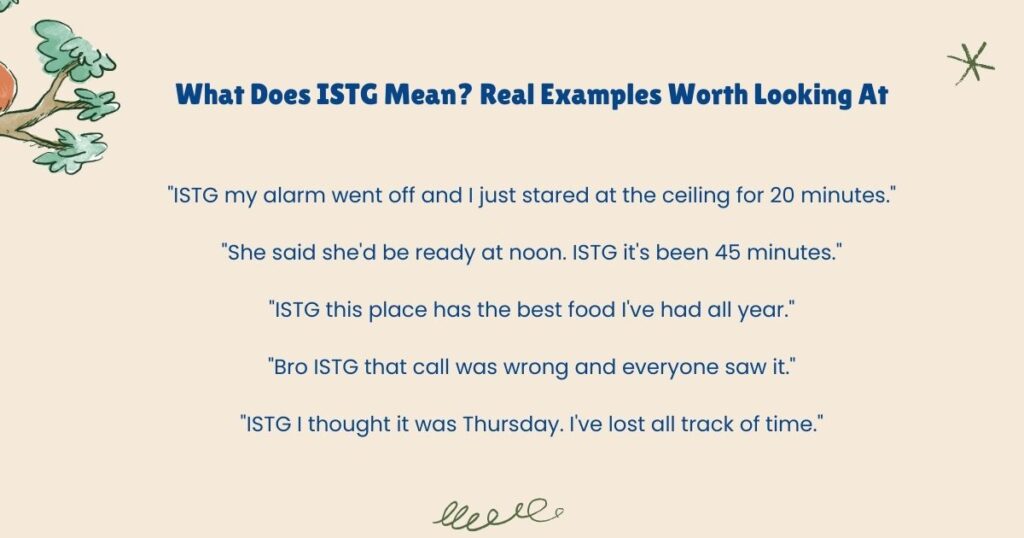
“ISTG my alarm went off and I just stared at the ceiling for 20 minutes.”
“She said she’d be ready at noon. ISTG it’s been 45 minutes.”
“ISTG this place has the best food I’ve had all year.”
“Bro ISTG that call was wrong and everyone saw it.”
“ISTG I thought it was Thursday. I’ve lost all track of time.”
“Don’t tell me to calm down, ISTG I am calm.”
“ISTG if this loads any slower I’m going back to books.”
These don’t need explanation. You can feel the moment behind each one.
A Few Things That Confuse People
The personality type angle — some people search for ISTG assuming it connects to something like Myers-Briggs. It doesn’t. That’s ISTJ, a personality type called the Logistician. ISTG is purely slang with zero personality type connection.
ISTH — almost always a typo. Phones autocorrect in weird directions and fingers slip. There’s no separate meaning there.
The gender question — people sometimes wonder if ISTG means something different coming from a girl versus a guy. It doesn’t. The meaning is the same. What shifts is personal communication style, not the word itself.
The religious read — ISTG came from “I swear to God,” but the way it’s used now is cultural, not spiritual. Most people typing it aren’t making any kind of religious statement. It’s emphasis, not prayer. Same evolution “OMG” went through years ago.
Read Also: WTD Meaning – Texting, Slang & Work Context Explained
Frequently Asked Questions
Is ISTG considered rude?
Not on its own. Context and relationship do all the deciding. Between friends it’s totally normal. Aimed at the wrong person in the wrong moment, it can feel sharp.
Can it be used sarcastically?
Yes, and this is one of the more common uses. Sarcastic ISTG usually comes with a tone mismatch — something overly positive said after obvious frustration.
Does ISTG mean something different on TikTok versus regular texting?
The meaning stays the same. TikTok tends toward more exaggerated, performative use in comments. In regular texts it usually feels more personal and direct.
Is it only used by teenagers?
Mostly associated with younger internet users, but it’s spread well beyond that. Anyone who spends time in comment sections or group chats has likely picked it up regardless of age.
Closing Thought
ISTG is one of those terms that feels confusing until you see the emotion behind it. Once you get that it’s basically someone reaching for the strongest casual emphasis they can find in four letters, everything clicks. You’ll start reading it right every time — and probably find yourself using it without overthinking it.

Hi, I’m the creator of Legacystance.com, dedicated to making English learning simple and enjoyable. I write clear, practical guides on adjectives, verbs, idioms, pronunciation, spelling, and more. Every article is carefully researched to give accurate, easy-to-understand information. My goal is to help readers improve their English skills confidently, one step at a time, with content that is trustworthy, useful, and beginner-friendly.