TBF = “To Be Fair.” You drop it when you want to add a point that balances out what’s being said — usually to defend someone, push back gently, or just keep things honest without starting a fight.
So You Saw It and Weren’t Sure
Maybe someone replied to your rant with TBF and you couldn’t tell if they were agreeing or low-key checking you. That confusion makes sense. TBF sits in a weird spot — it’s not a yes, it’s not a no, and depending on who’s saying it, it can feel supportive or slightly pointed.
That’s genuinely what makes it worth understanding properly.
The Real Job TBF Does in a Conversation
It’s a course-correction tool. Not an aggressive one — a quiet one.
When a conversation is heading one way fast and someone wants to slow it down without coming off as a killjoy, TBF is the move. It gives you permission to add something that goes against the group opinion without sounding defensive or preachy about it.
There’s also something a little self-aware about it. When people use TBF about themselves — “TBF I didn’t exactly help the situation” — it signals honesty. A willingness to not just play the victim. That’s a different energy than defending someone else, but it comes from the same instinct: just be real about it.
The Tone Problem Nobody Warns You About
Here’s what most explanations skip: TBF changes personality depending on who says it and when.
Between people who are close, it reads as honest. Between strangers or acquaintances, it can read as correction — like you’re showing up to tell someone they got it wrong.
And in sarcastic hands? It flips entirely. “TBF I’m sure he had a totally valid reason for ghosting” — nobody thinks that’s sincere. The whole meaning reverses.
Text doesn’t carry tone naturally, so TBF can land badly even when you meant it fine. If you’re ever talking to someone you don’t know well, just writing out “to be fair” feels less abrasive than the abbreviation. Weird but true — the full phrase reads warmer.
Situations Where TBF Actually Doesn’t Help You
When someone’s upset and needs to feel heard first, TBF almost always lands wrong — even if what you’re saying is accurate. Timing beats logic every time in emotional conversations.
In work settings, the abbreviation specifically creates friction. “To be fair” in an email reads as thoughtful. “TBF” reads like you forgot to switch out of your phone voice. Keep it out of anything professional unless you genuinely know the culture is casual.
Avoid it in public comment threads too, under someone’s personal post. What feels like a balanced take to you can look like a callout to everyone watching.
Read Also: PSA Slang Meaning: How It’s Used in Texts, Chats, and Social Media
How It Actually Shows Up (Real Examples)
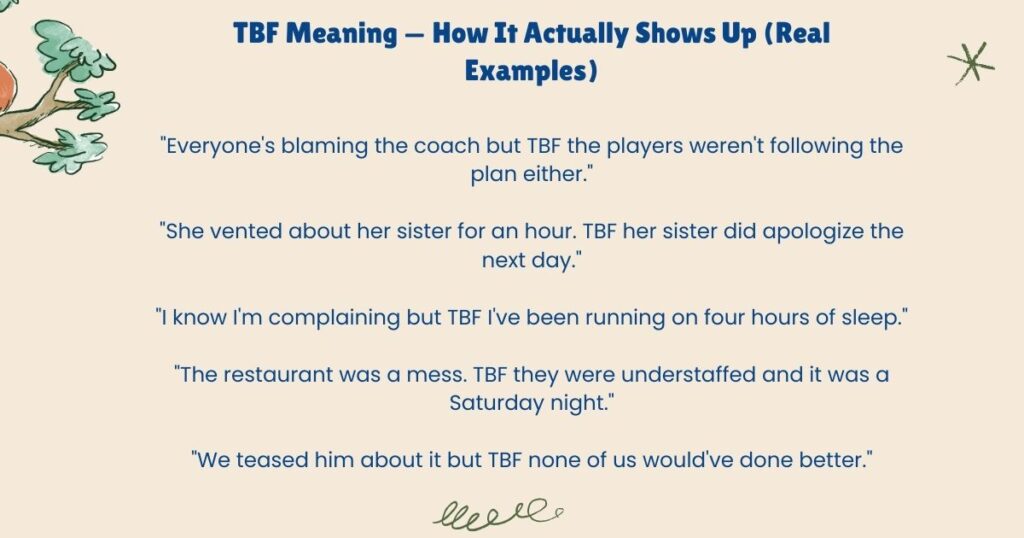
“Everyone’s blaming the coach but TBF the players weren’t following the plan either.”
“She vented about her sister for an hour. TBF her sister did apologize the next day.”
“I know I’m complaining but TBF I’ve been running on four hours of sleep.”
“The restaurant was a mess. TBF they were understaffed and it was a Saturday night.”
“We teased him about it but TBF none of us would’ve done better.”
“TBF I didn’t give him much to work with.”
“The new album got hate. TBF three of those tracks are genuinely good.”
Notice none of those pick a full side. That’s the whole point.
When TBF Means Something Completely Different
Outside of texting and social media, TBF carries different meanings depending on where you run into it.
In fitness and health contexts, TBF stands for Total Body Fat. If someone in a gym community or health app says their TBF dropped after changing their diet, they’re talking about body composition — not fairness.
In technical and engineering reports, it means Time Between Failures — a measure of how long equipment runs before it breaks down. Completely unrelated to slang, only shows up in very specific professional writing.
In baseball, TBF means Total Batters Faced, a stat used to evaluate pitchers. If you’re reading a sports analytics piece and TBF comes up, that’s the one.
In casual Urban Dictionary territory, some people use it as “Too Bad For” in trash talk, but that’s rare and pretty niche. The fairness meaning dominates by a mile.
Why People Started Using It So Much
Digital conversations move fast and leave no room for nuance. A lot of what gets lost in texting is the “yeah but also…” moment — the part where a real person would pause and add a little complexity before the conversation runs away from them.
TBF fills that gap. It’s compact, it doesn’t sound defensive, and it keeps things moving. Nobody has to write a paragraph. Three letters and everyone knows you’re adding a fair angle, not starting something.
That’s also why it spread so naturally — it solves a real problem that typed conversations have always had.
How to Respond When Someone Sends It to You
If someone TBFs you, they’re usually not attacking — they’re adding. The move is to engage with what they said, not dismiss it.
You can agree with it, counter it, or even laugh it off. What kills the conversation is just shutting it down with a “nah” or ignoring the point. TBF invites a little back and forth. Lean into that.
The Overuse Problem
Use TBF in every other message and it loses all weight. People stop registering it as a real point — it just becomes noise. Save it for moments when you’re actually adding something that pushes against the current direction of the conversation. That’s when it earns its place.
Common Mix-Ups
Some people misread TBF as “The Best Friend” — genuinely a thing that happens, especially with older users seeing it for the first time. Context usually clears it up fast, but it’s worth knowing that confusion exists.
The other mix-up is assuming TBF always takes someone’s side. It doesn’t. It’s designed specifically to not fully take a side. The whole point is balance, not defense.
Read Also: HYB Meaning: What “HYB” Means in Texts and DMs
Questions People Actually Have
Is TBF passive-aggressive?
It can be, depending on tone. “TBF you always do this” isn’t the same as “TBF the situation was complicated.” One is a soft accusation, the other is genuine fairness. The words around TBF do the heavy lifting.
Does TBF mean the same thing in the UK and US?
Yes, the slang meaning travels fine across both. It actually started in UK and US internet forums around the same time and spread from there.
Is it okay in a serious conversation?
Depends how serious. If someone’s grieving or in crisis, no — this isn’t the moment. If it’s a heated but not emotional disagreement, TBF can actually defuse things.
Do older people use it?
More than you’d think now. Family group chats have slowly absorbed a lot of internet slang, TBF included.
One Last Thing
TBF is small but it does real work. It’s the kind of word that keeps a conversation from going too far in one direction — not by shutting things down, but by quietly saying there’s more to this. Used right, it’s one of the more genuinely useful tools in casual communication. Used too much or at the wrong moment, it backfires fast. Now you know the difference.

Hi, I’m the creator of Legacystance.com, dedicated to making English learning simple and enjoyable. I write clear, practical guides on adjectives, verbs, idioms, pronunciation, spelling, and more. Every article is carefully researched to give accurate, easy-to-understand information. My goal is to help readers improve their English skills confidently, one step at a time, with content that is trustworthy, useful, and beginner-friendly.