“Serote” is Central American Spanish slang — raw, regional, and highly context-dependent. At its core it means something between “jerk,” “idiot,” and a crude reference to excrement. In El Salvador especially, it’s one of those words that can either start a fight or cement a friendship depending entirely on who’s saying it and why.
Here’s Why You’re Confused
This word doesn’t behave the way most slang does. You can’t just look it up, get a clean translation, and move on. Standard Spanish dictionaries skip it. Google Translate gives you something odd. Even fluent Spanish speakers from Mexico or Spain might shrug at it because it’s hyper-regional — born in Central American streets, not classrooms.
Most people land on this search after catching it in a comment section, a WhatsApp forward from a Salvadoran contact, or a TikTok where everyone in the replies seemed to understand something you didn’t. That gap is real, and it’s not your fault for not knowing.
The Feeling Behind the Word
Forget the dictionary definition for a second. What does this word do emotionally?
When someone says it in anger, it’s the linguistic equivalent of slamming a table. It’s sharp, physical-feeling, loaded with frustration. When a Salvadoran driver yells it at someone who cut them off, there’s no ambiguity — that person just got written off as worthless in one word.
But flip the energy entirely. Same word, said with a laugh and an arm around someone’s shoulder — suddenly it’s almost affectionate. “Mi cerote” said warmly between two old friends from Guatemala City means something close to “my guy” or “my idiot” in the fondest possible sense.
That’s what makes it hard to pin down. The word didn’t evolve into two meanings — people are just using it as a temperature gauge for how they feel in that exact moment.
How It Travels Through Real Conversations
It lives almost entirely in spoken language and informal text. You won’t find it in business emails or school assignments. Where it shows up naturally:
Group chats between Central American friends where the humor runs dark and unfiltered. Soccer commentary — live, in person, loudly. Street arguments where someone’s patience ran out. Meme captions on Salvadoran Instagram pages roasting politicians or bad drivers.
In text form it usually signals closeness. If someone sends you “oye cerote, ¿vienes?” they’re not insulting you — that’s probably “hey man, you coming?” from someone who considers you a real friend. The problem is that without tone of voice, body language, or knowing the sender, that same message reads completely differently to an outsider.
Country by Country — It’s Not All the Same Word
This matters more than most articles bother to explain.
In El Salvador, it hits hardest. It’s a genuine insult in tense situations, but among close male friends it flips into a badge of familiarity. Salvadorans also attach it to situations — “¡qué serote de día!” venting about a rough day.
In Guatemala, the softening is real. “Cerote” among friends there leans more casual — closer to “dude” than to a direct attack on someone’s character. Guatemalan social media uses it almost playfully.
Honduras and Nicaragua pull it back toward the harsher end. Less friendly-use flexibility, more genuine hostility when deployed.
Costa Rica treats it as a strong curse word — closer to how English speakers treat certain four-letter words. Casual but crude.
Mexico uses “cerote” mostly in its literal sense (bathroom humor) rather than as a social insult. The interpersonal weight is different there.
Knowing which country someone is from actually changes what you just heard.
Read Also: WTD Meaning – Texting, Slang & Work Context Explained
The Line Between Friendly and Offensive
This is where most outsiders get burned.
Tone carries about 80% of the meaning. The other 20% is relationship history. A word that bonds two Salvadoran childhood friends together since age twelve will land like a slap from someone who just met them.
There’s no middle ground here — either you’ve earned the right to use it casually with someone, or you haven’t. And you know when you have because they said it to you first, more than once, in clearly warm contexts.
Watch out for written messages especially. Sarcasm and warmth both disappear in text, and this word without vocal softening defaults to sounding hostile to anyone who doesn’t already love you.
Hard Stops — Leave It Alone in These Situations
With anyone older than you in a Central American family setting. Grandparents, aunts, uncles — this word in front of them signals you have no manners, full stop.
Any professional setting, even casual ones. Even if your Salvadoran coworkers joke with each other this way, you entering that circle uninvited doesn’t read as friendly.
Public spaces where you don’t know everyone within earshot. What feels like banter between you and one person gets heard by three strangers who don’t have the context.
If you’re not from Central America and you’re using it to sound “authentic” — people notice that immediately and it comes off as trying too hard or, worse, mocking.
What to Say Instead
If you need something with attitude but less cultural landmine energy:
For frustrated venting with friends, “idiota” and “tonto” both land without the same regional weight. For something with genuine bite, “pendejo” is understood across more of Latin America and carries its own intensity without the same geographic specificity. “Cabrón” works in Mexico and Spain contexts if that’s your audience.
None of these are polite. But they’re less likely to confuse the situation or accidentally signal something you didn’t intend.
Actual Examples Worth Reading
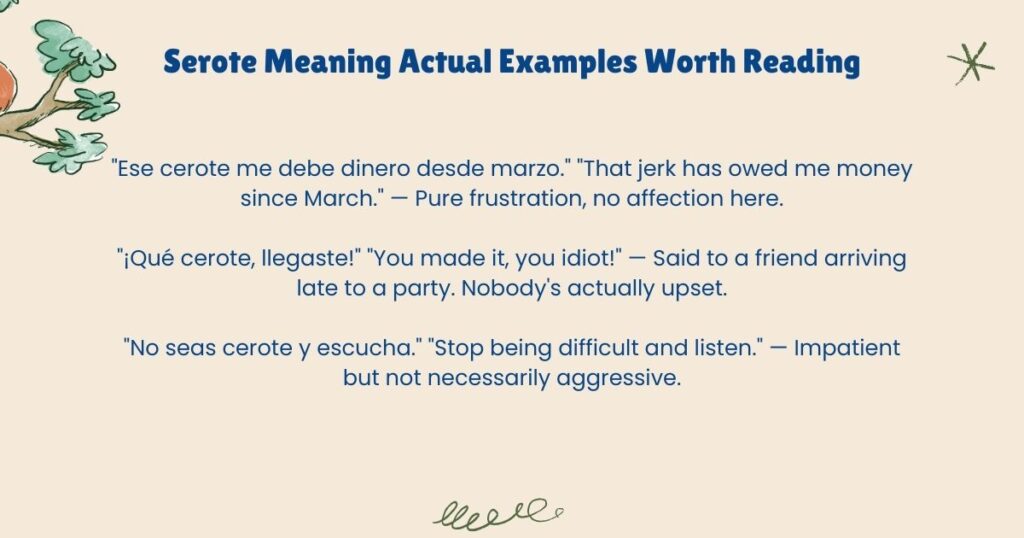
“Ese cerote me debe dinero desde marzo.” “That jerk has owed me money since March.” — Pure frustration, no affection here.
“¡Qué cerote, llegaste!” “You made it, you idiot!” — Said to a friend arriving late to a party. Nobody’s actually upset.
“No seas cerote y escucha.” “Stop being difficult and listen.” — Impatient but not necessarily aggressive.
“Soy un cerote, mandé el mensaje al número equivocado.” Pointing the word at yourself for messing up. Self-aware, a little funny.
“Mi cerote favorito acaba de entrar.” Genuinely warm. The person walking in is someone this speaker loves in their own rough way.
“¡Qué cerote de tráfico!” Aimed at traffic, not a person. Pure stress relief.
What the Internet Gets Wrong
Two mistakes show up constantly in search results and it’s worth clearing them up.
First — some sources claim “serote” means “scrotum” in English. That’s not accurate. The word roots in excrement, not anatomy. The surface-level spelling similarity to certain English words is coincidence.
Second — “cero” is not related. If you’ve seen people searching “cero meaning” alongside this word, that’s a mix-up. “Cero” is just the Spanish word for zero. Neutral, mathematical, completely unconnected to this slang.
There’s also scattered content claiming it’s Filipino slang. The Philippines has deep Spanish colonial influence, so borrowed terms exist — but “serote” isn’t a Tagalog word. If it surfaces in Filipino conversation, it was picked up, not native.
Read Also: HYB Meaning: What “HYB” Means in Texts and DMs
FAQs
Is it always vulgar?
By origin, yes. In practice, close friends have domesticated it into something more casual — but the vulgarity is always sitting underneath, ready to resurface if the tone shifts.
Why do Salvadorans seem proud of the word?
Language ownership is real. Using local slang, even crude slang, signals cultural identity. Salvadoran-Americans especially reclaim it online as a marker of where they’re from — not because the word is respectable, but because it’s authentically theirs.
Can women use it?
Yes, though social patterns in machismo-influenced cultures mean men use it more freely in public. Women absolutely use it — the contexts just tend to be more private or among close friends.
Is “serote” the same as “cerote”?
Same word, different spelling. “Cerote” is more standard written form. “Serote” is the phonetic, typed-fast version you’ll see in messages and comment sections.
Should I use it if I’m learning Spanish?
Learn it so you recognize it — that’s genuinely useful. Using it yourself before you’ve spent real time in those social circles is a different question, and the honest answer is: probably not yet.
Where This Leaves You
Some words exist only fully inside their culture. You can understand “serote” from the outside — the meanings, the geography, the tone shifts — but actually feeling when it’s warm versus when it’s hostile takes time around people who grew up with it.
What you can do right now is stop being caught off guard when you see it, understand roughly where the person using it is coming from, and know enough not to accidentally drop it in the wrong situation yourself. That’s actually most of what you needed.

Hi, I’m the creator of Legacystance.com, dedicated to making English learning simple and enjoyable. I write clear, practical guides on adjectives, verbs, idioms, pronunciation, spelling, and more. Every article is carefully researched to give accurate, easy-to-understand information. My goal is to help readers improve their English skills confidently, one step at a time, with content that is trustworthy, useful, and beginner-friendly.