PYT means “Pretty Young Thing.” It’s a compliment. People use it in texts, comments, and captions to say someone looks attractive and full of life. Done.
So Why Are You Even Googling This?
Probably because it showed up somewhere unexpected. A comment on your photo. A DM you weren’t sure how to read. A friend said it and everyone else laughed and you just kind of went along with it.
That’s the thing about slang — nobody announces it. It just appears and assumes you already know.
PYT has been floating around since Michael Jackson put it in a song back in 1982, but it moves differently now. It shows up in captions, group chats, replies — sometimes sweet, sometimes teasing, sometimes flirty. The letters are the same. The feeling behind them shifts.
The Actual Energy Behind the Word
Calling someone a PYT isn’t just about looks. It’s about a certain lightness they carry — confidence without trying too hard, charm that feels natural. The “young” part doesn’t even mean age most of the time. It’s more about freshness. That person who walks into a room and something just shifts a little.
Michael Jackson’s version was about desire and admiration wrapped in an upbeat funk song. The modern version kept the admiration, dropped the formality. Now it’s something you drop in a comment and move on. Casual, but genuine.
It sits somewhere between “you look great” and “okay, I see you.” Not as aggressive as calling someone a baddie. Not as mild as “cute.” It has its own specific lane.
The Way It Actually Shows Up in Conversations
You won’t usually see PYT in a thoughtful paragraph. It’s a one-liner. A reaction. Sometimes not even a full sentence — just those three letters with an emoji and that’s the whole message.
Someone posts a birthday photo. A friend drops “PYT 🔥” in the comments. No explanation needed, everyone gets it.
In group chats it usually comes right after someone shares a selfie or asks “how does this look?” The response is quick. Punchy. PYT lands better than a three-sentence compliment in that moment because nobody’s writing essays in a group chat.
What’s interesting is that the same word feels different depending on the relationship. Among close friends, it’s just hype — the same energy as “you look so good.” From someone you barely talk to, it gets a little loaded. Not offensive, just… a lot more to think about.
When the Tone Gets Complicated
This is the part most articles skip, so pay attention.
PYT can be sarcastic. Not often, but it happens. If someone messes something up and their friend texts “okay PYT 💀” — that’s not a compliment. That’s teasing. The skull emoji is doing a lot of work there, but so is the tone built up from everything before that message.
It can also feel off when the context doesn’t match. Someone you’ve never spoken to sliding into comments and calling you a PYT reads differently than your best friend saying the exact same thing. The word didn’t change. The relationship did.
One honest warning: in text, tone disappears. A playful PYT and a sincere PYT look identical on screen. If there’s any chance the person won’t read it the way you mean it — say something else or add enough context that it can’t be misread.
Where It Doesn’t Belong
Work messages. Full stop. Even if you’re on friendly terms with your colleagues, PYT doesn’t belong in a Slack channel or a work email. It’s not that it’s offensive — it’s that it’s out of place, and out-of-place compliments at work make people uncomfortable whether they say anything or not.
Strangers’ comment sections are another one. There’s a real difference between complimenting someone you actually know and dropping it on a public post from someone you’ve never interacted with. Same word, completely different reception.
If the other person isn’t someone who uses slang casually, PYT might just confuse them. They might Google it, land on the wrong meaning, and suddenly the conversation is awkward for no good reason.
What to Say Instead
When you want to keep it warm but skip the slang — “you look really good today” works every single time. Simple, no guessing required.
If you want something slightly more personality-driven without the acronym: “you’re giving main character energy” or “okay you woke up and chose to look like that apparently” — people respond well to specificity and humor.
For anything professional where a compliment is appropriate: “you looked great at the presentation” or “that look really worked for you” — clean, clear, context-appropriate.
Read Also: LWK Meaning in Text: What “Low Key” Really Means in Messages
Real Examples Without Overthinking Them
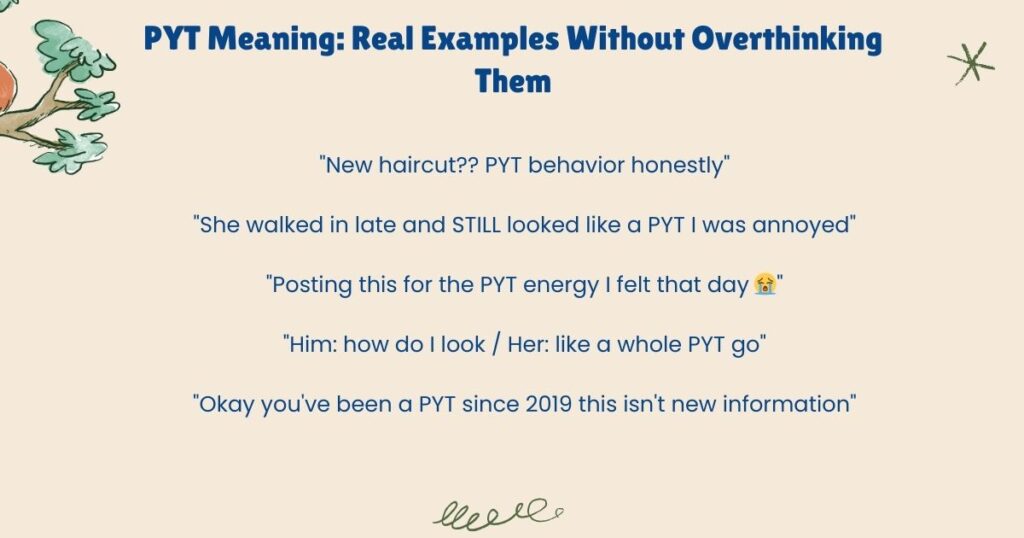
“New haircut?? PYT behavior honestly”
“She walked in late and STILL looked like a PYT I was annoyed”
“Posting this for the PYT energy I felt that day 😭”
“Him: how do I look / Her: like a whole PYT go”
“Okay you’ve been a PYT since 2019 this isn’t new information”
“We are NOT the same. You’re a PYT. I’m just surviving.”
“That photo has PYT written all over it. Frame it.”
These are how real messages look. Short. A little unpolished. Completely human.
The Michael Jackson Connection and Why It Still Matters
“P.Y.T. (Pretty Young Thing)” came out on the Thriller album in 1982. Upbeat, charming, undeniably catchy. The song painted this picture of someone worth chasing — bright, attractive, magnetic.
That image stuck. Decades later, TikTok creators started using the audio for outfit reveals and transformation videos. The nostalgia mixed with the visual format and suddenly a 40-year-old song was racking up millions of views from people who hadn’t been born when it came out.
That’s actually why PYT still feels fresh. It carries music memory for one generation and trend memory for another. Both groups are using the same term but arrived at it completely differently.
The Other Meanings (Because They Do Exist)
In some faith-based financial spaces, PYT stands for “Pay Your Tithes.” It’s motivational shorthand used in church communities to talk about financial giving. You’d see this in a religious newsletter or a group discussion about money management — not in a comment section.
In clinical or academic documents, it occasionally appears as shorthand for pediatric-related therapy terms. Extremely rare outside of professional paperwork. If you’re a student and you spot it on a worksheet or in a course document, the surrounding context will make the meaning obvious — it won’t be about compliments.
These exist. They’re worth knowing. But if you saw PYT in a social setting, it’s the Michael Jackson version. That’s 99% of real-world usage.
Misreads That Actually Happen
People assume PYT is always romantic. It’s not. A lot of the time it’s just a friend being a friend — no deeper meaning, no hidden message, just hype.
People also assume it only applies to young women. Nope. Guys get called PYTs. People call themselves PYTs in their own captions. The word is flexible.
The overuse problem is real though. If you call every single person a PYT constantly, it starts to mean nothing. Compliments that feel automatic stop feeling like compliments. Use it when it actually fits, not as a filler reaction to every photo you see.
Read Also: ISO Meaning Slang: What “ISO” Really Means & How to Use It
Genuine Questions People Ask
Can a guy be a PYT?
Yes, without any weirdness. The original song was about a woman but slang doesn’t care about that history. If the energy fits, the word fits.
Is it ever rude?
Only if used sarcastically or in a context where it clearly doesn’t belong — like an unsolicited comment from a stranger. In those cases it’s not rude exactly, just uncomfortable.
Does it mean the same thing everywhere?
The definition stays consistent. What changes is how it lands — depends on the relationship, the setting, and everything else happening in the conversation around it.
Is it safe to use at work?
No. Keep it out of professional settings entirely.
Why do some older people not recognize it?
They might know the song but not the slang evolution. The word went from a song title to everyday text language gradually. Someone who doesn’t spend time on social media might hear it and just think you’re referencing old music — which, technically, you kind of are.
Where This Leaves You
PYT is not complicated once you see it clearly. It’s a compliment with roots in a classic song that somehow kept evolving instead of fading out. It works best between people who already have a comfortable dynamic, used casually, in the right moment.
Read the room. Know your audience. And if there’s any doubt — just say what you mean in plain words. That works too.

Hi, I’m the creator of Legacystance.com, dedicated to making English learning simple and enjoyable. I write clear, practical guides on adjectives, verbs, idioms, pronunciation, spelling, and more. Every article is carefully researched to give accurate, easy-to-understand information. My goal is to help readers improve their English skills confidently, one step at a time, with content that is trustworthy, useful, and beginner-friendly.