Slang for “Public Service Announcement” — a quick way someone flags info they think you need to hear before they drop it.
You Probably Saw It Somewhere and It Threw You Off
Someone posted it in a story. Or a friend dropped it into a group chat and everyone kept talking like it made perfect sense. Meanwhile, you paused and thought… okay, what does that actually mean?
That’s normal. PSA is one of those terms people use without explaining. If you weren’t already familiar with it, there was no easy way to figure it out from context alone.
The Real Meaning Behind the Letters
On the surface, PSA comes from old TV and radio announcements — the kind where someone would interrupt your program to tell you something important about your community or your health. Think anti-smoking ads or emergency weather alerts from decades ago.
But online, nobody’s thinking about any of that history. When someone types PSA today, they’re basically saying: “What I’m about to tell you actually matters. Pay attention.”
That’s it. No formality required. No official tone needed. It’s just a signal that says “this next part is worth reading” — whether what follows is genuinely important or just something funny the person noticed.
The reason people love this shortcut is because it packs a punch without needing extra words. Writing “hey everyone, I just want to quickly let you know that…” takes forever. PSA does the same job in three letters.
Where It Actually Shows Up
Group chats are probably where most people first encounter it. Someone discovers something — a price change, a scam, a weird thing that happened — and instead of building up to it, they just lead with PSA and get right into it.
It works in work channels too. A teammate drops “PSA: the shared doc got deleted, check your local copies” and suddenly everyone’s paying attention.
On social media, creators use it as a hook. The first word in a caption or the opening line of a video. It creates that little pause — like someone tapping your shoulder before they say something.
The behavior stays the same no matter where you see it. Someone has information. They want you to actually read it. PSA is how they make sure you do.
How the Tone Completely Changes Based on Who’s Sending It
This is the part most people don’t think about until something goes sideways.
When it lands perfectly
A friend sending “PSA: that taco place closed down” in your group chat? Everyone gets it. Casual, helpful, maybe a little sad. No one overthinks it.
A coworker writing “PSA: IT is restarting the servers at 10 tonight” in a Slack channel? Clean, useful, appreciated.
When it can go wrong
The exact same format from a stranger or someone you don’t know well starts to feel different. It can come across as preachy. Like they’re assuming you don’t already know something or that you need their guidance.
“PSA: You should really stop eating late at night” — from your best friend while you’re joking around, maybe funny. From someone you met last week? That’s overstepping.
The tricky part is that PSA can accidentally make your advice sound like a lecture even when you didn’t mean it that way. It adds a little bit of authority to whatever you write after it. So if the situation is sensitive or the relationship is new, be careful about how you frame things.
When to Just… Not Use It
There are moments where PSA is the wrong call entirely.
Anything obvious doesn’t need it. If everyone in the chat already knows the information, slapping PSA in front of it just adds noise. People start ignoring you.
Selling or promoting something with PSA attached feels manipulative. People aren’t dumb — they can tell when “PSA” is just a wrapper around an advertisement.
During arguments or heated conversations, using PSA makes your side sound like you’re declaring it as universal truth. That’s not a discussion anymore. That’s a lecture disguised as concern.
And in genuinely serious moments — grief, mental health struggles, family issues — the casual energy of PSA doesn’t fit. It would feel dismissive without meaning to be.
Other Ways to Say the Same Thing
Depending on what vibe you’re going for, these work just as well without the “hey everyone listen up” energy:
Keeping it chill: “Heads up,” “just so you know,” or “quick note” all do the job in casual conversations without sounding like you’re making an announcement.
Keeping it professional: FYI is the cleanest option. Short, respectful, and it doesn’t demand attention the way PSA does. Perfect for emails or work threads.
Keeping it silly: “Breaking news:” or “urgent alert:” work great when everyone knows you’re obviously joking. Same playful energy, slightly different flavor.
Read Also: Dih Meaning: The Slang Everyone’s Using But No One Explains
Real Messages That Actually Sound Like Something a Person Would Send
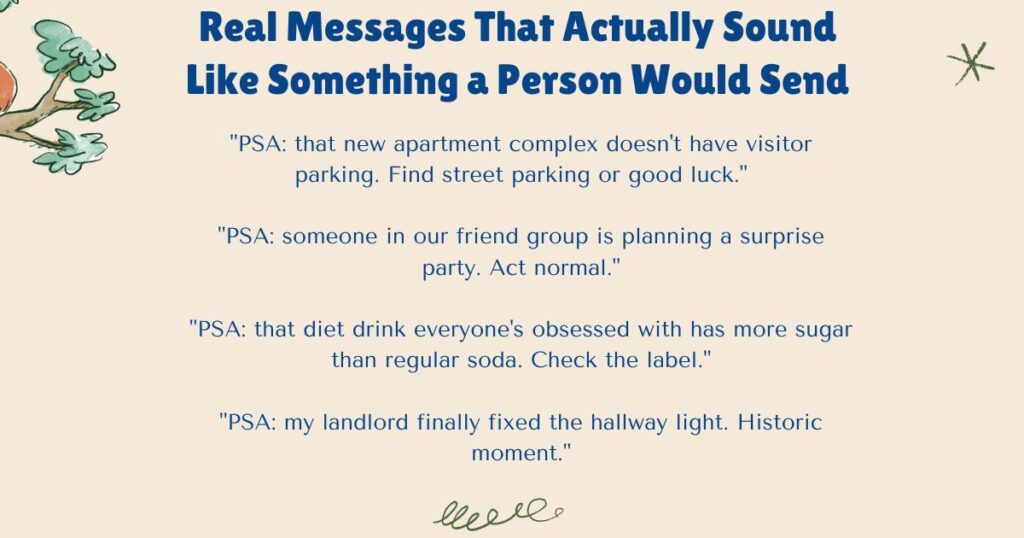
“PSA: that new apartment complex doesn’t have visitor parking. Find street parking or good luck.”
“PSA: someone in our friend group is planning a surprise party. Act normal.”
“PSA: that diet drink everyone’s obsessed with has more sugar than regular soda. Check the label.”
“PSA: my landlord finally fixed the hallway light. Historic moment.”
“PSA: if your charging cable keeps falling out, wrap a rubber band around the end. Works every time.”
“PSA: the library closes at 6 on Thursdays now, not 8. Found that out the hard way.”
“PSA: that girl from the party is actually taken. Stop sending her follow requests.”
A Few Things Worth Knowing About Culture and Context
How it plays out in different regions
In South Asian countries — Pakistan especially — people mix PSA into their everyday conversations but keep the acronym in English. You’ll see something like “PSA: exam schedule out, check the portal” in one breath and then switch fully into Urdu for the next message. The term travels well. The meaning stays the same. The context just shifts to fit local life.
The Pokémon confusion
If you’ve ever seen “PSA” in a gaming or collectibles conversation and it meant something completely different — that’s because it does. PSA in that world stands for Professional Sports Authenticator, a company that grades trading cards. A PSA 10 card is basically mint condition and can be worth serious money. Totally unrelated to the slang meaning. Just the same letters doing a different job.
Age gap in how people read it
Someone in their teens reads PSA as completely casual — almost like a comma. Someone older or less familiar with online culture might read it as more official or even passive-aggressive. Neither reading is wrong. It just depends on what world you’re in online.
Things That Confuse People Most Often
The biggest one: people assume PSA means the information is reliable. It doesn’t. It just means someone thought it was worth sharing. That’s not the same thing as it being true.
Sarcasm also gets lost constantly. Someone writes a PSA that’s obviously a joke in their head, but the reader has no context — no tone of voice, no facial expression. It just reads as a serious statement. If you’re being sarcastic, give the reader a hint so they’re not genuinely confused.
And then there’s the overuse problem. If one person in a group chat uses PSA for literally everything, it stops meaning anything. It becomes background noise. The whole point of PSA is that it feels like something slightly important just showed up. Use it too often and that feeling disappears completely.
Read Also: POS Meaning in Slang: What It Really Means Online, in Texts & Gaming
Real Questions People Have
Can PSA ever come across as rude?
Yes — mostly when the person reading it didn’t ask for your input. If you’re volunteering unsolicited advice and dressing it up as a PSA, some people will pick up on that. Context and relationship matter more than the word itself.
Is it only popular on TikTok?
That’s where a lot of people first noticed it recently, but it’s everywhere. Reddit, group texts, Instagram, work Slack channels — it shows up anywhere people communicate in short bursts.
Does it mean something different when a girl uses it vs. a guy?
Not really. The words after PSA change based on what someone’s talking about — relationships, beauty tips, sports, gaming — but the term itself works the same way regardless of who’s typing it.
What does Urban Dictionary say?
The main definition there matches what everyone actually uses — Public Service Announcement. There are some joke entries too, but they’re not reflections of real usage. The standard meaning is the only one you need to know.
Can I use PSA in a professional setting?
Depends on how casual your workplace is. In a relaxed Slack culture, it works fine for low-stakes info. In a formal email or corporate environment, stick with FYI or a straightforward subject line.
It’s just three letters doing a small but useful job online. Once you start noticing it, you’ll realize how naturally it fits into conversations — and honestly, you’ll probably start dropping it yourself without even thinking about it.

Hi, I’m the creator of Legacystance.com, dedicated to making English learning simple and enjoyable. I write clear, practical guides on adjectives, verbs, idioms, pronunciation, spelling, and more. Every article is carefully researched to give accurate, easy-to-understand information. My goal is to help readers improve their English skills confidently, one step at a time, with content that is trustworthy, useful, and beginner-friendly.