“Fratty” describes someone or something that gives off strong college fraternity energy. Loud, social, party-first, dressed like they just left a tailgate. That’s it.
You Saw It Somewhere and It Threw You Off
Maybe a tweet. Maybe a Reddit thread. Maybe your friend sent you a reel with the caption “so fratty lmaooo” and you laughed along but quietly had no idea.
It’s one of those words that feels like it should be obvious — and sort of is — but also isn’t when you stop and think about it. Is it a diss? Is it affectionate? Is it both? That confusion makes complete sense, especially if you didn’t grow up around U.S. college culture.
The Real Picture Behind the Word
In American colleges, fraternities are social clubs for male students — usually called “frats” for short. Over decades, a very specific stereotype grew around them: guys in polo shirts, always ready to party, speaking almost entirely in “bro,” competitive about everything, and extremely comfortable being loud in public.
“Fratty” is what happens when that whole image gets compressed into one word. Add “-y” to “frat” and you’ve got a fast way to say: this person, this place, this moment has that energy.
What makes the word interesting is that it works beyond actual fraternities. A bar can be fratty. A guy who never went to college can be fratty. A corporate office can have a fratty culture. It’s less about Greek letters and more about a specific flavor of confidence — the kind that involves chest bumps, sports chants, and a general “let’s go” attitude toward everything.
The Feeling It Carries
Here’s something most explanations miss: “fratty” almost always implies a group. It’s not really a solo word. A person alone in a coffee shop reading quietly isn’t giving fratty energy, even if he owns three polo shirts. The word implies crowd behavior — the way people act when they’re hyping each other up, competing over nothing, and treating every Friday like a championship.
That’s why it sticks. It captures a specific social dynamic that people recognize instantly, even if they’ve never set foot near a fraternity house.
Read Also: HYB Meaning: What “HYB” Means in Texts and DMs
How the Tone Shifts Depending on Who’s Talking
This matters more than people realize.
Said warmly between two people who love that world, “fratty” is basically a love language. “Dude this party is so fratty” means the vibes are exactly right. It’s a compliment wrapped in nostalgia.
Said with a slight eye-roll? It becomes mild criticism. Usually means someone finds the scene a bit much — too bro-heavy, too loud, too surface-level.
Said in a workplace context? That’s where it gets sharper. Calling a company culture fratty is rarely positive. It usually means the place feels cliquey, immature, or like success depends more on how well you golf and drink than how well you work.
Same word. Very different weight depending on context.
Situations Where It Gets Awkward
Dropping “fratty” casually around someone who had a bad experience with Greek life can land wrong fast. There’s real history there — hazing incidents, exclusion, toxic group dynamics. For those people, it’s not a lighthearted vibe word.
Using it at work to describe a colleague — even jokingly — can read as unprofessional or even dismissive. It implies immaturity, and most people don’t love hearing that, even indirectly.
And if you’re talking to someone from outside the U.S., the word might just not compute. Countries without a Greek life system don’t have the same mental image to pull from. You’d need to explain the whole thing before the word even makes sense.
What People Actually Say Instead
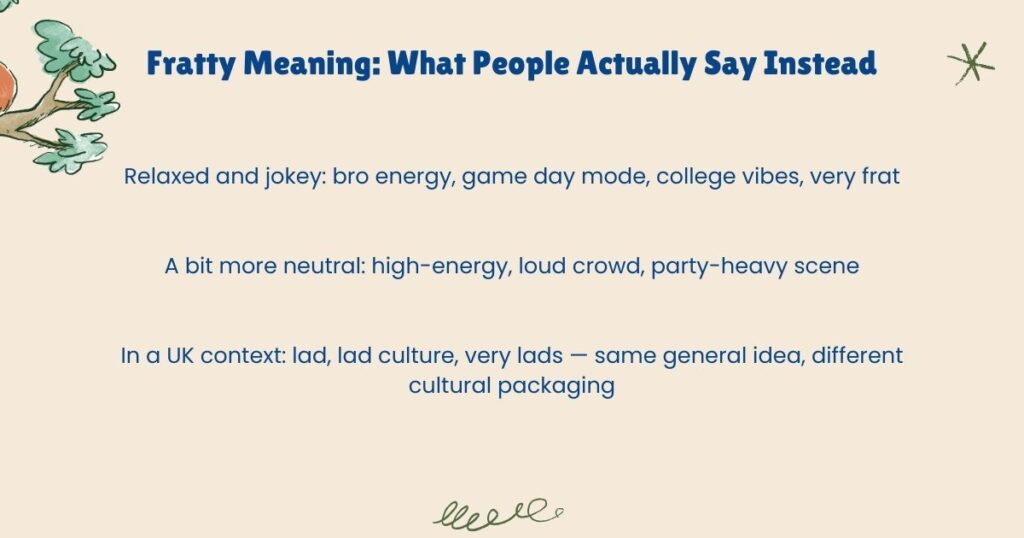
When “fratty” feels too specific or too risky for the situation, people reach for:
Relaxed and jokey: bro energy, game day mode, college vibes, very frat
A bit more neutral: high-energy, loud crowd, party-heavy scene
In a UK context: lad, lad culture, very lads — same general idea, different cultural packaging
None of these are perfect swaps. “Fratty” has a precision that’s hard to replace, which is honestly why it stuck around.
Lines From Real Life
“That entire beach bar is fratty from May through August — I respect it but I can’t stay more than an hour.”
“He does that thing where he points at you across the room and nods. Very fratty.”
“The company retreat had a fratty energy — axe throwing, beer Olympics, no one actually talked about work.”
“I matched with someone whose bio said ‘not fratty, I promise’ and somehow that made me more suspicious.”
“She throws the frattiest birthday parties. Trophies for flip cup. It’s a whole event.”
“That playlist is fratty in the best way possible — I felt 19 again for about forty minutes.”
“His laugh is fratty. You’ll know it when you hear it.”
One Thing That’s Changed
Ten years ago, “fratty” was mostly used by people who were directly inside that college world. Now it travels. You’ll see it applied to influencers, startup offices, clothing brands, sports commentary accounts, even TV show aesthetics.
The word expanded because the archetype did. You don’t need a fraternity house anymore to carry fratty energy — you just need the right combination of confidence, casual clothes, and an enthusiasm for things most adults have outgrown.
Younger people use it more loosely and often ironically. Someone might call themselves fratty as a bit. Older users still tend to tie it closer to actual Greek life.
Where People Get It Wrong
The biggest mix-up is treating “fratty” and “douchey” as the same thing. They’re not. Douchey is individual — one person being arrogant, vain, kind of gross about it. Fratty is collective. It’s a group vibe, a social style, an energy shared between people. You can be fratty and genuinely likable. Douchey is harder to pull off warmly.
Another common mistake is assuming it’s always negative. Plenty of people wear the word proudly. It can signal fun, loyalty, and a certain kind of easy social confidence that actually reads well in certain settings — sales, event planning, coaching.
And no, it’s not only for men. People describe women as fratty too, usually meaning the same bold, crowd-energizing personality just without the Greek letter hoodie.
Read Also: IKTR Meaning – What Does IKTR Mean and How to Use It
Real Questions Worth Answering
Does fratty mean someone is actually in a frat?
No. It just means they carry that energy. Could be a 35-year-old accountant who throws a legendary Super Bowl party every year.
Is it always about partying?
Mostly yes, but it bleeds into attitude too — competitive, group-oriented, physically confident. The party piece is just the most visible part.
Can something inanimate be fratty?
Completely. A bar, a playlist, a brand, an office, a neighborhood during football season — all fair game.
Does it mean the same in the UK?
Not really. The British version is closer to “lad” or “lad culture.” Same spirit, different reference point. If you use “fratty” with a British person, they’ll probably get it from American media, but it won’t feel native to them.
Before You Go
“Fratty” is a small word doing a lot of work. It holds an entire social world inside it — one that’s funny to some, grating to others, and genuinely meaningful to plenty of people who grew up inside it. Knowing what it means isn’t just about vocabulary. It’s about reading a room, understanding a reference, and knowing when the word fits and when it really, really doesn’t.

Hi, I’m the creator of Legacystance.com, dedicated to making English learning simple and enjoyable. I write clear, practical guides on adjectives, verbs, idioms, pronunciation, spelling, and more. Every article is carefully researched to give accurate, easy-to-understand information. My goal is to help readers improve their English skills confidently, one step at a time, with content that is trustworthy, useful, and beginner-friendly.