Feining means having an intense, almost desperate craving for something. It’s slang — a respelled version of “fiending” — and people use it when a regular want has crossed into obsession territory.
So Why Does This Word Feel So Confusing?
Probably because it looks like a typo at first glance. You’re scrolling through comments or reading a friend’s text and you hit “feining” and your brain does a little pause. Is that feigning? Is that a spelling error? Did someone just not care?
The answer is kind of all three and none of them. It’s not a dictionary word. It’s not a typo exactly. It’s slang that grew out of repeated misspellings until enough people used it that it became its own thing. The internet has done this with plenty of words — feining just happens to be one that trips people up because it looks so close to “feigning,” which means something completely different.
These two words are probably responsible for more quiet confusion than any other slang pair online right now.
Feining vs. Feigning — Get This Right Once
This mix-up is worth clearing up before anything else because it changes the entire meaning of a sentence.
Feigning is a proper English word. It means faking something. Pretending. Acting like you feel a way you don’t. “She feigned interest during the meeting” means she pretended to care. That word has been in the dictionary for centuries.
Feining is slang. It means genuinely, desperately wanting something. There’s no performance involved — it’s the real thing. The craving is actual.
So if someone says “he’s feining for her attention,” that means he genuinely can’t stop fixating on it. If someone says “he’s feigning interest,” he’s faking it. Opposite situations. Nearly identical spelling.
Spoken out loud, feigning sounds like “fay-ning” and feining sounds like “fee-ning” — which gives you something to hold onto when reading messages out loud helps.
Where This Word Actually Came From
The word “fiend” originally meant something close to a demon — an evil, consuming force. Over time it shifted into street slang for someone whose addiction had taken over their whole personality. By the time the ’80s crack epidemic hit, calling someone a fiend meant they were consumed by the need for a substance. Restless, shaky, unable to focus on anything else.
Rappers in the ’90s picked it up. “Fiending” got dropped into lyrics. It traveled from street corners into music and then into everyday language, where it slowly softened. By the time it reached TikTok comment sections, people were using the same word — now misspelled as feining — to describe wanting a specific flavor of chips.
Same word. Same feeling underneath it. Wildly different context.
That’s actually what makes slang interesting. The emotional core stays the same even when the stakes completely change.
What the Word Captures That Other Words Don’t
This is worth sitting with for a second — because there are plenty of words for wanting something. Craving. Wanting. Wishing. Desiring. So why reach for feining?
Because those words describe a calm, manageable want. Feining describes the version where the want has gotten loud. Where it’s the background noise of your whole afternoon. Where you keep circling back to it even when you’re trying not to.
“I’m craving pizza” sounds like a preference. “I’m feining for pizza” sounds like you’ve thought about it four times in the last hour and it’s starting to feel personal. The word adds urgency that other options don’t carry. That’s why people use it — it does something that a more neutral word just can’t.
How the Tone Shifts Depending on Situation
The word sounds casual and playful in most contexts. Two friends texting, group chats, comment sections — that’s its natural habitat. Nobody reads too much into it there.
The moment it moves into relationship territory, it gets stickier. “I’m feining for you to reply” from a close friend reads as dramatic and funny. From someone you barely know, it can tip over into uncomfortable. The exact same words land differently based on who’s sending them.
When It Gets Serious
In conversations about actual substance use or recovery, the word carries real weight. Its roots are in addiction language — not as a metaphor, but as a literal description of withdrawal and craving. Using it casually in a space where someone is dealing with that for real can feel dismissive, even if that was never the intention.
Reading the room with this word matters more than with most slang.
Read Also: PYT Meaning — What It Really Means in Texts, Instagram & Everyday Conversations
Situations Where You Should Just Use a Different Word
At work, feining doesn’t belong. Even in casual company Slack channels where people joke around — it’s the kind of word that can make someone do a double-take, and not in a fun way. “I’m feining for the Q3 results” is genuinely strange to read in a professional message.
In writing that lives beyond a text thread — a caption, a public post, an email — consider your whole audience. If even one person reading it might not know the slang, the word creates confusion instead of connection.
And in any conversation that touches real addiction, real recovery, or someone going through something hard with substances — leave it out entirely. Not because it’s offensive, but because the word came from that world. Joking with it in that space is the kind of thing you can’t take back easily.
Words That Carry Similar Energy
Not every situation calls for slang. Here’s what actually works depending on what you’re going for:
When you want the same dramatic feel: “Dying for,” “obsessing over,” “can’t stop thinking about” — all carry the urgency without the slang baggage.
When you want something a little more low-key: “Craving,” “really want,” “been thinking about this all day” — no explanation needed, anyone understands it.
When you’re joking and want something with age: “Jonesing” works for the same feeling, though people under 25 might not immediately catch it.
When the situation is professional and the craving is real: “Really looking forward to” or “genuinely excited about” — no drama, no slang, clean landing.
Examples That Sound Like Real People Wrote Them
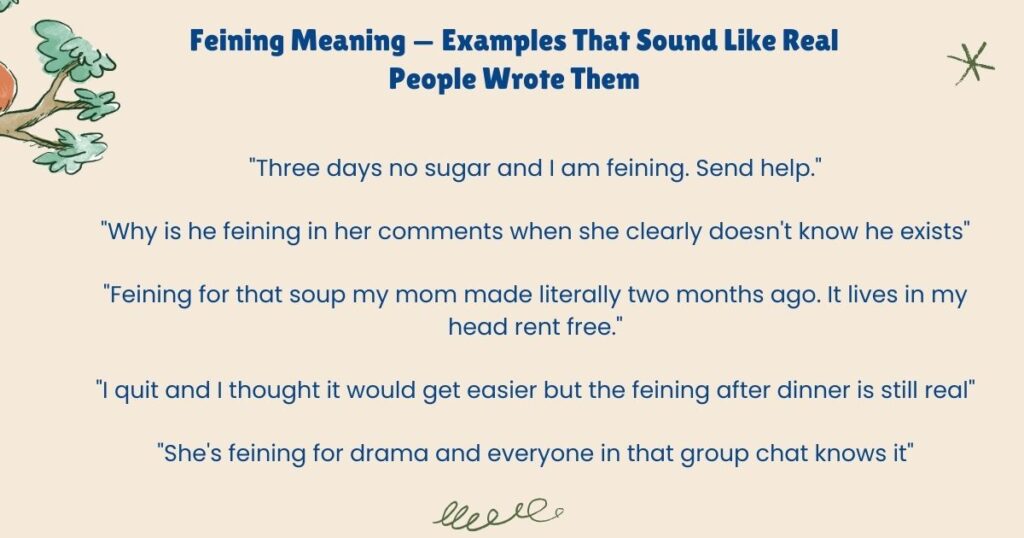
“Three days no sugar and I am feining. Send help.”
“Why is he feining in her comments when she clearly doesn’t know he exists”
“Feining for that soup my mom made literally two months ago. It lives in my head rent free.”
“I quit and I thought it would get easier but the feining after dinner is still real”
“She’s feining for drama and everyone in that group chat knows it”
“Just dropped the album and the fans are feining — first week numbers are gonna go crazy”
“I don’t even smoke anymore but walking past someone doing it outside the café… I felt it”
How Younger Users vs. Everyone Else Uses It
Gen Z shortened it even further — just “fein” with no “-ing.” Same meaning, fewer characters. “I’m fein for that” is completely normal in certain corners of the internet and sounds odd to anyone who didn’t grow up in those spaces.
Older millennials still tend to write “fiending” — the more traditional spelling. Same word, same meaning, just a different generation’s version of it.
TikTok sped up the casual spread significantly. When a word gets used in enough video captions and comment replies, it starts feeling normal even to people who never would have said it before. That’s essentially what happened here between 2020 and now.
The Misunderstandings Worth Knowing
The feigning/feining swap is the most common one, and it matters because getting it wrong reverses the meaning entirely. Someone who’s “feigning” is performing. Someone who’s “feining” is genuinely consumed. Those are not the same thing in the situations where it counts.
The other one is assuming the word always signals something serious or dark. Most of the time in 2025, it’s just someone being dramatic about food. The drug-adjacent roots don’t follow it into every conversation — context does most of the work.
And using it constantly drains it of meaning fast. When everything from a coffee order to a new Netflix show earns “I’m feining,” the word stops doing anything useful. It’s at its best when there’s actual urgency behind it.
Read Also: What Does Sharking Mean? The Real Meaning Across Dating, TikTok, Pool & More
Real Questions People Actually Ask
Does feining always have something to do with drugs?
Not anymore. It started in addiction language but the casual meaning has taken over most of the internet. Most people using it today just mean they really want something.
Is it the same as being “thirsty”?
Similar energy but slightly different. Thirsty usually points at attention-seeking, especially romantic. Feining is broader — it covers food, habits, people, trends, anything with that obsessive craving quality.
Can you use it as a compliment?
Yes, actually. “I’ve been feining for your cooking” is genuinely a compliment. It’s dramatic in a warm way if the relationship supports it.
What about “feining meaning Travis” — what does that search mean?
People connect it to Travis Scott’s music because his lyrics and aesthetic lean into that craving, high-energy, almost desperate hunger for something — whether it’s a high, hype, or an experience. Fans sometimes search the term after hearing it in that context.
Is Irish “feining” a different thing?
There’s a small niche where this comes up, sometimes linked to regional smoking slang or historical Gaelic terms, but it’s not a widespread separate meaning. If you saw it in an Irish context, the craving meaning most likely still applies.
One Last Thing
Feining is a word that traveled a long way — from describing some of the darkest parts of addiction to showing up in comments under food videos. That journey says something real about how language moves and what it carries with it.
You don’t need to overthink it. Most of the time when you see it, someone just really, really wants something. Now you know exactly what they mean.

Hi, I’m the creator of Legacystance.com, dedicated to making English learning simple and enjoyable. I write clear, practical guides on adjectives, verbs, idioms, pronunciation, spelling, and more. Every article is carefully researched to give accurate, easy-to-understand information. My goal is to help readers improve their English skills confidently, one step at a time, with content that is trustworthy, useful, and beginner-friendly.