DSL is slang for “Dick Sucking Lips.” It refers to someone with full, naturally plump lips. Explicit by nature, but often used as a compliment — or at least that’s how it’s intended.
You Saw It Somewhere and Now You’re Here
Maybe it was a comment under someone’s photo. Maybe a friend sent it and you laughed along without actually knowing. Or maybe your kid’s phone screen caught your eye for half a second.
DSL looks completely innocent — just three letters. That’s exactly why it travels so freely across comments, captions, and group chats without setting off any alarms. Until someone finally asks.
The Real Meaning Behind Those Three Letters
Full lips have always been considered attractive. DSL just took that idea and made it explicitly sexual — linking the appearance of someone’s lips to a sexual act rather than just calling them beautiful.
That gap between “your lips look amazing” and DSL is where all the tension lives. One is a clean compliment. The other has a second meaning baked right into it, whether the person saying it means it that way or not.
What makes it complicated is that some people genuinely use it as flattery with zero bad intent. Others use it knowing exactly what they’re implying. And the person receiving it? They’re left figuring out which one just happened.
Who This Gets Aimed At — and How It Lands Differently
Mostly it’s directed at women, and reactions split pretty sharply.
Some people embrace it. If someone’s proud of a lip look or just had filler done, DSL in the comments can feel like acknowledgment — like the effort landed. They’ll respond with fire emojis and own it completely.
Others find it reductive. Being noticed for one body part in a sexual context, especially by someone you don’t know well, doesn’t always feel like a compliment no matter how it was meant.
When it’s directed at men, the energy shifts. It’s almost always a joke — usually a roast between friends. A guy posts a photo after losing a bet, ends up wearing lip gloss, and the comments become a highlight reel. Nobody’s being sincere.
The Sender’s Relationship to You Changes Everything
This is the part most people don’t think about before they hit send.
Close friend: Usually lands fine. There’s enough trust and shared humor that it reads as playful. The context fills in the gaps that text removes.
Acquaintance or someone new: Gets uncomfortable fast. The exact same message that would make your best friend laugh can make someone you barely know feel like they’re being looked at wrong.
Complete stranger in a DM: Almost always reads as harassment, regardless of intent. No relationship means no safety net for interpretation.
Text doesn’t carry tone, facial expressions, or history. What feels like obvious humor in your head arrives as just words on a screen.
Read Also: What Does GMFU Mean? (The Real Answer Nobody’s Giving You)
Situations Where Using It Will Go Badly
Any professional setting — completely off the table. Work messages, LinkedIn, anything attached to your name in a career context. Doesn’t matter how casual your workplace feels.
Commenting it on someone’s public post when you don’t actually know them. Their whole network can see that comment, including people who will judge them for it.
Sending it as an opener on a dating app. It signals poor judgment more than anything else, and most people swipe away quickly after reading it.
Using it on someone who posted a normal photo that had nothing to do with their appearance. Not every selfie is an invitation for that kind of commentary.
Ways to Compliment Someone’s Lips Without the Baggage
Sometimes you genuinely want to say something nice and don’t need the edge that comes with DSL.
For casual and close friendships — “okay the lip combo is everything,” “that gloss is doing serious work,” “lip game has been elite lately”
For flirty but clean — “your lips are genuinely unfair,” “that lip look should come with a warning”
For straightforward — “those lips honestly look amazing” works every time and nobody’s going to screenshot it to show HR
Actual Examples of How It Gets Used
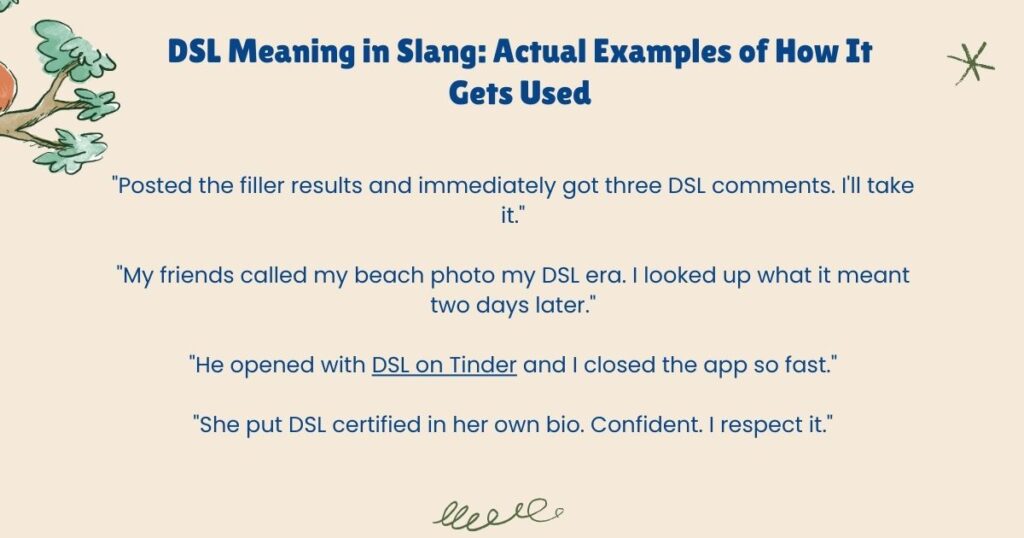
“Posted the filler results and immediately got three DSL comments. I’ll take it.”
“My friends called my beach photo my DSL era. I looked up what it meant two days later.”
“He opened with DSL on Tinder and I closed the app so fast.”
“She put DSL certified in her own bio. Confident. I respect it.”
“The whole group chat was calling Marcus ‘DSL king’ after that lip balm video. He had no idea for like four hours.”
“Someone I’ve never spoken to commented it on my photo. Blocked.”
“My coworker genuinely thought DSL was still just an internet connection type. She saw it in a comment and was very confused.”
The Other Meanings You Might Actually Run Into
Not everything called DSL is slang. Context flips the whole meaning.
Internet/Tech: Digital Subscriber Line. The older type of broadband that runs over phone lines. Still common in areas where fiber hasn’t arrived. If your internet provider mentions it, this is what they mean.
UK and Australian schools: Designated Safeguarding Lead. The staff member responsible for student welfare and safety concerns. Teachers and school administrators use this constantly in professional settings.
Medical/therapy notes: Occasionally shorthand for developmental speech-language in pediatric documentation. Rare outside of clinical paperwork.
If someone in an official or professional context says DSL, they’re almost certainly not talking about lips.
How This Term Moved Through Internet Culture
It started in raw online spaces in the early 2000s — Urban Dictionary territory, forums where nothing was off-limits. Back then it was more insult than compliment.
As lip aesthetics became a bigger part of beauty culture online, the meaning softened slightly. Lip fillers went mainstream, lip looks became content, and DSL found a different lane — less of a dig, more of an edgy acknowledgment.
The current version is somewhere between ironic and genuine depending on who’s using it. Younger users often deploy it self-aware — like they know it’s a lot and they’re saying it anyway for the reaction. That’s a shift from the original intent.
Worth noting for anyone who searched “DSL meaning French” — it’s not French slang. It sometimes appears in bilingual chats simply because it’s traveling from English-language internet culture, but there’s no French origin or equivalent.
Where It Still Trips People Up
The biggest misread is assuming the letters are neutral. They look like a company name or an abbreviation. So people repeat it, share it, or laugh along without realizing what they’re circulating.
Parents encounter it in their kids’ comments and have no frame of reference. Teachers see it in student group chats and have to decide if it’s a disciplinary issue. People new to a friend group use it because they heard others say it and think it just means someone looks good.
Overuse has also dulled it. When something gets plastered across enough makeup tutorials and comment sections, it starts functioning more as a personality marker than an actual statement. But that normalization doesn’t protect anyone from the moments where it lands wrong — and it does still land wrong regularly.
Read Also: What Does NFS Mean in Text? (From Girls, Guys, Snapchat & More)
Real Questions Worth Answering
If someone uses it on themselves, does it still count as slang?
Yes, and that’s actually one of the more interesting uses. Self-directed, it becomes a confidence statement rather than someone else’s commentary on your body.
Is it worse in text than in person?
In a lot of ways, yes. In person you can read the room. Over text, the same words land completely differently depending on the reader’s mood, the relationship, and what else is going on that day.
Does age change how people react to it?
Noticeably. People who grew up with this term as part of internet slang often read it as casual. People encountering it for the first time — especially older adults — are usually genuinely taken aback by what it means.
What about “DSL body” — is that a separate thing?
Some people extend the abbreviation loosely to describe general physical attractiveness, but it’s not a consistent or widely understood meaning. The lips interpretation is still the dominant one by a wide margin.
Is it considered harassment?
It can be, depending on context. Sending it unsolicited to someone, especially a stranger, in a direct message absolutely qualifies as unwanted sexual commentary. Whether it rises to a formal harassment complaint depends on the platform and situation.
One Last Thing
The letter combination looks clean. That’s basically the whole reason it spreads so easily — through comments, captions, and conversations where nobody flags it at first glance.
Now you know what it means, what it implies, and more importantly, what it signals about the person saying it. Use that information however makes sense for you.

Hi, I’m the creator of Legacystance.com, dedicated to making English learning simple and enjoyable. I write clear, practical guides on adjectives, verbs, idioms, pronunciation, spelling, and more. Every article is carefully researched to give accurate, easy-to-understand information. My goal is to help readers improve their English skills confidently, one step at a time, with content that is trustworthy, useful, and beginner-friendly.