A damily is a group of chosen people — friends, neighbors, or anyone close — who act like family without sharing blood or a last name. It’s warmer than “friends” and more honest than pretending biology equals love.
So Why Does This Word Even Exist
Because sometimes “friends” just doesn’t cover it.
There are people in your life who’ve sat with you through genuinely hard nights. Who remembered the thing you mentioned once six months ago. Who showed up with food when you didn’t even ask. Calling them “my friends” feels like introducing your person as “someone I know.”
Damily fills that gap. It names something real that was previously awkward to describe.
The word started spreading quietly through social media — mostly captions and group chats — and it stuck because it resonated immediately. People read it and thought yes, that’s exactly what I have. That’s usually how informal language survives: it earns its place.
What The Word Actually Carries
Here’s what most definitions miss — damily isn’t just a label. It’s a claim.
When someone uses it, they’re saying these people operate with family-level loyalty. Not convenience-based loyalty. Not fair-weather loyalty. The kind where someone drops plans when you need them.
It also tends to carry quiet gratitude. People who’ve rebuilt their sense of belonging — after moving cities, leaving difficult home situations, or simply growing apart from relatives — use this word with real weight behind it. For them, a damily wasn’t inherited. It was built slowly, sometimes painfully, and that makes it mean more.
The Difference Between a Friend Group and a Damily
A friend group is who you have fun with. A damily is who you call when fun is the last thing on your mind.
That distinction matters because the word signals depth of care, not just frequency of hangouts. Your coworkers might be your lunch crowd. Your damily are the ones who noticed when something was off before you said a word.
How It Shows Up Naturally
You won’t usually find this word in a serious conversation or a heartfelt letter. It lives in quick, casual moments:
A birthday caption with the whole crew. A group chat name. A voice note ending with “love my damily.” A comment under someone’s photo when you want to say more than just a heart.
The tone is almost always warm but never heavy. That’s part of why it works in text — it communicates deep affection without making anyone feel like they just received a formal declaration. Low pressure, high meaning.
When Tone Changes Things
Used between people with genuine history, it lands perfectly. But context shapes how it reads.
If you post it sarcastically — captioning a photo of your chaotic friends mid-argument — that reads as playful, assuming your audience knows you. If you use it sincerely about people who’ve actually been there for you, it reads as gratitude.
The version to watch out for: calling someone your damily before the relationship has actually earned that. Some people feel the weight of the word and it can come across as rushing intimacy that hasn’t developed yet. The word works best when it’s describing something that already exists, not something you’re hoping to build.
Where It Doesn’t Belong
A work presentation. A formal email. A message to someone you met last Tuesday.
It also doesn’t fit in grief posts or serious announcements where the lightness of the word would accidentally undercut the moment. There’s a register mismatch — the word is too casual for a eulogy and too intimate for a networking message.
Some people also use it so frequently that it loses meaning. If everyone you’ve ever met is your damily, nobody really is.
Read Also: Opps Meaning: What It Really Means in Slang, Social Media & More
Other Ways to Say It
If “damily” feels too casual for what you’re trying to express, or if the person you’re talking to wouldn’t know the word, these carry similar meaning:
Chosen family — more widely understood, slightly more formal
My people — casual, warm, works almost anywhere
Found family — popular in creative communities, carries a bit more emotional weight
My circle — neutral, no assumptions about depth
None of these have quite the same texture as damily, which is part of why the word keeps being used. It’s specific in a way these alternatives aren’t.
Actual Examples From Real Life
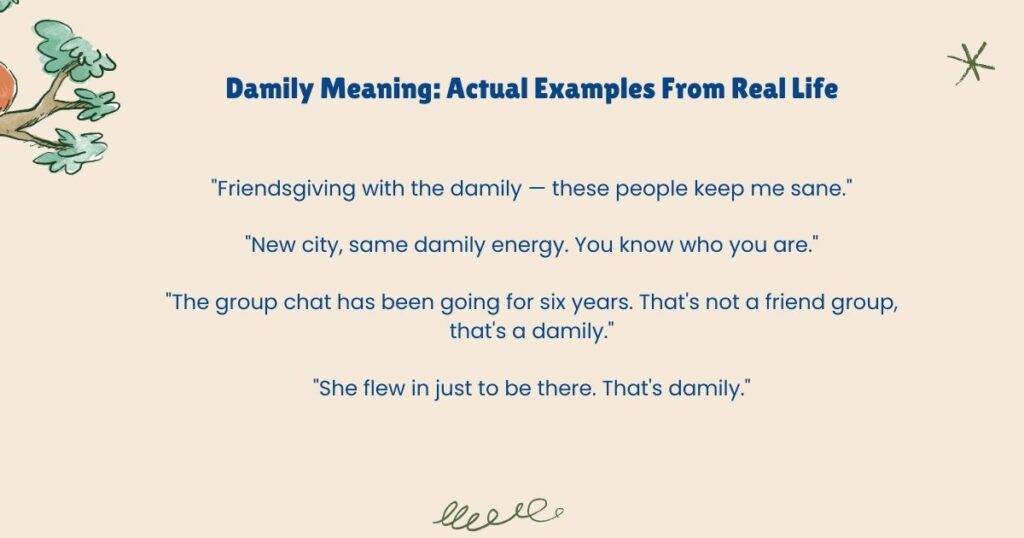
“Friendsgiving with the damily — these people keep me sane.”
“New city, same damily energy. You know who you are.”
“The group chat has been going for six years. That’s not a friend group, that’s a damily.”
“She flew in just to be there. That’s damily.”
“We don’t share a last name but we show up the same way.”
“Built something real here. My damily in this city hits different.”
Notice none of these over-explain. The word does the work when the relationship backs it up.
Who Uses It Most and Where
Mostly millennials and Gen Z, especially people living away from home or those who’ve intentionally distanced from complicated family situations. It thrives on Instagram, TikTok, and in group chats — places where casual language moves fast and emotional shorthand is valued.
It picked up real traction around 2019–2020, partly because conversations about chosen family and emotional support became much more mainstream. The word fit a cultural moment where people were openly acknowledging that family isn’t only biological.
Older generations tend to say “chosen family” for the same concept. Same idea, different vocabulary. Neither is wrong.
What People Get Wrong About It
That it’s always a typo. Sometimes yes, autocorrect is real. But in context, especially when it’s capitalized or used with clear warmth, it’s intentional.
That it implies something broken. People assume only those with difficult families use this word. Not true. Someone can have a loving biological family and also have a damily. They’re not replacements for each other.
That it’s shallow internet slang. It’s informal, sure. But the relationships it describes often aren’t shallow at all. The word just lives in casual spaces.
Read also: TBF Meaning — And Why It’s More Complicated Than You Think
Real Questions People Have
Is damily in the dictionary?
Not in major dictionaries yet, but it’s genuinely understood and used. Language earns dictionary entries over time — this one’s on its way.
Can coworkers be your damily?
If the relationship has moved past professional into real personal territory — yes. If you mostly talk about work, probably not quite there.
Is it ever offensive?
Rarely, but calling someone your damily when they don’t feel the same closeness can feel like too much too fast. Read the relationship first.
Does it work for pets?
Plenty of people think so. No one’s stopping you.
One Last Thing
The people who mean the most to you often don’t fit neatly into the word “friend.” Damily exists for exactly that — when the relationship has grown into something that deserves a bigger word, even if it’s an informal one.
If you’ve got people like that, you already knew what this word meant before you looked it up.

Hi, I’m the creator of Legacystance.com, dedicated to making English learning simple and enjoyable. I write clear, practical guides on adjectives, verbs, idioms, pronunciation, spelling, and more. Every article is carefully researched to give accurate, easy-to-understand information. My goal is to help readers improve their English skills confidently, one step at a time, with content that is trustworthy, useful, and beginner-friendly.