“Casi algo” is Spanish for “almost something.” It names that in-between space where two people share real feelings, real closeness — but never actually become official. Not a relationship. Not strangers. Just stuck in the almost.
You Probably Found This Because of a Feeling, Not a Word
Maybe a song lyric stopped you mid-scroll. Or someone in the comments wrote “casi algo 😮💨” under a post that felt uncomfortably specific to your life. Or your friend texted it to you about that person you’ve been circling around for months.
The funny thing is, most people who search this already understand it. They just want confirmation that what they lived through has a name — that it wasn’t made up, wasn’t dramatic, wasn’t nothing.
It was almost something. And that’s its own kind of real.
The Feeling Behind the Words
Here’s what sets “casi algo” apart from just saying “we never dated.” It’s not about the absence of a label — it’s about the presence of everything else. The inside jokes. The 1am texts. The way that person remembered small things you mentioned once. The plans that felt real even when they technically weren’t made.
You weren’t imagining it. Something was there. It just never crossed the line into something you could explain to people without the whole story.
That’s exactly why the phrase resonates so hard in Spanish-speaking communities — and why it jumped language barriers so fast. English has breakup vocabulary, dating vocabulary, even situationship vocabulary. But “almost something that mattered”? There wasn’t a clean word for that until this one started spreading.
How People Actually Use It
It rarely comes up in the moment. You won’t hear someone say “I think this is becoming casi algo” mid-situation. It’s more of a looking-back phrase — used when you’re processing, retelling, or finally naming what something was.
In texts and DMs it sounds like:
- “Okay I finally admitted to myself he was just a casi algo and deleted the thread”
- “This playlist is literally just my casi algo era from last year”
- “She’s not my ex. More of a casi algo. Different kind of sad.”
In comment sections it often shows up as a single phrase with no explanation, because none is needed. People just reply “casi algo 💀” and fifteen others hit like because they’ve been there too.
That kind of wordless recognition is rare. It’s what makes slang actually stick.
Tone Changes Everything With This Phrase
Same phrase, completely different energy depending on delivery.
Said softly, with some time and distance? It sounds like acceptance. A little wistful, a little peaceful. Like you’ve made your peace with it.
Said while you’re still in it? That’s frustration. That’s the “we’ve been doing this for four months and I genuinely don’t know where I stand” version.
Said with a laugh after one too many almost-relationships? Pure sarcasm. “Great, another casi algo, really building a collection here.”
One thing worth knowing: if you call someone else’s situation a “casi algo” to their face — especially when they thought it was more — that lands hard. It can feel like you’re minimizing what they felt. Even if it’s accurate, the timing matters. Read the room before you name someone else’s experience for them.
Casi Algo vs. Situationship — Worth Knowing the Difference
These two get swapped constantly, but they’re not quite the same.
A situationship tends to be mutual non-commitment. Both people are somewhat aware of what it is (or isn’t), and there’s usually a casual, low-pressure quality to it. It can stretch on for months without much tension.
“Casi algo” carries more weight. There’s a sense of potential — like it should have become something, like the pieces were there. The ending isn’t always dramatic, but the gap between what it was and what it could have been is what stings. One person is often more invested than the other, though not always.
If situationship feels like a shrug, casi algo feels like a breath you held too long.
The Song That Made It Go Everywhere
Nivel’s “Casi Algo” did what good music always does — it gave language to something people were already feeling. The song describes two people whose connection slipped away not from conflict but from hesitation. No villain, no big falling out. Just timing, and silence where honesty should have been.
The line that travels farthest — “éramos casi algo, pero se nos escapó” — translates roughly to “we were almost something, but it got away from us.” That passiveness is the whole point. Nothing was done wrong. It just didn’t happen.
That’s a harder grief to sit with than a clean ending, which is probably why so many people made that song part of their processing playlist.
When This Phrase Doesn’t Belong
A few places where “casi algo” would be genuinely out of place or unkind:
In professional settings. It’s personal slang. Keep it far from work conversations, LinkedIn, anything formal.
As a reply to someone actively hurting. If your friend is crying over someone and you respond with “sounds like a casi algo,” you might mean well — but it can read as dismissive. Sometimes people need to feel heard before they need a label.
Publicly tagging someone else’s relationship. Commenting “lol casi algo” on a post where the actual person can see it is just messy. What’s relatable slang to you might be a gut punch to them.
With people who don’t know the phrase. Sending “casi algo” to someone who doesn’t speak Spanish or isn’t chronically online is going to land as noise. Context doesn’t always travel.
Ways to Say It Without Using the Phrase
Sometimes you need to explain the feeling to someone who won’t know the term:
For a casual conversation — “we were talking but it never really went anywhere,” “we had a thing but nobody said it out loud”
When it’s heavier — “there were real feelings involved, it just never became official,” “it mattered but it didn’t have a name”
For the blunter crowd — “he kept me in the almost zone for months,” “she never committed but didn’t leave either”
None of these have the same poetry. That’s kind of the point of “casi algo” existing — it earns its place because the alternatives are clunkier.
Real Exchanges That Sound Like Actual People
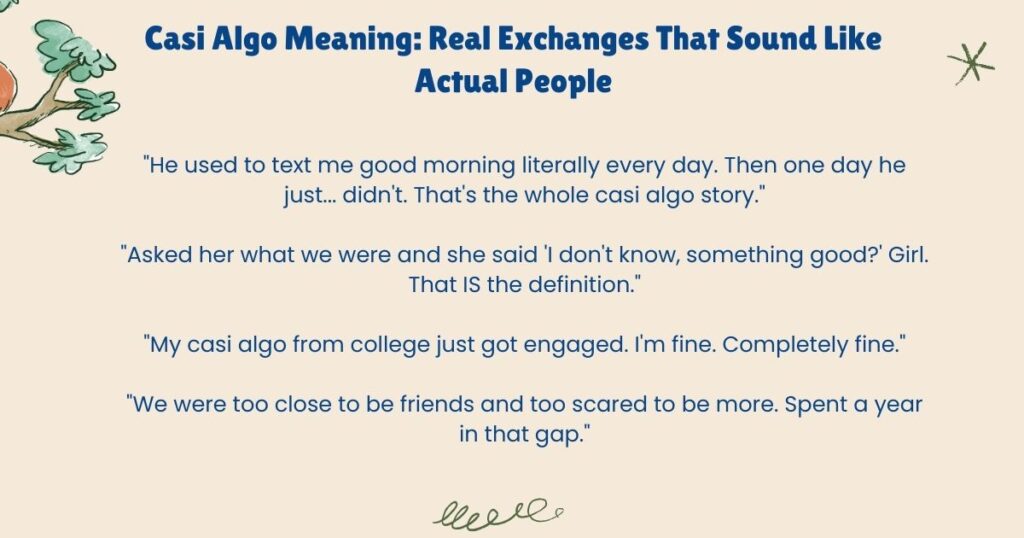
“He used to text me good morning literally every day. Then one day he just… didn’t. That’s the whole casi algo story.”
“Asked her what we were and she said ‘I don’t know, something good?’ Girl. That IS the definition.”
“My casi algo from college just got engaged. I’m fine. Completely fine.”
“We were too close to be friends and too scared to be more. Spent a year in that gap.”
“He’d introduce me to people but never say girlfriend. Casi algo with excellent PR.”
“I don’t have an ex. I have a casi algo and honestly that’s worse because I can’t even be properly sad about it.”
What People Get Wrong About It
The biggest misread is assuming it’s lighthearted — like a cute quirky thing to post about. For some people it is. For others, it was genuinely painful, and they’re using the word to process something real.
Don’t assume which one you’re dealing with when someone else uses it.
The other common mistake: thinking it only applies to romance. A job offer that kept getting delayed and then disappeared — casi algo. A friendship that had all the signs of becoming something closer before life got in the way — also casi algo. The romantic version just gets the most airtime.
Questions People Actually Ask
Does casi algo mean the same thing across all Spanish-speaking countries?
The literal Spanish, yes. But as internet slang, it’s most recognized among younger Latin American and Spanish speakers who’ve been exposed to it through social media and music. An older speaker might just hear “almost something” with no cultural weight attached.
Is it always about the other person’s fault?
Not at all — and honestly, that’s part of what makes the phrase feel honest. Sometimes both people were scared. Sometimes timing was genuinely bad. It doesn’t automatically mean someone was stringing someone else along.
How do you pronounce it without sounding awkward?
“KAH-see AHL-go.” Relaxed, not over-enunciated. If you’ve heard the Nivel song, just match the rhythm of how he sings it. That’s all the pronunciation lesson you need.
Why does it feel worse than an actual breakup sometimes?
Because there’s no closure script for an almost. Breakups come with social understanding — people know how to respond. An almost-relationship leaves you grieving something that was never officially acknowledged, which makes it harder to explain and harder to move past.
One Last Thing
“Casi algo” spread because it’s honest in a way that most relationship vocabulary isn’t. It doesn’t assign blame. It doesn’t overstate what happened. It just says: this was real, it mattered, and it didn’t become what it had the potential to be.
That’s not failure. That’s just one of the more human experiences there is.

Hi, I’m the creator of Legacystance.com, dedicated to making English learning simple and enjoyable. I write clear, practical guides on adjectives, verbs, idioms, pronunciation, spelling, and more. Every article is carefully researched to give accurate, easy-to-understand information. My goal is to help readers improve their English skills confidently, one step at a time, with content that is trustworthy, useful, and beginner-friendly.