“Big bear” points to one of four things: a famous constellation in the night sky, a warm nickname for someone big-hearted and physically solid, a specific term within the LGBTQ+ bear community, or a mountain resort town in California. Which one applies depends completely on the conversation you’re in.
Here’s Why People End Up Googling This
You didn’t stumble here randomly. Maybe someone texted you “you’re my big bear” and you weren’t sure if that was sweet or strange. Maybe BIG BEAR showed up in a NYT Connections puzzle and you guessed wrong. Maybe your astronomy class mentioned Ursa Major and somehow that led here.
The honest reason this phrase is confusing is that it genuinely lives in multiple worlds at once — science, mythology, modern slang, and a real geographic location. Most phrases pick a lane. This one didn’t.
The Nickname Version (What Most People Actually Mean Today)
When someone calls a person their “big bear,” they’re usually describing someone who’s large in presence but genuinely soft when it matters. It’s not about mocking someone’s size. It’s more like — this person could probably lift a car but also cried at a movie last week, and that combination is exactly why you love them.
People reach for “big bear” instead of “protective” because protective sounds clinical. Instead of “teddy bear” because that sounds too childlike. It lands somewhere between those two — physically substantial, emotionally safe. That’s the sweet spot the phrase lives in.
It’s also worth knowing that within bear culture in the LGBTQ+ community, “bear” refers to a man who’s bigger, often bearded, and embraces that aesthetic with full confidence. “Big bear” there just turns up that energy. It’s used as a genuine compliment, something people wear proudly.
The Astronomy Version (Older Than Any Slang)
Long before anyone used it as a nickname, “big bear” meant something specific on a clear night sky.
Ursa Major — Latin for “greater bear” — is one of the largest, most recognized constellations visible from the Northern Hemisphere. Most people know its most famous section as the Big Dipper. That spoon-shaped cluster of seven stars is actually just the tail and back of the full bear shape that makes up Ursa Major.
Why It Still Matters Practically
The two outer stars of the Dipper’s bowl act like an arrow. Follow them upward and you land directly on Polaris — the North Star. Sailors used this for navigation for centuries. Hikers still use it. No app required, just a dark sky and those two stars.
What makes Ursa Major feel slightly magical is that it never disappears below the horizon in the Northern Hemisphere. It circles the North Pole continuously, visible any clear night all year long. Ancient Greeks noticed this and said the bear “never bathes” — forever moving through the sky without rest.
Read Also: CFS Meaning Slang — What It Actually Says About Someone’s Mood
The Greek Myth Behind It
The Greeks didn’t just name a constellation. They built a whole tragedy around it.
Callisto was a young huntress in Artemis’s service, sworn to a life of independence. After Zeus became involved with her, Hera — furious — transformed Callisto into a bear. Years later, her own son Arcas came close to killing her while hunting, not recognizing her. Zeus intervened and placed both of them in the sky — Callisto as Ursa Major, Arcas as Ursa Minor nearby.
The story stuck because it carries real weight: jealousy, transformation, being stuck in a form that hides who you really are. That emotional core is probably why this myth survived thousands of years while dozens of others faded.
Not Just a Greek Thing
Here’s what’s genuinely interesting — cultures that had zero contact with ancient Greece independently looked at the same stars and also saw a bear. Native American traditions described those stars as a bear being hunted. Hindu astronomy mapped them as the seven sages. Finnish sky lore connected them to a bear hunt where autumn leaves carry the bear’s color.
Same stars. Same animal. Across continents. That’s not coincidence — it says something about how universally bears represent strength and something worth watching.
Bugbear — Because This Word Trips People Up
Bugbear is not big bear with a typo. It means something completely different.
A bugbear is a personal fear or recurring annoyance that’s probably bigger in your head than in reality. “Job interviews are my bugbear.” “Parallel parking is my eternal bugbear.” That kind of use.
It came from old folklore — a goblin-like creature invented to frighten children into behaving. Over time it shifted into describing any exaggerated dread. Totally separate word, totally separate history. Just looks related at a glance.
Big Bear the Place
Big Bear Lake is a mountain town in Southern California’s San Bernardino Mountains. Skiing in winter, hiking and lake activities in summer. It has that specific small-mountain-town energy — slightly sleepy off-season, packed on holiday weekends.
The name comes from the bears that genuinely roamed the area heavily in the mid-1800s. Hunters reported large numbers of them, and the name stuck. So even the town’s identity circles back to the animal.
Tone Traps Worth Knowing
Calling someone “big bear” assumes a level of closeness. Between partners or tight friends, it’s warm and it lands perfectly. With someone you just met, it crosses into territory that feels oddly personal before the relationship earns it.
There’s also a size sensitivity worth being aware of. If someone’s not comfortable with comments about their body, “big bear” can sting even with the best intentions. The nickname works when you know the person genuinely well enough to know how they receive it.
When to Skip It Entirely
In work emails, formal writing, or any situation where professionalism matters — this phrase doesn’t belong. It’s too intimate for those settings. Also skip it when someone’s clearly not in a lighthearted space. Affectionate slang during a tense moment tends to miss badly.
Read Also: PYT Meaning — What It Really Means in Texts, Instagram & Everyday Conversations
Real Examples That Sound Like Actual Conversations
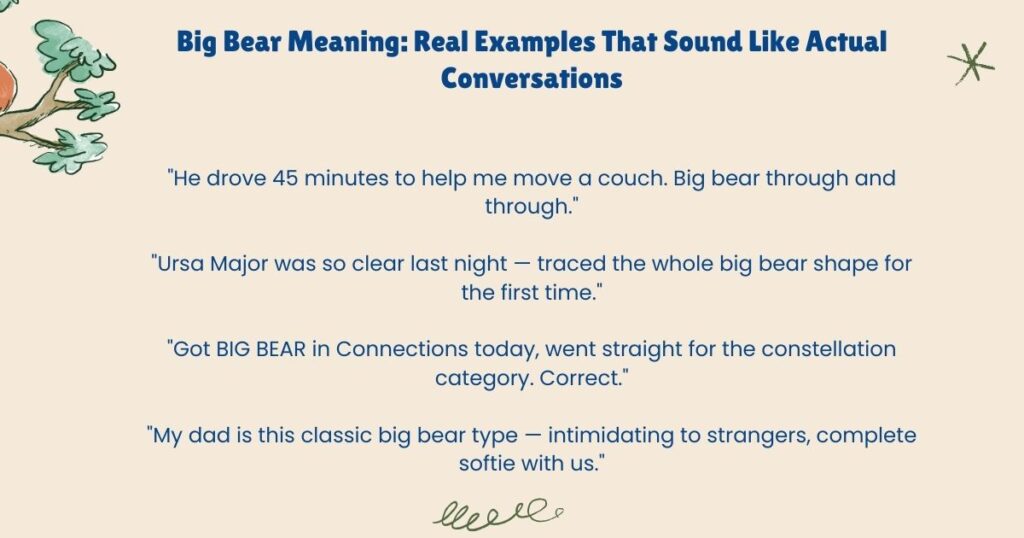
“He drove 45 minutes to help me move a couch. Big bear through and through.”
“Ursa Major was so clear last night — traced the whole big bear shape for the first time.”
“Got BIG BEAR in Connections today, went straight for the constellation category. Correct.”
“My dad is this classic big bear type — intimidating to strangers, complete softie with us.”
“Callisto becoming the big bear in the sky is honestly one of the saddest Greek myths.”
“He’s known in bear spaces as a big bear — owns it completely, love that for him.”
“Big Bear Lake in February is underrated. Quiet slopes, half the crowds.”
Real Questions People Actually Ask
Is “big bear” always meant affectionately?
In most modern uses, yes. The exception is if it’s said with clear sarcasm — like rolling your eyes at someone being overdramatic about something small. But that reading is rare. Default assumption is warm.
Does it mean the same thing everywhere?
Not quite. In bear culture it’s community-specific with its own history. In general slang it’s more about personality energy. In astronomy it’s a constellation. Geography gives it a whole different meaning again. Same phrase, different worlds.
Why do so many cultures see a bear in those stars?
Genuinely no definitive answer. Bears were significant to most ancient cultures — powerful, dangerous, present across continents. It’s likely that the pattern of stars loosely suggested a large animal, and bears were the large animal that made the most cultural sense. The overlap across unconnected civilizations remains one of those quietly fascinating details in astronomy history.
Is bugbear related to big bear?
No. Different word, different origin, different meaning entirely. Bugbear comes from old folklore creatures used to scare children. It now means a recurring irrational fear or annoyance. The spelling similarity is just coincidence.
Closing Thought
What’s genuinely interesting about “big bear” is that whether you’re talking about a constellation, a Greek myth, a nickname, or a mountain town — the underlying feeling is similar across all of them. Size, protection, something that watches over. The ancient Greeks put it in the sky to guard it.
People use it as a nickname for someone they feel genuinely safe around. Even the town named itself after creatures that dominated the landscape. It’s the same idea wearing different clothes across different centuries.

Hi, I’m the creator of Legacystance.com, dedicated to making English learning simple and enjoyable. I write clear, practical guides on adjectives, verbs, idioms, pronunciation, spelling, and more. Every article is carefully researched to give accurate, easy-to-understand information. My goal is to help readers improve their English skills confidently, one step at a time, with content that is trustworthy, useful, and beginner-friendly.