BBW means “Big Beautiful Woman.” It’s used to describe women with fuller bodies who embrace their size confidently. Think of it as celebrating curves instead of hiding them.
Understanding BBW: Pride vs. Discomfort
BBW stands for “Big Beautiful Woman,” but what it actually signals depends on who’s using it. Some women wear it proudly, celebrating their curves and ignoring old beauty rules. Others don’t like the label—it can feel patronizing or reduce them to their body size instead of seeing them as a whole person.
The meaning also changes depending on context: on Instagram or in friend groups, it can be empowering, while on dating sites or from strangers, it might feel objectifying. Basically, BBW flips “big” from an insult into something positive—but only if the person using it agrees with that message.
Where You’ll Actually See It
Dating apps are ground zero. People put BBW in their bios to filter out shallow matches early. Saves everyone time—if you’re not into curvier bodies, you’ll swipe left and nobody’s feelings get hurt.
Fashion communities use it constantly. Search “BBW outfit ideas” and you’ll find styling tips tailored to bigger frames—where to find jeans that fit thighs and waist, which necklines work best, how to layer without adding bulk.
Friend groups might toss it around casually. “She’s BBW and looks fire in that dress” or “I need BBW-friendly stores, regular sizes don’t work.” In these moments, it’s just descriptive shorthand, no deeper meaning.
Social media hashtags (#BBW, #BBWFashion, #BBWStyle) connect people sharing body-positive content. That’s where the term lives loudest—proud selfies, clapping back at trolls, building community.
Reading the Room Matters More Than You Think
Empowerment vs. objectification: When a woman calls herself BBW, it’s empowerment. But a stranger saying, “I love BBW girls” can sound like objectification.
Friends can joke: Close friends might say “BBW squad” and everyone laughs. Same words from a stranger? Creepy.
Professional settings: Never comment on a coworker’s body. Body-size labels don’t belong in formal or work spaces.
Red flag: If BBW makes you focus on someone’s body more than their personality, you’re using it wrong. Appreciation is fine; defining someone by size is not.
Times to Just… Not
Drop the term entirely when talking to someone you don’t know well. Compliments about appearance work better without body-type labels attached. “You look amazing” beats “You look amazing for a BBW” by a mile.
Skip it in any formal situation—work emails, professional networking, public speeches. Even in supposedly progressive spaces, singling out body size feels inappropriate.
Don’t use it to make health assumptions. BBW describes appearance, not fitness level, diet, or medical status. Connecting it to health conversations turns it into concern-trolling.
Avoid it in public comments on photos unless the person used it first about themselves. Even then, read carefully. Just because someone calls themselves BBW doesn’t mean they want strangers weighing in on their body.
And definitely don’t use it as your only descriptor for someone. “My BBW friend” sounds reductive. “My friend Sarah” works better. Her size isn’t her introduction.
What Else People Say Instead
If you’re talking about yourself: Some women prefer “curvy,” “thick,” “plus-size,” or “full-figured.” Others skip labels entirely and just describe specific features they like. “I’ve got hips” or “I’m bigger” works without formal terminology.
If you’re being respectful about someone else: “Plus-size” is usually safest. It’s neutral, widely understood, and doesn’t add extra meaning. Fashion industry uses it, so it’s recognizable without being clinical.
In casual friend talk: “Thicc” (spelled with two c’s) has different energy—playful, internet-y, often about specific body parts like thighs or butt rather than overall size. “Fluffy” or “squishy” only works if you’re extremely close and they’ve used those words first.
When you don’t need a label at all: Most of the time? This is the move. Just talk about the person without mentioning their body type. Wild concept, but it works.
Read Also: POS Meaning in Slang: What It Really Means Online, in Texts & Gaming
Real Conversations
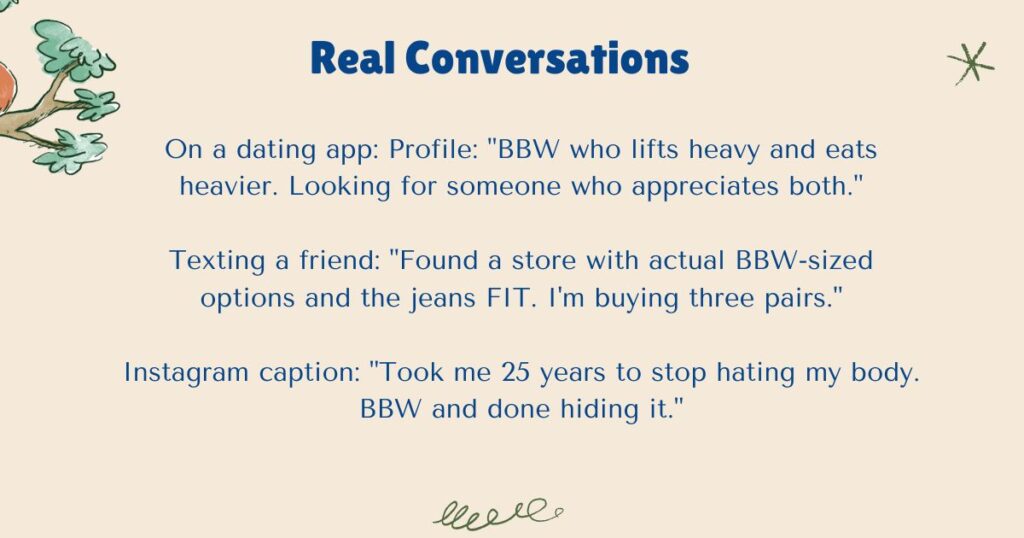
On a dating app: Profile: “BBW who lifts heavy and eats heavier. Looking for someone who appreciates both.”
Texting a friend: “Found a store with actual BBW-sized options and the jeans FIT. I’m buying three pairs.”
Instagram caption: “Took me 25 years to stop hating my body. BBW and done hiding it.”
Bad dating message: “Hey beautiful, I’m really into BBW women 😍” (This screams fetish, not genuine interest in who she is.)
Good dating message: “Your profile made me laugh—especially the part about your cat judging your cooking. What’s the worst thing you’ve burned?”
Friend conversation: “Should I try bodycon dresses?” “Why not? BBW influencers wear them all the time and look incredible.”
Online forum post: “I’m so over people assuming BBW means lazy. I teach three spin classes a week.”
How Meaning Shifts Across Spaces
TikTok uses BBW in outfit videos, makeup tutorials, body-positive duets. It’s celebratory there, part of a bigger movement toward size acceptance.
Twitter has whole communities around it—#BBWTwitter connects people sharing experiences, frustrations, victories. The tone leans supportive.
Dating sites get trickier. Some platforms built specifically for plus-size dating embrace the term openly. Others avoid it because it’s been weaponized in fetish contexts where people treat body types like collectibles.
Gen Z seems divided. Some love reclaiming it, others think it’s outdated language from their parents’ generation. They prefer either reclaiming “fat” as neutral or ditching size labels completely.
Cultural background changes everything too. Western body-positive movements adopted BBW enthusiastically. In cultures with different beauty ideals or more conservative views on discussing bodies, the term either doesn’t exist or carries totally different weight.
What People Get Wrong
Assuming it’s universally flattering: Calling someone BBW without knowing how they feel about it can backfire hard. Not everyone wants to be defined by size, even positively.
Thinking it’s recent: The term launched in the 1970s. It’s been around longer than most people realize, which is why some consider it dated.
Missing the fetish problem: In certain spaces online, BBW became a category that treats women like objects to collect rather than people to connect with. When someone leads with “I love BBW girls,” they’re usually revealing which problem they are.
Confusing it with health markers: You can’t tell someone’s fitness, eating habits, or medical situation from their size. BBW describes how someone looks and how they feel about it—nothing more.
Using it interchangeably with any plus-size description: BBW has specific connotations around confidence and self-acceptance. A woman who’s plus-size but uncomfortable with her body wouldn’t identify with the term.
Read Also: Dih Meaning: The Slang Everyone’s Using But No One Explains
Questions People Actually Ask
Can I use this term about myself if I’m not sure I’m “big enough”?
There’s no size requirement or gatekeeping. If you connect with it and it feels right, use it. Nobody’s checking qualifications.
What if I’m attracted to BBW women—is that bad?
Attraction isn’t bad. Reducing people to a body type is. If you’re genuinely interested in someone as a whole person who happens to have a curvier body, you’re fine. If you’re collecting “types,” that’s the problem.
Is BBW the same as thick or curvy?
Not exactly. “Thick” usually emphasizes specific areas—thighs, butt, hips. “Curvy” can mean hourglass shape at any size. BBW is more about overall bigger body size plus attitude about it.
Do men have an equivalent term?
BHM (Big Handsome Man) exists but barely gets used. The whole concept lives more in women’s spaces and conversations.
Why do some people hate this term?
It can feel patronizing (the forced “beautiful”), fetishizing (being reduced to size), or outdated (language around bodies keeps evolving). Personal preference varies wildly.
Should I mention it when complimenting someone?
Usually no. Compliment the outfit, the confidence, the smile—literally anything except their body classification. That’s not the compliment you think it is.
Look, language around bodies stays messy because bodies are personal and culture keeps shifting. BBW works for some people as an identity, bothers others as a label, and confuses everyone else trying to figure out if it’s okay to say. Your safest bet? Let people choose their own words.
If someone calls themselves BBW, cool—you can use it in that context. If you’re guessing or assuming, you’re probably about to make things weird. When describing anyone else, their body type doesn’t need to come up unless they brought it up first. Simple as that.

Hi, I’m the creator of Legacystance.com, dedicated to making English learning simple and enjoyable. I write clear, practical guides on adjectives, verbs, idioms, pronunciation, spelling, and more. Every article is carefully researched to give accurate, easy-to-understand information. My goal is to help readers improve their English skills confidently, one step at a time, with content that is trustworthy, useful, and beginner-friendly.