Bad juju means a negative force, bad luck, or an uneasy feeling that something is off, cursed, or heading toward disaster. It’s what people say when their gut is louder than their brain.
So Why Does This Word Even Confuse People
Because it sounds made up but it isn’t. It sounds spiritual but people use it as slang. It sounds old but it trends on TikTok. Someone drops it in a comment or a text and you’re sitting there like — is this a joke? A warning? A vibe?
That in-between quality is exactly why it confuses people. It belongs to multiple worlds at once and doesn’t fully commit to any of them.
The Feeling Behind the Word
Forget the definition for a second. Think about a moment when everything in you said no before your brain could explain why.
You meet someone and smile at them but something quietly tightens in your chest. You’re about to make a decision that looks fine on paper but feels completely wrong. You walk into a room and the air just feels heavy for no reason you can point to.
That’s the feeling bad juju is describing. It’s not about facts. It’s about that pre-logical alarm that goes off when something isn’t right.
What makes people reach for this phrase specifically — instead of just saying “I have a bad feeling” — is that bad juju implies the negativity has a source. It’s not random. Something or someone is carrying it. An envious person nearby, a situation with dark history behind it, a place where things have repeatedly gone wrong. The word quietly suggests the bad isn’t accidental.
The Origin (Shorter Than You’d Expect)
Juju comes from West African spiritual traditions — particularly Yoruba and Hausa cultures — where it referred to sacred objects and rituals used for protection or harm. When Europeans encountered these practices during colonization, they borrowed the word and flattened its meaning into something exotic and vaguely threatening.
By the mid-1900s it had drifted into American jazz culture and counterculture circles. “Bad juju” emerged as the casual version — no ritual required, no spiritual expertise needed, just a phrase for when life feels cursed.
That history matters a little. The word has roots people still consider sacred. Worth keeping in the back of your mind.
Real Situations Where People Use It
At its core, bad juju is a warning system dressed in casual language. You’ll hear it when someone’s trying to flag something they can feel but not fully explain.
A friend texts you about a job offer that looks perfect but something feels wrong about the manager. A teammate blames a losing streak on the new uniform. Someone refuses to go back to a restaurant where three bad things happened in a row. A person leaves a relationship not because of anything they can name, but because the energy just never felt right.
None of these situations have clean logical explanations. That’s the whole point. Bad juju fills the gap between I know something’s wrong and I can’t prove it yet.
It also shows up lighter — almost as a joke. Someone burns their toast, spills coffee, and misses the bus all before 9am and texts their friend “bad juju day, staying inside.” That’s not spiritual. That’s just frustrated humor with a colorful word attached.
When the Same Phrase Means Something Completely Different
This is the part most people miss.
Bad juju spoken in a joking tone during a lighthearted conversation is basically just slang for “this seems sketchy” or “that’s a terrible idea.” Easy, casual, no weight to it.
Bad juju spoken quietly by someone who is genuinely shaken — by a string of losses, a relationship that keeps falling apart, a business that won’t move no matter what they do — that’s a different conversation entirely. That person isn’t being dramatic. They’re trying to name something they can’t explain and it’s clearly affecting them.
If you respond to the second type with the same energy as the first, you’ll come across as dismissive. Reading which version you’re dealing with is honestly more important than knowing what the phrase means.
Read Also: Dih Meaning: The Slang Everyone’s Using But No One Explains
Situations Where You Should Leave This Phrase Out
In a work email or professional setting, it lands strangely. Telling a client a project has “bad juju” isn’t going to build confidence. Use plain language — I have concerns about the timeline lands a lot better.
If you’re in a conversation with someone who holds genuine spiritual beliefs connected to African traditions, throwing the word around casually can feel dismissive. Not always, not with everyone — but the awareness is worth having.
When someone is going through something genuinely painful — a death, a serious illness, a major failure — explaining it as bad juju can make them feel like you’re not taking their situation seriously. Sometimes people need empathy, not energy talk.
Other Ways to Say It, Depending on What You Mean
If the vibe is casual and you just want to say something feels off — bad vibes, sketchy energy, something’s not right here.
If you want something with a little more spiritual weight — bad karma, negative energy, a bad omen.
If you’re being playful or a little dramatic — that’s cursed, major disaster energy, haunted situation.
Bad mojo is probably the closest single swap — same casual tone, similar meaning, slightly bluesier feel.
Eight Examples That Actually Sound Like Real People Talking
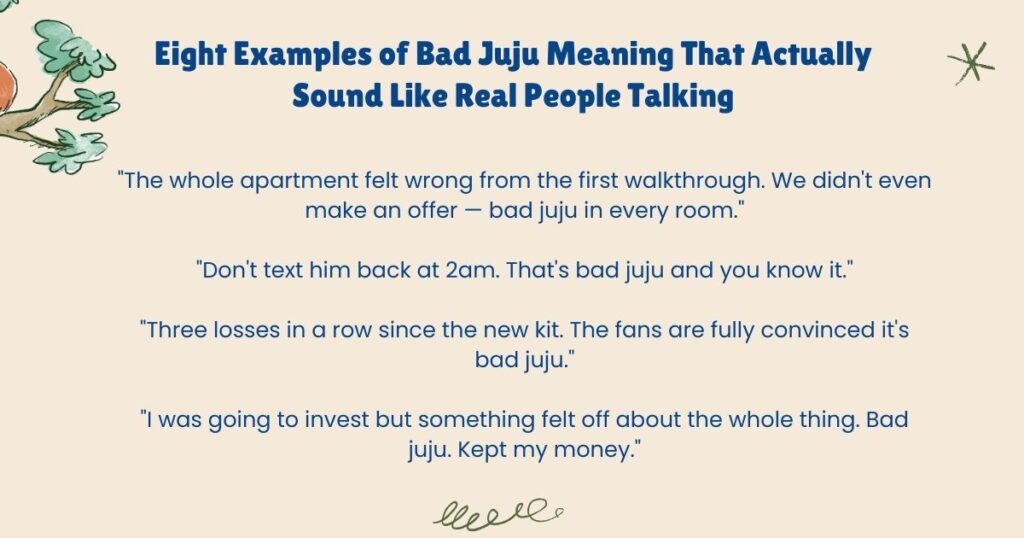
“The whole apartment felt wrong from the first walkthrough. We didn’t even make an offer — bad juju in every room.”
“Don’t text him back at 2am. That’s bad juju and you know it.”
“Three losses in a row since the new kit. The fans are fully convinced it’s bad juju.”
“I was going to invest but something felt off about the whole thing. Bad juju. Kept my money.”
“She showed up wearing her ex’s jacket on the first date. I left early. Life’s too short for bad juju.”
“Every time I’m in a good place, something in that friendship drags me back down. That’s not coincidence, that’s bad juju.”
“Broke my phone, missed my flight, got rained on without an umbrella. Fully cursed. Bad juju week.”
“The deal looked perfect. Numbers made sense. But my gut kept saying no. Turned it down. Called it bad juju. Never looked back.”
The Good Juju Side of It
People don’t say good juju as often, but the concept is real — it’s the opposite energy. The feeling that things are flowing, luck is on your side, the right people keep showing up at the right moments.
Where bad juju signals block and drain, good juju signals alignment. You carry a charm that’s worked before. You’re around someone whose presence genuinely lifts the room. You’ve been consistent with something and it’s quietly building into something good.
Both ideas share the same root belief — that energy is real, it moves, and it influences what happens to you.
Read Also: FW Meaning: Decoding “I FW You” Without the Confusion
Why People Still Believe in It (Even People Who’d Say They Don’t)
Psychologically, bad juju serves a function. When things cluster — three bad things in a row, a person whose presence always precedes disaster, a decision that never works out no matter how you approach it — the brain looks for a pattern. Calling it bad juju is actually a way of saying this pattern is real and I should respond to it.
Whether or not invisible forces are literally involved, the instinct to notice patterns and protect yourself from repeated harm is completely sensible. The word might sound superstitious. The underlying behavior it describes is just self-preservation.
Common Misreads
Assuming bad juju always means the person is being superstitious or irrational. A lot of the time it’s just intuition wrapped in a casual phrase.
Treating it as a joke when someone means it seriously. The lightness of the word can make it easy to laugh off — but sometimes that laugh is the wrong response.
Using it so often it loses meaning. Like any phrase, overuse turns it into background noise. When everything is bad juju, nothing is.
FAQs
Is bad juju offensive to say?
Not in most casual contexts. But since the word juju comes from African spiritual traditions that are still practiced today, using it mockingly around people with those beliefs can feel dismissive. Casual use between friends is generally fine — just read the room.
Does it always have a spiritual meaning?
Not anymore. The spiritual roots are there in the background, but in everyday modern use, most people are just using it as colorful language for bad energy or a bad feeling. Though some people do use it with full spiritual seriousness — depends entirely on who’s talking.
Is bad juju the same as the evil eye?
They’re related ideas. The evil eye — known as nazar in South Asian and Middle Eastern cultures — refers specifically to harm coming from someone’s envious gaze. Bad juju is broader. It can come from a place, a situation, an object, or a person. Overlapping concept, different cultural wrappers.
What if I’m not superstitious — can I still use it?
Completely. Most people who say it aren’t claiming to believe in magic. They’re using it as a way to describe a gut feeling, a pattern, or a situation that just keeps going wrong. The spiritual origin doesn’t require spiritual belief to use the phrase.
One Last Thought
What makes bad juju stick around as a phrase — across decades, cultures, slang cycles, memes — is that it names something real. That quiet alarm. That pattern your gut catches before your brain does. Whatever you want to call it, most people have felt it. Bad juju just happens to be one of the more interesting ways of saying so.

Hi, I’m the creator of Legacystance.com, dedicated to making English learning simple and enjoyable. I write clear, practical guides on adjectives, verbs, idioms, pronunciation, spelling, and more. Every article is carefully researched to give accurate, easy-to-understand information. My goal is to help readers improve their English skills confidently, one step at a time, with content that is trustworthy, useful, and beginner-friendly.