A private swimming pool is one of those home features that can look effortless from the outside. The water is clear, the deck is clean, and the owners seem able to walk outside and swim whenever they want. What visitors usually do not see is what happens before the weekend barbecue: testing water chemistry, emptying baskets, cleaning leaves, checking the filtration system, and occasionally dealing with equipment that decides to stop working at the least convenient moment.
That does not mean owning a pool is necessarily difficult. Modern pumps, robotic cleaners, automatic chemical systems, covers, and monitoring equipment have removed much of the manual work that previous generations of pool owners accepted as normal. A well-designed pool with modern equipment can require surprisingly little hands-on attention. A neglected pool with old equipment, poor circulation, trees overhead, and no cover can become a regular source of frustration.
The real question, therefore, is not simply whether pools require maintenance. They do. The better question is how much time, money, and responsibility a private pool requires compared with the enjoyment it provides. For some households, that trade makes perfect sense. For others, the pool becomes an expensive decoration that gets used a few weekends a year.
Understanding what ownership actually involves before installing or buying a house with a pool can prevent expensive surprises later.
The Pool Dream and the Routine Behind It
A private pool changes how people use their homes, particularly during warm months. Instead of organizing a trip to a public pool, lake, beach, or water park, a family can walk outside and swim. Parents can spend summer afternoons at home while children play in the water. Adults can exercise before work, cool down after gardening, or invite friends over without planning an entire outing.
Privacy is another major advantage. Public swimming areas can be crowded, noisy, and restrictive. A private pool lets homeowners decide when to swim, how long to stay outside, what music to play, and who joins them. Families with young children often appreciate having swimming available without packing bags, driving somewhere, finding parking, buying food, and carrying wet clothing home.
Pools can also become social centers. During warm weather, gatherings often naturally move toward the water. The pool itself provides entertainment, while the surrounding deck can accommodate food, drinks, loungers, umbrellas, and outdoor cooking. Some homeowners build complete outdoor living areas around their pools, combining them with kitchens, shaded seating, fire pits, and dining areas arranged almost like restaurant tables around the main swimming space.
Exercise adds another practical reason for ownership. Swimming places relatively little impact on joints while working several major muscle groups. A long pool can support lap swimming, while smaller pools can still work for water aerobics, resistance exercises, and general movement. Older adults and people who dislike gyms may find themselves exercising more simply because the pool is a few steps from the house.
These benefits explain why many homeowners accept the maintenance. The mistake is assuming that clear water happens automatically.
Every pool is a small water-treatment system. Water constantly collects dust, pollen, leaves, insects, sunscreen, body oils, rainwater, and microorganisms. The filtration system removes particles, while sanitizers control bacteria and algae. Water chemistry has to remain within reasonable ranges so that the sanitizer works properly and the pool does not damage equipment or irritate swimmers.
The amount of work varies enormously. A covered pool in a dry environment with modern equipment may stay clean with limited intervention. An uncovered pool beneath several large trees can collect debris almost every day. A heavily used family pool requires more chemical management than a pool used by two adults twice a week.
Weather also matters. Heat increases chlorine consumption and encourages algae growth. Strong winds bring debris into the water. Heavy rain can dilute chemicals and alter water balance. Long periods of direct sunlight break down chlorine more quickly. Pool maintenance therefore changes with the season rather than remaining identical throughout the year.
This variability explains why two pool owners can give completely different answers when asked whether owning a pool is difficult. Their pools may require entirely different amounts of work.
What a Normal Week of Pool Ownership Actually Looks Like
Routine pool maintenance sounds more intimidating when every possible task is placed on one large checklist. In practice, homeowners divide those tasks across different time intervals. Some take a few minutes. Others happen only several times a year.
Skimming is one of the most frequent jobs, particularly for uncovered pools. Leaves, insects, flowers, and other floating debris can be removed with a simple net. Doing this regularly prevents material from sinking to the bottom or entering the filtration system. A relatively clean pool might need only a quick check, while a pool surrounded by trees can require much more attention during certain seasons.
The pool’s baskets also collect debris. Skimmer baskets sit near the waterline and capture material before it reaches the pump. The pump itself normally has another basket. If either becomes packed with leaves, circulation can weaken. Emptying these baskets generally takes only a few minutes.
Water chemistry needs regular attention as well. Chlorine or another sanitizer prevents microorganisms and algae from taking over. Pool owners also monitor pH because water that becomes too acidic or too alkaline can cause problems for swimmers, equipment, and sanitizer performance.
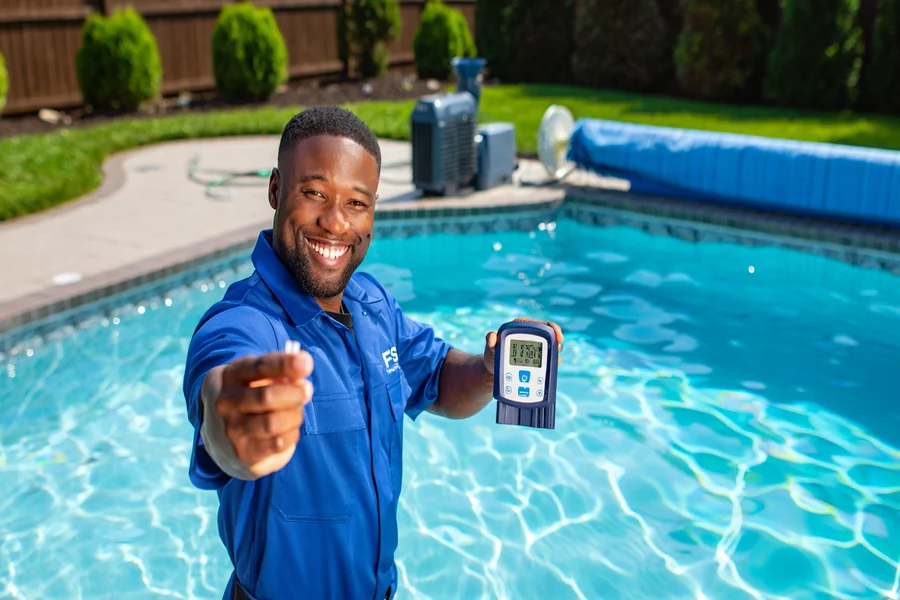
For many residential pools, testing a few times per week is enough once the owner understands how the water normally behaves. Test strips provide quick estimates, while liquid or digital kits can give more precise measurements. The process itself takes very little time. The greater challenge is learning what the numbers mean and knowing when to make adjustments.
Owners often find the first few months more complicated than later years. At the beginning, every chemical result can seem like a problem requiring immediate correction. With experience, patterns become obvious. A homeowner may learn that a particular pool needs additional chlorine after several hot days or that heavy rain tends to lower certain readings.
Cleaning the surfaces is another recurring job. Dirt can settle on the pool floor, while algae and mineral deposits may develop on walls and steps. Traditional pool owners use brushes and manual vacuums, but robotic cleaners have changed this part of maintenance considerably.
A modern robotic cleaner can travel across the floor and sometimes climb walls while collecting dirt in its own filter. Owners typically place the robot in the pool, let it complete its cleaning cycle, and then empty the filter afterward. It does not eliminate every maintenance task, but it can remove one of the most time-consuming jobs.
Pool filters require attention less frequently. Cartridge filters usually need periodic removal and washing. Sand filters may be backwashed depending on system design and pressure readings. The exact schedule depends on pool size, environmental conditions, and how much debris enters the water.
The pump itself normally runs for several hours each day to move water through the filtration system. Modern variable-speed pumps can run at lower speeds for longer periods while using much less electricity than older single-speed equipment. Owners generally do not interact with the pump every day once its schedule is programmed.
Automatic chlorination systems reduce another part of the workload. Saltwater pools, for example, use a salt chlorine generator to create chlorine from salt dissolved in the pool water. The pool still uses chlorine; the difference is how it is produced. Owners still need to test and balance the water, but they do not have to manually add chlorine as frequently.
Automatic chemical dosing systems can go further by measuring conditions and adding chemicals when needed. Smart controllers can send readings or alerts to a phone. These systems cost more than basic equipment, but they can make sense for people who value convenience.
Pool covers provide one of the simplest ways to reduce maintenance. A cover keeps much of the debris out of the water and can reduce evaporation. Depending on the design, it may also help retain heat. Automatic covers are particularly convenient because owners can open or close the pool without wrestling with a heavy cover manually.
A homeowner who combines good filtration, a robotic cleaner, an automatic sanitizer, and a cover may spend relatively little time actively cleaning the pool during a normal week. Someone using older equipment and doing everything manually will spend considerably more.
Professional servicing changes the equation again. A pool technician can visit weekly or on another schedule to test chemicals, clean surfaces, inspect equipment, and handle routine adjustments. The homeowner still needs to pay attention between visits, particularly after storms or unusual weather, but most of the technical work can be outsourced.
The choice therefore comes down partly to money versus time. Pool owners can perform nearly everything themselves at lower cost, invest in automation, pay for professional maintenance, or combine all three approaches.
The Problems That Turn Easy Pool Ownership Into Hard Pool Ownership
Routine maintenance is usually predictable. Unexpected problems create most of the frustration associated with pools.
Algae is one of the most visible examples. A pool that appears perfectly clear can begin turning cloudy or green if sanitizer levels fall too low, circulation becomes poor, or water conditions favor rapid algae growth. Warm weather can accelerate the process.
Treating a mild algae problem may involve adjusting water chemistry, increasing sanitizer levels, brushing surfaces, running filtration longer, and cleaning the filter. Severe cases can require repeated treatment and several days of work. Preventing algae is far easier than recovering from a badly neglected pool.
Cloudy water creates another common complaint. Several conditions can cause it, including inadequate filtration, unbalanced chemistry, high levels of dissolved material, or large numbers of tiny suspended particles. Owners sometimes make the problem worse by adding chemicals without identifying the cause.
Equipment failures can be more expensive. Pumps, heaters, salt cells, valves, lights, controllers, and automatic covers eventually wear out. A broken pump can become urgent because circulation stops. A heater failure is less serious for water quality but can prevent swimming during cooler weather.
Leaks deserve particular attention because small losses can be difficult to detect. Pools naturally lose water through evaporation and splashing, so owners may initially assume that frequent refilling is normal. A persistent leak can increase water bills and potentially cause damage around the pool structure or underground plumbing.
Pool design strongly influences how often these problems appear. Circulation systems need to move water throughout the entire pool rather than leaving areas where water remains relatively stagnant. Poorly placed returns or an undersized pump and filter can make maintaining water quality harder.
Location matters just as much. Installing a pool directly beneath several mature deciduous trees may create shade, but it can also create constant cleaning. Leaves, seeds, flowers, pollen, twigs, and bird waste can all fall into the water. Tree roots may create additional complications around decks or underground structures.
Choosing the right finish also affects long-term work. Concrete, fiberglass, and vinyl pools have different maintenance characteristics. Concrete surfaces are durable and highly customizable but may eventually require resurfacing. Vinyl liners provide a smoother surface but can tear and eventually need replacement. Fiberglass shells generally have smooth surfaces that can make algae attachment more difficult, although size and shape options are more limited.
Pool size influences workload but not always in the obvious way. A larger pool requires more water, more chemicals, and potentially more energy to heat. However, very small pools can sometimes experience faster chemical changes because there is less water to buffer contamination or weather effects.
Heating adds another system to maintain. Gas heaters can warm water quickly but may have significant operating costs. Heat pumps use electricity and work differently depending on air temperature. Solar systems can reduce energy consumption in suitable climates but require adequate installation space and weather conditions.
The easiest pool to maintain is therefore not necessarily the smallest or cheapest one. Good engineering, appropriate equipment, sensible placement, and access for servicing matter more than many buyers realize.
What a Private Pool Really Costs After Installation
Construction receives most of the attention when people budget for a pool, but ownership continues long after the contractors leave.
Electricity is one recurring expense. Pumps must circulate water, while heaters can consume considerably more energy depending on climate, desired water temperature, pool size, and equipment type. Lighting, automatic covers, cleaning systems, and other accessories also use electricity, although their contribution may be relatively small.
Modern variable-speed pumps can reduce electricity consumption compared with old single-speed pumps. Instead of operating at maximum speed whenever they run, they can circulate water more slowly for longer periods. The savings can be meaningful over the life of the pool.
Water creates another expense. Pools lose water primarily through evaporation, splashing, filter maintenance, and occasional leaks. Hot, dry, and windy weather can substantially increase evaporation. Covers can reduce these losses.
Chemicals create ongoing costs as well. Chlorine pools require sanitizer along with chemicals for controlling pH, alkalinity, and other water characteristics. Saltwater systems reduce the need to purchase chlorine regularly but introduce other expenses, including the eventual replacement of the salt cell.
Cleaning equipment ranges from inexpensive nets and brushes to robotic cleaners costing hundreds or even thousands of dollars. Robots eventually need replacement parts, filters, tracks, brushes, or motors depending on the model.
Filters also have replacement or servicing costs. Cartridge elements wear out eventually. Sand filtration media can last for years but will eventually require replacement. Pumps contain seals and moving components that may fail.
Heating can become one of the largest operating expenses for owners who want warm water outside the hottest months. Maintaining a high temperature continuously requires much more energy than heating only when needed. Pool covers can reduce heat loss overnight, making heating more economical.
Long-term structural expenses should also be included in ownership calculations. A concrete pool may eventually require resurfacing. Vinyl liners have limited service lives and need replacement. Deck surfaces crack or wear. Coping can loosen. Tiles can break. Lights fail. Automatic covers may need new fabric, motors, tracks, or mechanical components.
None of these costs necessarily make pool ownership unreasonable, but ignoring them produces an unrealistic budget.
There are essentially three financial approaches to maintenance. The lowest-cost approach is doing most routine work yourself. This requires learning water chemistry, cleaning equipment, and basic troubleshooting. Owners still pay for repairs beyond their abilities, but labor costs remain relatively low.
The middle approach combines DIY care with professional assistance. An owner might handle testing and cleaning while paying a technician for seasonal opening, winterization, equipment repairs, or occasional water problems. This model works well for homeowners comfortable with basic maintenance but uninterested in becoming amateur pool technicians.
The highest-convenience approach uses regular professional servicing and extensive automation. The homeowner may do little beyond checking the pool between service visits. This costs more, but households with limited free time may consider the expense worthwhile.
Property value complicates the financial equation. A pool can attract buyers who actively want one, particularly in warm climates where swimming seasons are long. Those buyers may value the fact that installation work has already been completed.
Other buyers see exactly the opposite. They may worry about maintenance expenses, safety around children, reduced yard space, or repair costs. In cooler climates where pools can be used only a few months each year, those concerns may carry more weight.
Condition also matters. A recently renovated pool with modern equipment may add appeal. A twenty-year-old pool with stained surfaces, outdated equipment, cracked decking, and an aging heater can look like an upcoming bill rather than an asset.
Homeowners should therefore avoid assuming that every dollar spent on a pool will return through a higher sale price. A pool is primarily a lifestyle purchase, not a guaranteed investment.
When the Pool Is Worth the Work—and When It Is Not
The strongest argument for owning a pool has little to do with resale value. It is frequency of use.
A family that swims four or five days per week during summer receives very different value from a pool than a household that swims six times per year. Both owners pay for maintenance, but one gets hundreds of hours of use while the other maintains a large body of water mostly for appearance.
Families with children can get substantial use from a pool, especially during school vacations. Instead of planning entertainment every day, the pool itself becomes an activity. Children may also become more comfortable swimmers through frequent exposure to water, although access to a pool makes supervision and safety measures even more important.
Adults who genuinely enjoy swimming may also find ownership worthwhile. Someone who swims laps every morning does not need to drive to a gym or public facility. The convenience can change whether exercise actually happens.
People who entertain frequently can benefit in another way. A pool creates a natural gathering point and may make the home more useful for birthdays, barbecues, family events, and informal evenings with friends.
The calculation becomes less attractive when the pool receives little use. Some homeowners love the idea of owning a pool but discover that daily life leaves little time for swimming. Children grow older and lose interest. Work schedules become busier. Travel takes up weekends. The pool remains, and the maintenance continues whether anyone swims or not.
Climate plays an important role. In warm areas, pools may remain useful for much of the year. In regions with long winters, the swimming season may be relatively short unless the pool is enclosed or heavily heated. Owners in cold climates may also need to winterize outdoor pools, adding another seasonal task.
Safety represents one responsibility that cannot be automated away completely. Drowning can happen quickly, particularly with young children. Physical barriers, appropriate gates, alarms, covers, and other safety systems can reduce risk, but adults still need to supervise children around water.
Local laws may specify fencing and gate requirements. Insurance companies may also have conditions related to pools. Anyone considering installation should check building regulations, safety codes, and insurance requirements before construction rather than after the pool has been completed.
Pets create another consideration. Some dogs enjoy swimming, but they still need safe entry and exit points. Pool covers are not automatically safe for animals unless they are specifically designed to support weight. Chemicals should also be stored where children and pets cannot reach them.
Space matters too. A pool occupies part of the yard that could otherwise hold grass, gardens, play equipment, outdoor dining, or simply open space. Large properties can often accommodate several functions, while smaller lots force owners to make choices.
Prospective owners should also consider their tolerance for maintenance. Some people genuinely enjoy caring for their homes and outdoor spaces. Testing water and cleaning a pool feels no more burdensome to them than mowing a lawn. Others dislike recurring household tasks and quickly become irritated by anything requiring weekly attention.
Automation can narrow that difference but cannot eliminate ownership responsibility. Even a heavily automated pool still needs someone to notice when the pump sounds strange, the water level drops unexpectedly, the cleaner stops moving, or the water begins losing clarity.
Hiring a professional can transfer much of that responsibility, but the homeowner remains financially responsible when equipment fails.
For anyone buying a house with an existing pool, a professional inspection is worth considering. A general home inspection may not identify every pool-related problem. A pool specialist can examine pumps, filters, heaters, surfaces, plumbing, lights, covers, and control systems. Discovering that a pool needs resurfacing, a new heater, and a new pump immediately after buying the house can turn an attractive backyard feature into an expensive surprise.
People considering new construction have an opportunity to make ownership easier from the beginning. Choosing an appropriate location, installing modern filtration, using a variable-speed pump, including automated sanitation, buying a robotic cleaner, and considering a cover can substantially reduce routine work.
Good design can also reduce unnecessary complexity. Decorative waterfalls, multiple pumps, elaborate heating systems, attached spas, extensive lighting, and automated water features can make a pool impressive, but every additional component creates another potential maintenance point. Homeowners should decide whether those features will actually be used.
Simple pools are often easier to own
So, is taking care of a private pool really difficult? For a properly designed modern pool, routine maintenance is usually manageable. Testing water takes minutes. Robots can handle much of the physical cleaning. Automated systems can maintain sanitizer levels. Covers reduce debris and evaporation. Professional technicians can handle work the owner does not want to perform.
The harder part is accepting that a pool is never completely passive. Water chemistry changes. Equipment ages. Storms create messes. Pumps fail. Surfaces eventually need attention. Owners must either spend some of their own time or pay someone else to do the work.
The advantages are equally real. A pool can provide exercise, entertainment, privacy, family time, and a reason to spend more time outside at home. For households that use it regularly, those benefits can easily justify the routine.
The disadvantages become harder to defend when the pool sits untouched for most of the year. Maintenance does not stop simply because nobody feels like swimming.
A practical decision therefore starts with behavior rather than appearance. Consider how many months per year the pool could realistically be used, how often your household would swim, who would maintain it, whether you are comfortable paying for professional service, and how much of your yard you want to dedicate to water.
A private pool does not have to become a second job. With the right equipment and realistic expectations, it can be a relatively manageable part of home ownership. But it will always require more attention than an empty patch of lawn. The households happiest with pools are usually not the ones who expect zero work. They are the ones who use the pool enough that the work feels justified.