You got a message that said “FWM later” and now you’re staring at it. That happens more than people admit — because FWM looks simple but quietly carries two different meanings depending on who sent it and why.
Short answer: FWM most often means “f*ck with me” — which in casual texting translates to “talk to me,” “hit me up,” or “reach out.” In some replies, it also means “fine with me” as a quick agreement. Same letters. Completely different energy.
The Two Real FWM Meanings (And How to Tell Them Apart)
“F*ck with me” is the dominant meaning. Despite sounding edgy, it’s mostly used as an open invitation — not aggression. It means: I’m here, reach out, let’s connect. You’ll see it in captions, DMs, and casual texts constantly.
“Fine with me” shows up when someone’s responding to a question or suggestion. Quick, low-effort agreement. No attitude behind it.
One mental trick that actually works: swap FWM with “hit me up” in the sentence. If it fits, the person means “f*ck with me.” If the sentence needs “sounds good” or “sure” instead — it’s “fine with me.” Try both. One will land naturally, the other won’t.
Where You’ll See FWM and What It Sounds Like There
In text messages, FWM is almost always an invitation. “FWM when you’re free” = reach out whenever. Casual, no pressure.
On Instagram, people drop it in captions to signal openness or confidence. “Posting more this week — FWM” means follow along, interact, or slide in. It doubles as attitude and approachability at once.
On TikTok, creators use it to invite engagement or signal self-assurance. “FWM if you’re on this side of TikTok” is less about one person and more about finding your people. It carries community energy there.
In dating DMs, FWM can feel flirty — but it’s not automatically romantic. Some people just naturally communicate with this kind of directness. Read the whole conversation before assuming anything.
FWM From a Guy, FWM From a Girl — Does It Change?
People search this constantly, so here’s a straight answer: the meaning doesn’t change based on gender.
When a guy says FWM, he wants attention, a reply, or reconnection. Could be friendly, could be flirty — depends on what came before it in the conversation.
When a girl says FWM, same core meaning: “I’m open, talk to me.” It often reads as confident, especially in a caption or bio.
What changes is tone, and tone comes from everything surrounding that word — not the word itself.
FWM Real Examples Across Different Situations
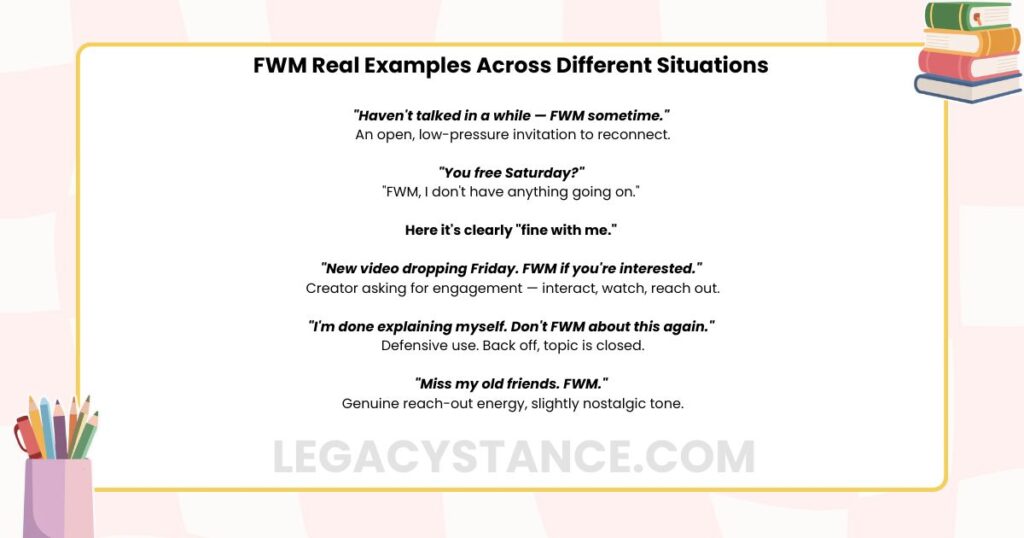
“Haven’t talked in a while — FWM sometime.”
An open, low-pressure invitation to reconnect.
“You free Saturday?”
“FWM, I don’t have anything going on.”
Here it’s clearly “fine with me.”
“New video dropping Friday. FWM if you’re interested.”
Creator asking for engagement — interact, watch, reach out.
“I’m done explaining myself. Don’t FWM about this again.”
Defensive use. Back off, topic is closed.
“Miss my old friends. FWM.”
Genuine reach-out energy, slightly nostalgic tone.
The Layer Most Explanations Miss
FWM carries a confidence layer that “text me” or “HMU” doesn’t have.
Saying “message me” is neutral. Saying “FWM” puts something on the line — it takes a small amount of boldness to use. That’s why it lives in creator captions, rap lyrics, and posts from people who want to come across as both approachable and self-assured at the same time.
It’s not just a request. It’s a statement: I’m here, I’m open, come to me.
That subtle difference changes how you read it — and how you respond.
How to Reply to FWM
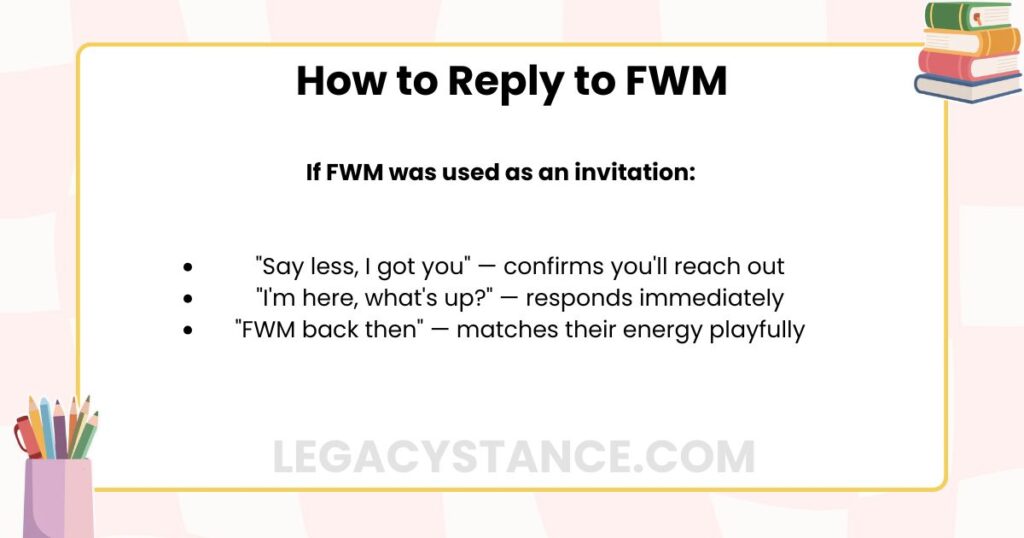
If FWM was used as an invitation:
- “Say less, I got you” — confirms you’ll reach out
- “I’m here, what’s up?” — responds immediately
- “FWM back then” — matches their energy playfully
If someone said “don’t FWM” — give them space. That version means they’re not open to conversation right now. Pushing back makes it worse.
Is FWM Appropriate to Use?
It contains a word that not everyone is comfortable with, so context matters.
Between close friends in casual texts — completely fine. In a comment on someone’s social media where the vibe is relaxed — usually okay. In a message to a teacher, coworker, or someone you barely know — skip it entirely.
If you’re unsure whether someone will receive it well, “hit me up” or “I’m good with that” delivers the same message without the risk.
Read also:
WGFT Meaning — What It Really Means in Texts, Chats, and Online
DPMO Meaning in Text, Chat, Instagram, TikTok & More
FAQ’s about FWM
Does FWM always mean something positive?
Mostly yes. The “f*ck with me” version is almost always an invitation or expression of confidence. It only turns negative with “don’t” in front of it — then it means back off or don’t test me.
What’s the difference between FWM and HMU?
HMU (hit me up) is softer and works in almost any casual conversation. FWM has more edge and confidence built into it — it fits better in social media culture, street-influenced language, or conversations where the tone is already informal and bold.
What if I genuinely can’t tell which meaning someone meant?
Reply naturally to the conversation around it. If a question came right before FWM, it’s “fine with me.” If FWM appeared on its own or at the end of a reaching-out message, it’s “talk to me.” Most of the time the rest of the sentence gives it away.
Is FWM used the same way across all age groups?
Not really. People under 25 use it freely and casually. Older audiences may not recognize it at all, or may find the implied word uncomfortable. Like most internet slang, it travels fastest in younger, social-media-heavy communities — and slower everywhere else.